- Volume 57(1 Suppl 1) , Number 1
- Page: 303–45
Congress abstracts
The test is an antibody detection assay. Polystyrene or carboxylated latex bead particles are coated with sonicate of a laboratory grown atypical non-pathogenic mycobacterium, M.w. A drop of test serum is added to a drop of sensitized beads, mixed throughly and gently rocked. Positive sera cause agglutination within two minutes. With this test, sera from, 110 leprosy, 82 active tuberculosis, and 70 apparently healthy control were screened. The results demonstrated that the test detects 79% of patients with infectious form of multibacillary leprosy and 85.6% of active pulmonary tuberculosis patients. False positivity was 2%. The reproducibility of the test in several hands was evaluated using coded samples. The test is rapid, simple, and easy to perform and can be a useful aid to clinical diagnosis.
PO 510
A Preliminary Study on Comparison of Serological Activity in Sera from Patients with Leprosy, Contacts of Leprosy Patients and Normal Controls
Tulip Tan, Boey Lai Peng and Kamarudin b Ali
Middle Road Hospital, Singapore
The presence of phenolic glycolipid (PG1) in M. leprae has been described in recent literature. Antibodies directed against the lipid were found In serum from leprosy patients. Using the phenolic glycolipid antigen, ELISA method has been developed for sérodiagnostic test of leprosy Infection. In this preliminary study for comparison of serological activity using ELISA method, a total of 209 sera were studied. They were collected from leprosy patients (37 cases), family contacts of leprosy patients (29 cases), health workers in direct contact with leprosy patients (21 cases) and normal controls (122 cases). 37 leprosy patients (40.54%) had positive antibody level as compared to 4.0% in normal controls. The difference was statistically significant (x2 - 22.9, p< 0.001). Comparisons made against the family contacts (40, 5% compared with 3.4%) and the health workers (40.54% compared with 4.8%), Indicated significant results, (p< 0.005 and p < 0.025 respectively). 75% of patients with lepromatoua (LL) leprosy had positive antibody compared with 31.25% tuberculoid (TT) leprosy patients. The difference was not statistically significant as the number of sera tested was small. LL leprosy patients also tended to have higher antibody levels than TT leprosy patients.
PO 511
SEROLOGICAL ANALYSIS OF LEPROSY PATIENTS UNDER MULTIPLE DRUC THERAPY (MDT) IN VIETNAM. A PRELIMINARY REPORT.
Nguyen Thi Hang, Dang Due Trach, Nguyen Kim Trinh, Nguyen Diem Hong, Hoang Thuy Long(1); Nguyen Duy Ktiang & Le Kinh Due(2); P.R. Klatser(3) & J.T. Hendriks(4).
(1)National Institute of Hygiene and Epidemiology, Hanoi, Vietnam.
(2)Dermatology Institute, Hanoi. Vietnam.
(3)Royal Tropical Institute, Amsterdam, The Netherlands
(4)Dep't of Medical Microbiology, University of Amsterdam, The Netherlands.
In an ongoing survey to study the immune status in leprosy patients under multiple drug therapy (MDT)
we determined on regular 3-month intervals total immunoglobulin levels and specific antibodies to a synthetic antigen based on M. leprae derived phenolic glycolipid. Local negative control values have been established for these parameters in healthy persons, patients contacts and tuberculosis patients.In leprosy patients, total-IgG declined from initia 1 (before therapy) high valueB to normal during the course of therapy. Total-IgM increased during the first three months of MDT, but then gradually decreases in most patients. In lepromatous cases, IgM-DMG levels decreased during the first year under MDT, but went up again after 15 months in some patients. The relation of these findings in the humoral immune response under MDT with accorapaning changes in clinical parameters is currently being investigated.
PO 512
SEROLOGY OF LEPROSY: THREE DIFFERENT TECHNIQUES.
R.J. Franco, L. Cecere, L. Llopis, A. Balbi.
Hospital Nacional B. Sommer, Bs.As., Argentina.
An ELISA assay for M. leprae where two antigen was absorbed on a membrane filte r has been developed in our laboratory. M. leprae was isolated from subcutaneous lepromas of untreated patients using the procedure described by Philip Draper in 1979. A suspension of 2 x 10⁶ bacteria per ml in 0.01 M amonium acetate-carbonate pH 8.2 was used as antigen. Five ul of this suspension were spotted in different positions and the filter was blocked with 10% BSA and washes were performed with phosphate buffered saline pH 7.2, 0.1% Tween 20. Horseradish peroxidase labelled antihuman rabbit IgG was used in the secondary reaction and hidrogen peroxide and 3.3' diarainobenzidine Tetra HC1 in the color reaction. Immunofluorescense tests were performed on glass slides using the antigen suspension described for ELISA tests. ELISA-ABS on plates was performed as previously described by us (R.J.Franco y col., Temas de Leprologia Nº 74, 1987) and FLA-ABS using the technique described by Abe et al (Int.J.Lepr. 48:109-119, 1980). Serum of lepromatous patients and from healthy people from non-endemic areas were used as positive and negative controls. All serums were absorbed with M. vaccae and BOG. We have tested serum from several groups, household contacts, blood relatives, hospital workers, patients with pulmonary tuberculosis, healthy people with BCG and leprosy patients' sons which have been isolated from their parents. Results show that the sensitivity and sepcificity of the proposed assay is satisfactory for clinical investigation of serology of M. leprae.
PO 513
SERO-IMMUNO REACTIVITY OF MOLECULARLY ISOLATED PROTEIN ANTIGENS OF MYCOBACTERIUM LEPRAE
O. Mandock, S. Davidson, T.M. Shinnlck,
R.G. Navalkar and R. H. Gelber
Department of Microbiology & Immunology, Morehouse School of Medicine, Hansen's Disease Laboratory, Centers for Disease Control, Atlanta, CA. and Hansen's Disease Center, San Francisco, CA, U.S.A.
Studies were conducted on over sixty sera from patients In BT, BB, BL and LL stages of leprosy infection employing armadillo-derived M.leprae cell sonicate and the different molecularly cloned proteins. Preliminary data using immunoblot technique indicate the presence of several sero reactive bands against the M.leprae cell sonicate, predominantly in bacillary active patients. These bands occurred In the range of 14 to 65 Kd.
The sera were also screened for the presence of anti bodies reactive to M.leprae antigens present in plaques of the lambda gt 11 recombinant clones Y3184 (12Kd), Y3164 (28Kd), V3180 (36Kd) and Y3178 (65Kd). Drops of recombinant phage were placed in lawns of E.coli Y1090, the phage were grown and the antigens transferred to nitrocellulose for immunoblotting. Early results showed the presence of 65Kd and 36Kd in a few of the sera studied. No reactivity was observed with the other proteins.
These studies are being continued for further confirmation, using sera from all stages of leprosy infection (TT to LL), both treated and untreated, lepromin positive and lepromin negative contacts and normal healthy individuals.
PO 514
SEROLOGICAL RESPONSES TO DEFINED MYCOBACTERIAL ANTIGENS IN BORDELINE TUBERCULOID LEPROSY
Roche P, Britton WJ, Ivanyi J*.
Mycobacterial Research Laboratory, Anandaban Leprosy Hospital, Katnmandu, Nepal; and *MRC TB & Related Infections Unit, Hammersmith Hospital, London, Britain.
Patients with leprosy of the Borderline Tuberculoid form are a heterogenous group with a range in clinical appearance and immunological responses. This has been evident in Nepal during the implementation of Multi Drug Therapy, when it is often uncertain as to whether a BT patient should have the Multibacillary or Paucibacillary type of therapy. We have prospectively examined the serological responses of 100 untreated BT patients to carbohydrate and peptide antigens to determine if these are possible indicators of increased bacterial load. Antibody response to Phenolic glycolipid and lipoarabinomannan were measured by ELISA using synthetic D-BSA and LAM of M.tuberculosis as antigens. When compared to healthy Nepali control subjects, 20% of BT patients had IgM anti-PGL antibodies and 35% had IgG anti-IAM antibodies. By contrast 72% of sera from untreated BL patients and 94% of sera from untreated LL patients contained IgM anti-PGL antibodies and 90% of BL sera and 100% of LL sera contained IgG anti-LAM antibodies. Few BT sera contained antibodies to the M.leprae specific epitope on the 35 KD protein as measured by MAb inhibition assay. The clinical extent of disease and bacillary index of the seropositive and seronegative patients will be presented.
PO 515
Monoclonal Antibodies Against Different Fractions of Mycobacterium leprae
Tsehay Atlaw, Rolf Kiessling, Ayenew Nurilign, Armauer Hansen Research Institute, Addis Ababa, Ethiopia.
Murine monoclonal antibodies produced previously in the leprosy system have been generated after immunization with preparations derived from whole M. leprae. We have used a more refined approach whereby individual fractions of Western blots of SDS-PAGE preparations were used to immunize mice in order to generate monoclonal antibodies. Thirty one fractions, ranging in molocular weight from above 200 KD to 14 KD were emulsified in DMSO and in complete Freund's adjuvant and used to immunize Balb/ C mice and a second immunization was given two weeks later. Mice were killed three days after the final (third) booster immunization and spleen cells from these mice were fused with the mouse myeloma fusion partner SP2/0. Thirteen mice have been killed and supernatants from more than 300 hybrids tested in the ELISA. A total of 48 hybrids were positive for antibody production and of the ones tested in the Western blot, one hybrid (15-3-C-11) showed reactivity with strong bands in the molecular weight range of the original fraction used for immunization. After cloning this hybrid, 373 clones were tested, 36 of which are 'strongly positive in the ELISA against M. leprae sonicate antigen and are being expanded for testing in the Western blot to see if the original bands used to immunize can be recognized.
This novel approach of producing monoclonals against individual antigenic components is important in that unique M. leprae antigenic components which are of importance can be used selectively to produce hybrodomas with better specificity and more potential towards immunodiagnosis and as probes in molecular studies of leprosy.
PO 516
"SEROLOGY BY IMMUNOENZIMICASSAY (ELISA) ON LEPROSY PATIENTS AND THEIR CONTACTS, SUBCLINICAL INFECTION AND HIGH RISK GROUP DETECTION".
Liliana María Olivares, Raúl Franco, Lilian Cecere, María Elena Fariña and Juan C. Gatti. "Leprosy Center"-High School of Medicine, Buenos Aires University - F.J. Muñiz Hospital and B. Sommer National hospital. Buenos Aires, Argentina.
Summary. The authors propose: 1) To study the serology by imnunoenzimicassay (ELISA) on Leprosy patients and their household/non household contacts. 2) To appraise the subclinical infection and high risk group incidence. Miterialfi and Methods: There are two groups under analysis. The first one composed by: leprcmatous and dimorphous patients (active and non active) and tuberculoid ones. The second group is cornposod by: leprosy contact healthy subjects, including the following subgroups: household/non household contacts of leprcmatous, dimorphous and tuberculoid patients (untreated or with recent treatment, less tlian five years) and recent houseliold/non liouseliold contacts of inactive leprosy patients or old ones (more than five years treatment). Within both groups sera are studied through the iirmjnoenzimicassay procedure with previous absorption by Mycobacterium BOG and vaccae and there are also developed clinical, bacterioscopy, histopathological examinations and Fernandez-Mitsuda reaction. Results: Positive serologies are observed in all active leprosy pat ients (leprcmatous and dimorphous ones). It is verified a high subclinical infection incidence tinong normal subjects householding with LL and BL leprosy patients (2/3 of household subjects). It is found the high risk group composed by those subjects with subclinical infection, negative Mitsuda reaction, householding with active leprosy patients. Conclusions: It is emphasized the importance of serology by immunoenz imicas say, as early detection methodology of subclinical infection and high risk groups. Groups to which should be oriented chemoproptiilaxis procedures, with clinical and eerologycal subsequent follow-up, in order to appraise their evolution.
PO 517
Multi-media Educational Campaign about Hansen's Disease
Oliveira, Maria L. W; Moreira, Maria B. R.; Pereira, Gerson F. M.; Alves, José J. P. National Division for Sanitary Dermatology - MS.
The stigma associated with Hansen's disease is widely disseminated throughout Brazil. The prejudice is felt not only in society at large but also among health professionals and it has become an obstacle in the path of effective leprosy control actions.
The official change of the name leprosy to Hansen's disease was intended to occur together with a far-reaching mass media campatngn. That was not the case, however. To the contrary, both society and the government circles were incline to underplay the problem.
The results observed after the first six months of th multimedia campaingn - TV, radio, newspapers, as well as films posters and leaflets - point to the desirability of keeping up this campaingn.
PO 518
A MODEST BUT USEFUL TOOL TO GUIDE THOSE WHO, ALTHOUGH NOT ENGAGED IN HEALTH ACTIVTTl, WISH TO COOPERATE IN CASE FINDING.
Donini Palmiro and Verona Sisters
Kalongo Leprosy Project, Lira,
Uganda.
A 6-Page booklet with 39 colour photos has beem produced, to meet the requests of all those who, thoust not engaged in health activities, are willing to assist in the detection of leprosy cases. The cooperation of those people of good will is very valuable, not only because they permit to expand leprosy cose finding, but because through friendly and informal relations they often have a better chance to persuade suspected leprosy sufferers to let themselves be examined and treated, by doctors.
The text has been arranged according to the suggestions received from the target users themselves.
Accordingly it deals with the cause of leprosy; it shows the effectiveness of present day treatment; it gives facts which may counteract wrong popular beliefs; it gives guidance in dealing with individuals who may be affected by skin diseases other than leprosy.
Copies of it, in English, are available writing to:
fr. dr. Donini - via S.POLO 337
25 010 S. POLO (Bs) Italy
PO 519
INVOLVEMENT OF STUDENTS IN LEPROSY HEALTH EDUCATION PROGRAMME - AN EXPERIMENT.
S. S. Naik, S.G. Samant, P.M. Godbole.
Acworth Leprosy Hospital Society for Research, Rehabilitation and Education in Leprosy, Wadala, Bombay-400 031. India.
The students' participation at college and high school level can be obtained for leprosy Health Education Programme if proper motivation is done and involving non-leprosy agencies such as student community will help to overcome the stigma of leprosy in Society.
The details about the experiment of last four years of "Involvement of college students volunteers" and "Mitra" ("Friends" action oriented programme for high school students) has been discribed. The participation of 25 active members in college students' group gives approximately 200 Health Education talks on leprosy per year which costs at 30% of routine health programme. In "Mitra" activity has 6000 students membership and participation of 116 high schools in Maharashtra State. The programme work out as cheaper and effective and acts as an auxillary force to augment routine services in leprosy. Both these experiments have potential of multiplication in different regions.
PO 520
INCREASING PUBLIC AWARENESS OF LEPROSY THROUGH TOURISM.
Richard Marks
Leprosy Patient; Owner, Damien Tours, P.O. Box 1, Kalaupapa, Hawaii, 96742.
Founded on the principles that people fear what they don't understand and cannot understand something unless they see it, Damien Tours has been in operation at the Kalaupapa Settlement for 22 years. Approximately 5,000 tourists a year travel to Kalaupapa and go on this guided tour. Many other visitors come as quests of patients.
The tour is patient owned and operated and is designed to show how far medical knowledge and treatment have come. It tells the story of Father Damien and Mother Marianne but at the same time shows that nowadays the major wreckage from the disease comes from mi sunders tanding rather than the disease itself. Recognizing that for too many years leprosy has been covered up, the tour operates on the premise that unless you bring the disease out in the open and talk about it, you won't do anyone any good.
Not only has visitation to Kalaupapa increased public awareness, it has had an effect on the patient community itself. Seeing that they are accepted by tourists simply as people with problems, the patients themselves have become more at ease with strangers and now travel freely throughout the United States and the world.
PO 521
AN URBAN RURAL CONTRAST STUDY ON COMIC STRIPS, A NOVEL MEDIUM FOR LEPROSY HEALTH EDUCATION.
C.S. Cheriyan, Health Education Materials Department, German Leprosy Relief Association, 4. Gajapathi Street, Shenoynagar, Madras - 30.
This study is the first of this kind conducted In order to assess the impact of comics as a medium for health education on the knowledge and attitude of peopleabout leprosy. A questionnaire was administered at random on 2000 literate people from 3 urban (1200) and 2 rural (800) areas in South India for this study.
On analysis of the data collected it was found that 98,4% in the urban and 91.2% in the rural areas said that they believed leprosy is curable. Interestingly enough 97.6% and 89.3% respectively in the urban and rural areas were able to reproduce the signs andsymptoms of leprosy. With regard to attitudes 80.8% in the urban and 78.2% in the rural areas had said that leprosy patients should not be driven out of homes, instead they should be cared.
It was also found that comic strips were welcomed by an overwhelming majority of the respondents in urban (93%) and in rural (78%) areas a3 a medium for health education in leprosy. It is obvious that they made a definite Impact on enriching the knowledge of the respondents and in helping them change their attitudes and beliefs about leprosy. It was also found that the comics were very well received by all, especially the younger generation.
PO 522
EDUCATION SANITAIRE DANS LA LUTTE CONTRE LA LEPRE EN MARTINIQUE
M. CONSTANT-DESPORTES, S. VEILLARD, A. YEBAKIMA, J.M. GEMIEUX (Comité Raoul FOLLEREAU, MARTINIQUE).
En Martinique, la lutte contre La Lépre remonte à plus de 50 ans (depuis Etienne MONTESTRUC). L'organisation actuelle est basée sur:
- un dépistage actif et passif
- une information sanitaire très poussée
- une polychimiothérapie.
Les axes d'information de la population sont essentiellement des supports audiovisuels (diaporamas, films, dépliants, livrets, affiches) et des émissions radio-télévisées.
La Journée Mondiale de lutte contre la Lèpre est une occasion cù la population est totalement associée (messe, gala d'artistes, exposés-débats...). Les thèmes de ces dernières années ont été :
1965 : la Lèpre dans le conte créole
1966 : la Lèpre dans la Bible
1967 : Hommage à Etienne MONTESTRUC
1968 : la Lèpre dans la Caraïbe.
Une enquête effectuée en 1965 a permis de situer le niveau des connaissanoes populaires sur la maladie. La majorité des personnes interrogées connaissent l'existence de la Lèpre, citent l'apparition d'une tâche comme symptôme initial, attribuent la maladie à un manque d'hygiène et ont une grande peur du lépreux. Tous ces résultats sont mis à profit peur une meilleure information de la population.
PO 523
The knowledge and the attitude of leprosy in junior high school teacher in Taiwan
Pao-Feng Tsai and Pesus Chou
Der Yuh Nursing Junior College
Taipei, Taiwan
The knowledge and the attitude of leprosy were studied among 7257 junior high school teachers in Taiwan during July 21 to August 20, 1986.
The knowledge of leprosy was categorized into f ive items: (1) etiology, (2) clinical sign, (3) cause of disability and deformity, (4) curability, and (5) transmission. Excluding the transmission item, the correct answer rates of the other four items of knowledge were above 50%. The etiology item was the highest (74.4%) and the clinical sign was the lowest (52.1%). About half of the teachers thought that leprosy is easily transmitted or had no idea about the transmission, hence their attitude toward leprosy was negative.
The attitude of leprosy was categorized into three items. (1) fear, (2) shame, and (3) refusal. Except for the refusal item, the attitude of the other two items were toward positive.
There was a positive relationship between the knowledge and the attitude. Age was inversely correlated with the total score of both the knowledge and the attitude. Educational level, the teacher's major course and teaching course were not significant factors for the snowledge and the attitude of leprosy. The attitude of "shame" was influenced by the mass media and the caring experience.
PO 524
A THREE TIER COMMUNICATION MODEL FOR COMMUNITY PARTICIPATION IN LEPROSY CONTROL
H.M. Saleem, T. Jayaraj Devadas and R.S. Mani Indian Leprosy Foundation, Shenoynagar, Madras 600 030, India.
The model adopted by Indian Leprosy Foundation aims at: 01. Transmitting scientific information on leprosy to the general public 02. Utilising community institutions to achieve this purpose and 03. Providing opportunity for large scale participation of youth in leprosy awareness campaign.
Methodology: Educational institutions are selected as settings for implementing this three tier model of communication. Tier I: Full time Field Officers are recruited and given intensive orientation on leprosy and alloted a geographical area of operation Tier II: Field Officer with the permission of authorities addresses the entire students of each institution collectively and in batches on facts about leprosy with suitable aids and orient them for community communication and Tier III: Each student is given a maximum target of 60 persons from the neighbourhood to be contacted and conveyed facts about leprosy within a time schedule.
Tools: Students are given a fact sheet format to be returned to their schools after recording details of contacts. Certificats and mementos to students and institutions are given in appreciation of their participation.
This model ensures communication effective through peoples participation.
PO 525
THE KALAUPAPA SETTLEMENT AS PART OF THE UNITED STATES NATIONAL PARK SERVICE.
Henry G. Law
Park Superintendent, Kalaupapa National Historical Park, National Park Service, U.S. Department of the Interior, Kalaupapa, Hawaii, 96742.
The U.S. National Park Service is entrusted with the preservation of such natural wonders as The Grand Canyon, Yellowstone and Yosemite National Parks. However, it is also responsible for areas that are deemed to be of great historical value, such as Independence Hall, the Statue of Liberty, Ellis Island, Alcatraz Prison and the White House. Due to its extremely educational and inspirational history, Kalaupapa was declared a National Historical Park in 1980 and thus became a part of the National Park System. While ensuring that the history of Kalaupapa will not be forgotten, this action also ensures that the remaining patients may live out their lives in the place they have come to regard as home.
Although the Park is filled with significant natural and archeological resources, the primary resource is the patients and their history. It is their story that makes Kalaupapa National Historical Park unique. Dedicated to the education of present and future generations with regard to the realities of leprosy, the Park stands as a monument to the patients' ability to endure and overcome, both physically and spiritually, not only disease but man's inhumanity to man.
PO 526
VOCATIONAL REHABILITATION OF LEPROSY PATIENTS
A-STUDY IN HARYANA STATE
(Duggal S, Minocha H.S. and Sujata)
In this presentation, we have attempted to extend the analysis with reference to the vocational rehab11itation of the dehabilitated Leprosy Patients to find out the number and nature of placement in which they are absorbed. We have also attempted to analyse the record from the various employees in order to find out how many of these are able to obtain fit ness certificates after treatment. Analysis of 600 inmates of the 6 different colonies of Haryana were studied for the present problem. The study revealed that while the job problems of Leprosy Patients belonging to non-lepromatous types have been solved satisfactorily, the infections patients continue to suffer from job problems. Further it was felt to relax the rules governing issue of fitness certificates and tiring them more in tune with the endemicity of leprosy at least in industrial area.
* Dr. Mrs. Suman Duggal, Honorary General Secretary, Hind Kusht Nivaran Sangh, Haryana, Chandigarh, India.
** Mr. Harbhajan Singh Minocha, Organising Secretary, Hind Kusht Nivaran Sangh, Haryana, Chandigarh, India.
*** Dr. Miss Sujata Sharma, Ph.D, Psychologist, Hind Kusht Nivaran Sangh, Haryana, Chandigarh, India.
PO 527
Strategies for training human resources with a view to the implenientation of the proposal for restructuring the Leprosy Control Program in Brazil.
Oliveira, Maria L.W; Fontanive, Nilma S.; Patroclo, Maria A. A; Moreira, Maria, B.R. - National Division for Sanitary Dermatology/MS
The problems with human resources for the restructuring of the Leprosy Control Program in Brazil are not related to the scarcity of said resources, since we have an overabundance of university trained professionals (physicians, nurses, and social workers).
Nevertheless, the deeply rooted prejudice regarding leprosy and the lack of a govermental policy in this field accounts for the fact that staffs cannot be counted on to perform their duties. Also, salaries are low and, therefore, seldom comply with their working schedules.
In an endeavor to use the services of this personnel training methodologies have been adopted which deal exhaustively with the development of an awareness about the problem of leprosy control, as well as proper consideration of the above mentioned attitudes of the personnel in question.
In connection with above, the following topic will be discussed:
* ''A methodology for problem management" and the application thereof in the training of nurses, physicians, social workers, and educators;
* The adaptation of this methodology to the training of secondary and elementary school level personnel; and
* Instructional material (videotape recordings, slides, tap recordings, and texts), to be used in medical schools.
PO 528
THE PATIENT AS LEARNER.
By Jeanette Hyland MPH.
The Author spent nine years in Paramedical training, Control Program planning and administration. She observed that patients were often expected to absorb the same load of information and adopt the same new habits and attitudes irrespective of the varying manifestation of their disease and their differing circumstances.
In 1979 the Author formulated a GUIDE TO HEALTH EDUCATION NEEDS OF PATIENTS, identifying what the patients needed to learn after taking account of the type of disease, likelihood of complications arising, presence of deformity or disability etc..
This guide is submitted in its 'pre-multi-drug-regime' form for information, discussion and adaption should participants find it useful.
It is recognized that this quide deals only with formulation of the CONTENT of the educational message, but it trie s to emphasize some of the tasks that must be undertaken by the PATIENT AS LEARNER.
In the Author's experience many health workers who deal routinely with patients often over-simplify the dull repetitiv e job'of giving health education'. As long as health workers regard 'a patient as a patient as a patient' their efforts at education will tend to be inadequate and inappropriate.
Perhaps their job would be brighter if they thought of each patient as a learner with specific but varying learn learning needs.
The usefulness and effectiveness of this guide is to be studied by the Author in 1989 as part of a Ph.D. thesis on Health Education in Leprosy Control in Nepal.
PO 529
HANSEN'S DISEASEPUBLIC ENLIGHTENMENT CAMPAIGN IN NIGERIA.
Uchenna M. Ekekezie.
Leprosy referral & Research
Centre, Uzuakoli, Nigeria.
This paper is o review of the methods upad and theconstraints facing a new Health Education campaign started in Nigeria. The aims of the campaigns are among other things, to educate the general public on the facts on leprosy in order to remove the age-old social etigma which is still very strong in this environment, to foster early case-finding, to publicise MDT and prepare Health workers and the public for the integration of Leprosy into the General Health Service.
This campaign is the very first tine in Nigeria that a clear-cut publicity or prominence of any kind is given to Leprosy. The basic starting capital was provided by Rotary International.
Being a relatively new aspect of leprosy control activity, the project is beset with constraints of equipment and therefore scale.
The major goal of the presentation therefore Is to bring this project to the notice of colleagues In the field of Leprosy, with the hope that as a team we shall together find solutions to the numerous problems that hinder the project. Itis also hoped that they may make suggestions on how to improve on the campaign..
Finally, sharing the experience may also stimulate leprosy workers in other areas especially those who have as yet not started any public education programmes.
PO 530
Chemoprophylaxis of leprosy in Southern Marquesas by a single supervised dose of 25 mg/kg rifampicin.
J.L. Cartel, R. Taylor, S. Chanteau, J. Roux, Ph. Celerier J.H. Grosset. Institut Malardé, BP 30, Papeete, Tahiti.
From 1967 to 1987, the average annual detection rate of leprosy all forms remained stable in Polynesia : 8.8 new cases per 100.000 inhabitants. An epidemiological study pointed out that, during this period, the detection rate was similar in all of the archipelagoes except in the Southern Marquesas archipelago where it was of 60 per 100.000. In order to reduce this high detection rate it was decided (i) to insure that all known cases de tected in Southern Marquesas receive multidrug therapy (WHO regimen) and (ii) to give a single supervised dose of 25 mg/kg of rifampicin (RMP) to the entire population of Sth Marquesas and to the Southern Marquisians living outside of their home island. For a 99 %, 90 % or 80 % effectiveness of the chemoprophylaxis, the number of expected cases of leprosy could be significantlyreduced 4, 5 and 5 years, respectively, after chemoprophylaxis. In addition, a seroepidemiological study based on the evaluation of the PGL1 antigen and antibody levels before and after chemoprophylaxis was decided for the entire Southern Marquisian population. In 1987, a demographic census of the South Marquisians living in their home island or outside in Polynesia was performed. The administration of the chemoprophylaxis and the blood sample collection were carried out from January to March 1983. The coverage of the trial, the expected impact of the chemoprophylaxis and the first results of the sero-epidsmiological study are reported.
PO 531
Study on the association between some epidemiological characters and basic and associated (multiple) causes of death among groups of leprosy patients deceased in São Paulo State, Brazil.
Lombardi, C.; Souza, J.M.P.; Costa Jr., M.L.; Lima, P.D. & Buchalla, C.M. Public Health School, University of São Paulo, Brazil.
Within a universe of 13,066 leprosy patients (n = 13, 066) who died in São Paulo State, Brazil, the basic and associated (multiple) causes of death were codified by a nosologist, according to 9th I.C.D.. The following epidemiologic characteristics are compared:
1) age at diagnosis; 2) age at death; 3) duration of disease before diagnosis; and 4) total duration of disease, among the five sub-groups: 1) the total universe; 2) basic cause of death= leprosy; 3) basic cause of death = nephropathy; 4) basic cause of death = leprosy + nephropathy, present as associated cause ; 5) basic cause of death = leprosy + nephropathy absent as associated cause.
PO 532
Secular trends of leprosy incidence (detection) in São Paulo State, Brazil, 1935-84.
Lombard, C.; Costa Jr., M.L.; Souza, J.M.P.; Lima, F.D.
Public Health School, University of São Paulo, Brazil.
Secular trends of detection rates of leprosy in Sao Paulo State are described within a year period. Specific rates by age, sex, leprosy clinical type and by some counties of the state are also presented. Implications between distributions profiles and control policies/therapeutic regimens are discussed in the light of an historical approach.
PO 533
Réflexions sur la lépre an Algérie: à propos d'un cas autochtone dans la région de Tlemcen (ouest algérien)
Omar BOUDGHENE-STAMBOULI, Abdelkader MERAD-BOUDIA et Otmane BOUALI.
Services de Dermato-Vénéréologie et Maladies Infectieuse Centre Hospitalo-Universitaire de Tlemcen (ALGERIE)
Au Maghreb, on 1984, la situation de la lèpre était la suivante: Maroc =incidence annuelle de 200 cas, Algérie = 21 cas vivants et TUNISIE = 176 cas vivants.
En 1987, nous signalions le 3ème cas de la région de Tlemcen (60 km du Maroc) en un siècle. Après les 4 cas de OUGHANEM et coll., il représentait le 5ème exemple de lèpre autochtone, sans contacts connus avec des hanseniens vivants.
En Algérie, l'apport exogène était do 167 sur les 228 cas répertoriés de 1888 à 1974. En 1984, il était de 3 sur 21.
Nous assistons donc à une extinction de la maladie de HANSEN avec cependant quelques cas sporadiques (résurgence de foyers résiduels).
Les voyages et l'accroissement des échanges vont-ils modifier cette tendance?
PO 534
LEPROSY ENDEMICITY IN YALISOMBO, A PREVIOUS LEPROSARIUM-VILLAGE IN ZAIRE.
Guy Groenen, Stefaan R. Pattyn, Peter Guys, Jo Colston.
Bureau National Lèpre, Kinshasa, Zaire. Leprosy lab. IMT Antwerp, Belgium.
Yalisombo (YAL) is a previous leprosarium 25 km downstream from Kis(angani). After 1960 DDS treatment was very irregular and frequently non existent. In 1984 a population survey was conducted with clinical, bacterial, histopathological exams, lepromin testing and PGL antibody tests on a sample of people. Among 1590 people there were 256 leprosy (L) patients (16.1%) 30 MB and 226 PB, prevalences 1.94 and 14.2%. 78% of families had at least one case. 59% of patients had L when settling in YAL, 41% developed L during their stay. Surveys during 85, 86, 87 revealed 2, 5, 4, new L cases among the persons examined in 1984, all PB. The results of the findings will be presented in detail.
PO 535
EPIDEMIOLOGICAL SURVEY OF THE "VILA IDEAL"
SLUN - RIO DE JANEIRO - BRAZIL -
MOREIRA A, TADIANA AND ALMEIDA T., JACIRA.
Due to the high endemicity of Hansen's Disease in "Duque de Caxias Municipality", Rio do Janeiro State, Brazil, a epidemiological Survey of the "Vila Ideal" slum was planed. The goal was to know the prevalence of skin disease of sanitary concern and, also, to analise the socio-economical conditions of the population, especialy those related with environement sanitation. 450 dwellings were visited and 86% of the population (1903) screened by dermoncurological examination performed by auxiliary personnel. Tables will show the frequency of skin diseases that received treatment on domiciliary basis. 19 cases were suspicious of Hansen' s Disease. The social profile will be assessed trough the study of several parameters of the population:- economical, sanitation, personnal and home higyene.
PO 536
15-YEAR REVIEW OF LEPROSY CONTROL WORK IN MADRAS-A METROPOLITAN CITY IN INDIA
DEREK LOBO, MANI MATHEWS, JACOB MATHEW, T.S. PETRO AND R.NARAYANAN.
GREMALTES REFERRAL HOSPITAL AND LEPROSY CENTRE, SHENOYNAGAR - MADRAS, INDIA.
MADRAS is the third largest metropolitan city-India, with a population of 3.75 million, out of which a population of 1.75 million is covered for leprosy control work by our institution, thus making it one of the largest URBAN LEPROSY CONTROL programme under a single agency.
A 15-Year Review of Work is presented spanning 1972 to 1987. The following parameters are available-Annual new case detection rate, prevalence rate, deformity rate, ulcer rate, Lepromatous rate, Percentage of Monolesions, School children prevalence, Slum prevalence, Age / Sex ratio, Clinical Classification and Bacteriological Status.
The profile of leprosy over the 15-year period is discussed along with various problems related to URBAN LEPROSY CONTROL.
PO 537
THE RURAL LEPROSY CONTROL.
A.G. Soeparlan, I.Agusni, S. Martodihardjo, H.Sukanto, M.I.Ilias.
Dept.of Dermatology, Airlangga Medical Faculty, Dr.Sutomo General Hospital, Surabaya, INDONESIA.
In the management of leprosy are some important problema which have to be considered for a better result : 1) The absence of an accurate data. 2) The patient compliance, the long and tedious therapy, 3) The physical deformation. 4) The social-economic condition and the general attitude towards leprosy.
Point 2 could be solved with the MDT application, which can reduced the long duration of treatment to a considerable shorter time. With this advantage of therapy, the Indonesian Leprosy Foundation in Surabaya try to overbridge the 3 above mentioned constraints by way of an integrated management, in which the Local Authorities, the Health Center Medical Team and the whole community are involved, so that the leprosy problem and management will become a common duty of the whole society. Therefore a "Rural Leprosy Control project" is established in Ngronggot and Tanjunganon, two subdistricts in the Province of East Java . Method: Education and Upgrading in leprosy for the members of the already ecxisting Authorities Wifes Organization (Dharma Wanita) with their P.K.K. (The Family Welfare Education) pro ject and Caders for Leprosy Control who are volunteers from the community.
A satisfactorily result is accomplished .
PO 538
MULTI-DRUG THERAPY AND THE OCCURENCE OF NEW CASES IN A LEPROSY COLONY
The Society for the Eradication of Leprosy C/o. Mrs. Leela Moolgaokar, Bombay House, 24, Homi Mody Street, Bombay 400 023.
Dr. R. Ganapati Dr. C.R. Revankar Dr. V.V.Dongre Mr. D. H. Gole Mr. M. R. Neet
The chain of transmission of leprosy will be broken, if the source of infect Ion 1s curta iled of f. The introduction of Mu1ti-drug therapy, under super-v is Ion, in a compact, self settled, leprosy colony, not only eliminated the pool of Infection but the emergence of new cases was also brought down to a near zero level.
The work of the Society in the said Colony with multi-drug therapy will be projected and the yearwlse results of the successive six resurveys will be revealed. The epidemiological significance of the findings will be discussed.
PO 539
ANALYSIS OF THE HOUSEHOLD CONTACTS OF 129 MULTIBACILLARY CASES D RING THE FIRST CONTACT SURVEI IN ZARIA PROVINCE, KADUNA, NIGERIA.
DR. S.A.R. KRISHMAN, DR. T. SRINIVASAM, DR. LOUIS GUSSENHOVEN, DR. M.O. ADELEYE*
Ministry of Health, Leprosy Control Training & Research Contre, P.M.B. 1089, Zaria, Kaduna State, NIGERIA.
*Director, Ilorin University, Kwara State, NIGERIA.
The contact of 129 Multibacillary index cases have been screened clinically, supported by slit skin smear study. From the 129 index cases, the household cases of 3,186 were screened. The number of newly detected cases, age, sex, type, the deformity grades were discussed. This study was conducted as a parametre to measure the impact of Multidrug treitment for future comparative studies.
PO 540
EVOLUCION DE LA ENDEMIA LEPROSA EN REPUBLICA DOMINICANA 1966-1987.
Dr. Huberto Bonaert Díaz, Miriam Hilario y Barbara García. Instituto Dermatológico. Santo Domingo. República Dominicana.
Al inicio de las actividades de la dirección actual (año 1966) se encontraban inscritos en registro activo en la Secretarla de Salud Pública 282 enfermos. Al 31 de diciembre de 1987 la cifra de enfermos inscritos alcanzó a 7,620 con un promedio de casos nuevos anuales de 346.4 siendo el máximo de 481 año 1975 y el mínimo de 249 año 1987. La linea de tendencia, sobre 21 años manifiesta un carácter decendente que demuestra la eficacia de las medidas de control.
El porcentaje de formas Multibacilares da 34% siendo el de Lepra Lepromatosa del 20.5%. Las discapacidades en enfermos nuevos han disminuido de un 50 por ciento en 1966 a un 8 por ciento en 1987, presentando grado III dos casos solamente.
PO 541
Evaluation du Programme Contrôle Lèpre Sénégal depuis 1982.
J.C. Naudin - F. Diouf and J. Millan
Responsable Médical DAHW - Sénégal
B.P. 8262 Dakar - Yoff. SENEGAL
Selon les Directives Nationales depuis six anx chacun des neuf Services Lèpre Régionaux, couvrant 9495 malades ont évolué par trois phases d'activités.
- Prè Polychimiothérapie (PCT) : 1932-35 voit la réorganisation des Recueils de données, du fichier lèpre, le recyclage du personnel, toute directive résumée er un Fichier Technique. La gestion est centralisée et informatisée, les laboratoires et salles d'hospitalisations crées. Le Comité de Coordination (Ministère de la Santé, Institut de Lèprologie, DAHW) assure une liaison mensuelle avec chaque Secteur. Enfin sont lancés deux essais : PCT Sélective : (Nouveaux Cas-Rechutes sur Dakar et villes de Région) et Cordonnerie mobile.
- Phase PCT : En 19Ö6 débute la PCT "indiscriminée" où sur Zones choisies tout malade sous Disulone est décidé "mis en PCT ou guéri". En 18 mois 20 % du Territoire est couvert avec, après évaluation positive faite (1987), l'espoir d'une couverture de l'ensemble des malades d'ici 1993.
- Phase Post-PCT : En 1986 est lancé le Programme Education Sanitaire des malades mutilés et 23 Centres ouverts, suivi en 1988 par le Programme "Chaussure pieds anesthésiques". La fin de l'installation du Programme est faite en 1938 par la Planification de l'Education Sanitaire Population (axes : écoles primaires, radiophonie et population cibles : hôpitaux, PCT etc...)
PO 542
DECLINING INCIDENCE OF HANSEN'S DISEASE IN RIO GRANDE DO SUL STATE BRAZIL.
Jair Ferreira
Secretariat of Health and Environment. Rio Grande do Sul State, Porto Alegre, Brazil.
Rio Grande do Sul State, the Southern state of Brazil (Area: 282.184 km2, population: 8859.000), has a prevalence rate of Hansen's disease running between 0,40 and 0,50/1000 pop during the last 20 years. The control program (started In 1936), since 1968 Is based in a horizontalized system of health care. Leprosy cases are treared in general health care centers, which belong to the Secretariat of Health of the State. The only relevant technical or administrative changes made in the program in this period were the improvement of supervision (since 1974) and the replacement of the sulphonic monotherapy by another standardized scheme which associates 100mg of sulphona with 600mg of Rifamipicine, daily, during the first three months of treatment of multibacillary cases, in 1977.
The detection rate of new cases, which maintain the same level, with small variations, in the period 1974-1981 decreased quickly in the last six year, falling from about 3,5 cases/100.000 in 1981 to about 2,0 cases/ 100.000 in the period 1985-1987. Other epidemiological Indicator (decreasing proportion of paucibacillary cases and increasing age average among new cases and decreasing proportion of cases with positive skin smear among multibacillary patients in treatment) suggest that the decrease of the detection rate Is not related to operational factors but to a real decrease In the Incidenee of the disease, probably due to IntroductIon of a bactericide drug (Rifampicine) in the standardized treatment of multibacillary cases.
PO 543
A STUDY ON SUBCLINICAL LEPROSY INFECTION IN BUSIA DISTRICT-PRELIMINARY COMMUNICATION.
J.O. Nyawalo
C. Okelo ) Kenya Medical Research Institute,
P.A.Orege )
J.K.Mwatha ) Alupe Leprosy & Skin Diseases Research Centre.
M. Were. )
The study is being undertaken to detect individuals with subclinical infection and those at risk of getting multibacillary leprosy. Factors influencing infection with Mycobacterium leprae are also being explored.
The study population is composed of various categories of contacts of leprosy patients and a control population. Infection by M.leprae has been determined by using M.leprae specific glycolipid in enzyme linked inrnunosorbent assay. Lepromin test has been done to detect ability of the study population to mount resistance to infection through cell mediated inmunity.
27.6% (or 401 people) of the study population have subclinical leprosy infection. 22.9% (or 74 individuals) of the infected group are lepromin negative and are at risk of getting multibacillary leprosy. Doth these groups form a target population for vaccination, chemoprophylaxis or close follow up for overt leprosy and early treatment. They can also be followed up to monitor changes in their immune status. Age, sex lepromin positivity arid DCG status do not influence the prevalence of subclinical infection. The prevalence of subclinical infection does not vary significantly among contacts of paucibacillary and multibacillary patients so far.
The study continues.
PO 544
Programa de Control de lepra de la Republica Argentina
D.R. Achenbach M. Antola, J Ganopol, J.C. Granata.
M. Liturri, R. Manzi, O. Terriles.
Se efectúa una descripción histórica del problema de la lepra en la Argentina y se mencionan 'los diversos sistemas aplicados para combatir la endemia, hasta llegar a la situación actual con la paulatina integración de la enfermedad en la atención médica general con participación prioritaria en las acciones de atención primaria. Se enfatiza sobre la necesidad de incluir el tema en los programas de educación paro la salud en todos los niveles y promover su participación en diversos programas de investigación, estimulando áreas de interés, tales, como: inmunología terapéutica, rehabilitación, bacteriología, epidemiología, etc.
PO 545
DOWNWARD TREND OF LEPROSY INCIDENCE IN POLAMBAKKAM, ASSESSED BY BIRTH COHORTS ANALYSIS
Mark Vanderveken, M. F. Lechat, C. Vellut, E. Declercq Epidemiology Unit., Catholic University of Louvain, Brussels, Belgium.
The Polambakkam Leprosy Control Programme started in 1955. A birth-cohorts analysis has been performed on the 23.772 patients detected between 1962 and 1982, period during which case-detection rates approximated incidence rates. Cohorts studied were born between 1891 and 1980. Birth cohorts analysis mainly aims to assess how the risk of developing the disease is related with the past experience of life.
At all ages, incidences were higher for older cohorts. The results favor the hypothesis that infection has been decreasing ever time, so that persons born later were expobed to lower rates of Infection.
People born after 1941 and particularly the cohort born 1951-1955 have experienced a marked decline in the incidence of leprosy in ages 20 to 40.
This reflects the effects of control for preventing infection in people aged below 15 at the time the programme was launched. It also suggests that Infections occur early in a large majority of cases, sometimes with a prolonged incubation period.
The limited downward trend in childhood is discussed.
Age seems to influence similarly the different cohorts. Incidence increases sharply in younger age-groups until the age of 14. For a given period of birth, older people have lower leprosy case rates than young people. The possible meanings of these observations are discussed.
Results are presented by type of leprosy and by sex.
PO 546
EPIDEMIOLOGIC DATA ON LEPROSY PATIENTS ATTENDING THE LEPROSY CLINIC OF THE DIJKZIGT HOSPITAL IN ROTTERDAM.
Claire Bouman*, Roél Chin A Lien** and Ben Naafs**.
*Medical student Erasmus University Rotterdam, **Dept. of Dermatovenoreology Dijkzigt Hospital, Erasmus University Rotterdam.
Data available on 213 leprosy patients attending the leprosy clinic between 1945 and 1988 were analysed in retrospect concerning epidemiological data; classification, sex, origin of patient, age at onset, start of treatment, immigration into the Netherlands and duration of treatment.
Special attention was given to the occurance of complications during multi drug intervention treatment and possible relapses thereafter.
The findings will be discussed.
PO 547
INTEGRATED HEALTH CARE IN THE EPIDEMIOLOGY AND CONTROL OF LEPROSY.
R.S. Mani, A. J. W. Jacob and MR. M.V. Ramana Emmaus Swiss Leprosy Project, Chittoor District, Palamaner, Andhra Pradesh, South India.
Epidemiology by determining the distribution and determinants of a disease grins at the root cause of disease. The old adage is all too true that 'Prevention is better than Cure'. Powerful drugs like Rifampicin or the promise of a vaccine will help to control leprosy, but there are other epidemiological factors which must be dealt with if a complete control and ultimate eradication is to be envisaged.
Immunity is one of the main factors in determining disease and where protein energy malnutrition exists, immunity is very low and concomittant infection also reduces immunity. In a country such as India, where there exists so much of malnutrition, parasitic infections, Tuberculosis, crowded and unhygenic living, immunity is bound to be low. Poverty and ignorance are contributory factors in the lowering of immunity.
For these reasons, we at Palamaner have modified the SET pattern of work at no extra operational costs, except for drugs and vaccines, so that our work is now directed to integrated health care with leprosy as our primary aim. In an area of 1817.29 sq.km. and a population of 3, 04, 123 we have 95 Mobile treatment points and a system of clinics that treat leprosy patients, non-lep rosy general patients, T.B., eye, Mother and child care, Immunisations, Domicilliary rehab ilitation and health education programmes.
PO 548
REACTULISATION DE L'EPIDEMIOLOGIE DE LA LEPRE EN TUNISIE
ZAHAF A., MZIOU T.J., LANGUILLON J.
SERVICE DERMATO C.H.U. SFAX -TUNISIE-
En Tunisie, pays a faible endémicité lèpreuse, la lèpre est reléguée au second plan malgré que les statistiques montrent que la forme lèpromateuse donc contagieuse de la maladie est do loin la plus rencontrée.
Une étude épidémiologique faite après 2 ans d'activité de l'équipe mobile do lutte contre la lèpre sous l'égide du C.I.O.M.A.L., montre que 3 foyers à endémicité relativement importante existent : Mahdia : 55 cas ; Mednine : 40 cas ; Sfax : 39 cas. l'homme est 2 fois plus atteint que la femme, cette prédominance est surtout nette dans la forme lèpromateuse. L'âge présumé de contamination est situé après la puberté et avant l'âge de 20 ans, mais peut survenir à tout âge. Le pic de fréquence d'âge des malades dépistés est situé entre 55 et 70 ans, témoin d'une transmission faible à la population jeune. 65 % des patients sont sans profession par mutilations invalidantes dues a la maladie. 90 % vivent dans des zones rurales et appartiennent à des classes sociales pauvres. La contamination est le plus souvent familiale. 61% des patients ont au moins un lépreux dans la famille. La forme lèpromateuse polaire est la plus fréquente représentant plus de la moitié des cas (57 %). Ceci souligne la gravité de la lèpre en Tunisie. Les autres formes de lèpre sont beaucoup moins fréquentes et se répartissent en : lèpre interpolaire : 29,5 % ; lèpre tuberculoide polaire : 3 % ; lèpre indéterminée : 4,5 %. Les complications réactionnelles sont fréquentes : ENL : 26 % ; RR : 45 %. 55 % des malades ont des lésions ostéo-articulaires plus ou moins avancées avec une impotence fonctionnelle totale par mutilation dans 27 % des cas. Les maux perforants plantaires sont observés chez 15 % d'entre eux.
PO 549
THE PRESENT LEPROSY SITUATION IN KATSINA STATE IN NORTHERN NIGERIA
Kees Wnaldijk
Babbar Ruga Leprosy Hospital, Katstna, Nigeria
As calculated from the available data (C.M.Ross 1951, WHO-LAT survey 1960, NSL purvey 1977 and own findings 1983-87) the present leprosy situation is described. In total there are some 6,500 leprosy patients with signs of active/inactive infection of whem 1,200 (18%) have multibacillary and 5,300 (82%) have paucibacillary leprosy. A minimum of 5,500-6,000 have been registered at least ince in their life and as such have received antileprosy drug treatment, sofar only DDS montherapy. At present there are still 3,300 patients on the registers who are receiving either DDS monotherapy or MDT. With a rate of 9-15% in multibacillary and below 1% in paucitacillary patients, there are a maximum of 120 leprosy patients with DDS resistance. There are maximally 300 new leprosy patients a year which stands for an annual incidence rate of 0.0625‰. With a rate of over 60% disability grade 2 or more (involving hands in 50%, feet in 30% and eyes in 15%), there are at least 4,000 leprosy patients with gross disability of hands and/or feet and/or eyes.
It seems that with an intenaified effort it is possible to have leprosy under control by the year 2000. However, the care for thousands of mutilated leprosy patients has to be continued at least till the year 2010.
PO 550
Evaluación del Plan de Lucha contra la enfermedad de Hansen en la Provincia de Las Palmas
Desde hace cuatro siglos la endemia de Lepra se ha mantenido sin grandes variaciones en estas Islas Canarias
En 1982 se realiza un estudio epidemiológico que -- abarcó indicadores sanitarios (Tipo de Lepra, Ingesta de meditacion, controles realizados, pruebas analíticas, radiológicas etc.), indicadores sociales (Profesión, Estudios, hábitos etc.), así como las variantes políticas y económicas que podían ser causas del mantenimiento de esta endemia.
Desde 1982 hasta el final de 1987, se lian ido intro duce iendo una serie de medidas correctoras sobre aquellos factores negativos que se detectaron en el estudio epidemiológico anteriómente citado.
El presente trabajo intenta evaluar las acciones tanto sociales (ayudas para mejorar el medio ambiente, ayudas al transporte, Ayudas al Estudio, etc), sanitarias (control de convivientes, criterios terapéuticos, Educación Sanitaria, rehabilitación etc.) que se han venido realizando a lo largo de estos cinco años y que quedaban integradas dentro del Plan de Lucha contra la Enfermedad de Hansen en la Comunidad Autónoma de Canarias.
PO 551
THE TRENDS OF EPIDEMICS OF LEPROSY IN FUJIAN PROVINCE
Shao Kangwei, Jiang zhilin, Yu Biying, Hong Baoying et al.
Provincial Institute of Dermatology, Fuzhou, China
In Fujian Province, 27506 cases of leprosy were found during the last thirty or more years. By the end of 1986, 1723 active cases remained, with a prevalence of 0.06 per thousand, showing a decrease of 90.3% from the previous high, the case-finding rate decreased by 91%. The mean incidence decreased by 87.8% .the incidence of child cases decreased significantly from 2.13/100,000 to 0.09/100,000. The mean age of the patients at the time of confirming the diagnosis shifted to the older groups, denoting that the disease was well under control. In view of the shortening of the duration of the disease, the increasing of the percentage of the patients in early stage (from 28.3% to 52.8%), the decreasing of the cases with disability and deformity (from 31.2% to 18.4%), and the increasing of the percentage of the paucibacillary cases with a single skin lesion (from 9.4% to 16.5%) in this province, a significant accomplishment in leprosy control has been achieved, and the goal of basically eradicating the disease by 1995 should be reached.
PO 552
PREVENTION OF LEPROSY WITH DAPSONE AFTER 20 YEARS
Deng Yenshan, Zhang Zixiu, et al., Department of Dertatology Second Hospital, Xian Medical University, Xian, China
The use of dapsone as a measure of prevention of leprosy was studied in two neighbour communes (township) in Chenggu, Shanxi, of which the incidence of leprosy was high. All leprosy cases in the too communes were sent to local leprosaria before the study. Then 178 house-hold contacts were selected randomly in the Kenchuan commune as the chemo-prophylactic group and 147 house-hold contacts Here selected in the Mengying commune as controls. All of the 178 contacts in the dapsone group were given to dapsone for one year; no drug or placebo were given to the controls. The observation has been lasted for twenty years. One leprosy case occurred in the contacts with dapsone prophylaxis, six cases of leprosy developed among the controls. The difference in incidence per unit of person-year between the two groups was statistically significant (p<0.05). The difference of the incidence rates showed that the protective effect of dapsone against leprosy was about 87.30%. The preventive effect during the first ten years was better than that of the latter ten years and the difference was statistically signiIicant (p<0.05). These results indicate that dapsone can be used as an effective prophylactic drug for the house-hold contacts.
PO 553
LE PROFIL EPIDEMIOLOGIQUE DU LEPREUX A ABIDJAN (CÔTE D' IVOIRE)
Pierre - André Aka
Centre de Dermatologie, CHU Treichville (Côte d'Ivoire)
A partir de 144 cas de LEPRE observés au C.H.U. de Treichville au Centre de DERMATOLOGIE, de janvier 1983 à décembre 1986, nous tentons de dégager un profil épidémiologique du lépreux. Au terme de cette étude, il faut retenir que:
- la confrontation clinico permet d'eliminer de noumbreux cas parfois facilement ét etiquetés cliniquement Lèpre. Elle permet également de classer la forme et de préjuger de l'état immunitaire.
- la prédominance des formes tuberculoïdes témoigne de l'ancienneté de l'infestation hansénienne en Côte d'Ivoire.
- la macule, longtemps indéterminée, garde une valeur diagnostique appréciable, surtout chez l'enfant.
- l'appréciation de la période d'incubation comporte actuellement de nombreuses inconnues, en raison de multiples facteurs : pour éviter d'être banni ou chassé de la communauté villageoise ou rejeté par les soi-disants bien portants, le malade lépreux cache le maximum possible les lésions cutanées de lèpre - La maladie existe dans toutes les couches socio-professionnelles depuis le cadre, le haut fonctionnaire jusqu'aux chômeurs, en passant par les élèves, les paysans, les ouvriers - La distribution gratuite des médicaments anti-lèpre à des malades précocement diagnostiqués constitue un motif supplémentaire de motication et d'espérance de guérison - La réhabilitation et la réinsertion du lépreux suppose un supplément d'âme, de générosité et de solidarité pour que ce dernier se considère cum; un être cormï tous les autres et accepté comme tel. Dès lors, une éradication de la lèpre serait possible par la conjonction d'un vaccin anti lèpre efficace, d'un changement des mentalités, d'une stratégie multidirectlonnelle et à long terme anilèpreuse internationale rigoureuse.
Dr. Pierre-André Dermatologue-Lèprologue Abidjan (RCI)
PO 554
LA LUTTE CONTRE LA LEPRE DANS LE HAUT-UELE ZAIROIS : RETROSPECTIVE ET RESULTATS DU TRAVAIL DE FOPERDA DES ANNEES 1975 A 1987
Bola N, Deverchin J, Eeckhout E, Kivits M, Tonglet R
Institution : Fondation Père Damien, Isiro, Zaïre
Après un historique de l'action sanitaire menée depuis 1924 dans le Nord-Est du Zaïre - spécialement contre la lèpre-, les auteurs expliquent en détail le travail effoctué depuis 1975, Le centre de Pawa coordonne les activités anti-lèpre menées par 20 équipes mobiles en 1975, actuellement au nombre de  , qui ont vu chuter le nombre de malades : 17 404 en 1975, 1 077 en 1987; les nouveaux cas se sont réduite de 2 9^3 en 1975 à 220 en 1987.
Le taux d'endémicité est passé de 40 ‰ 1919 à 13 ‰ en 1975 et à 2 ‰ en 1985.
la méthodologie de travail verticale pure a été modifiée : certaines zones de santé, celle de Pawa par exemple, bien organisées, ont pu intégrer les soins des lépreux aux soins de santé primaires, encadrées par un superviseur lèpre.
PO 555
EPIDEMIOLOGIC STUDY OF SUBCLINICAL INFECTION WITH MYCOBACTERIUN LEPRAE AMONG HOUSEHOLD CONTACTS OF LEPROSY PATIENTS INCULIACAN, MEXICO
Wangsuphachart Y, Buchanan TM & Koepsell TD
Department of Epidemiology, University of Washington, Seattle, Washington, USA
A retrospective cohort study of subclinical infection with M. leprae among household contacts of lepromatous leprosy patients was conducted at the Public Health Center, Dermatology Clinic in Culiacan, Mexico. 175 index leprosy cases 15-65 years old and 645 household contacts of these cases aged 15-80 were followed up from January, 1981 to December, 1985. Data collected from this population vere analyzed to assess the effectiveness of antibody testing to phenolic glycolipid antigen (PGL) of M. leprae and the Mitsuda Lepromin skin test (MITSUDA) in detecting subclinical infection among high risk contacts of the index cases. During 5 years of follov up, 34 new leprosy cases vere diagnosed in these 645 contacts, for a cumulative incidence of 5.3%. The age-adjusted relative risk (RR) of leprosy among contacts with positive PGL antibody (PGL-Ab) was 13.59 (95% CI=6.71-27.49). Among contacts with negative/intermediate MITSUDA tests, the age-adjusted RR was 4.86 (95% CI=1.57-15.08). The increased risk associated with a positive PGL-Ab test or a negative/intermediate MITSUDA test vas greater for males than for females, although this conclusion is based on small numbers. Blood relative contacts (first, second, and third degree relatives) of the index cases who had a positive PGL-Ab test (RR= 19.07) vere at higher risk than spouses of the index cases (RR= 13.09). The risk among blood relative contacts with a negative/intermediate MITSUDA test (RR=8.06) was higher than among spouses (RR=2.08). These results suggest possible genetic susceptibility to leprosy among the household contacts of index cases. Intervention against leprosy in this endemic area should be directed at blood relative household contacts of cases vith positive PGL-Ab and negative/intermediate MITSUDA skin test results.
PO 556
FINDINGS IN THE LEPROSY CONTROL WORK OVER THREE DECADES IN A HYPER ENDEMIC AREA
Dr. E. Vomstein and Dr. Devarajan, Leprosy Relief Rural Centre, Chettipatty, Salem, India.
The project covers a population of 500,000 spread out in 96 villages in a typical rural area of the hyper endemic zones for leprosy.
Methodology: Survey Education and Treatment (SET) was the basic methodology followed in the programme.
26 peripheral clinics were located in the project. Each clinic is headed by a trained para medical worker.
At the project Head Quarters there is hospital well equipped with laboratory, physiotherapy and surgical facilities which takes care of the specilised medical needs of the patients.
Over 30 years the project recorded 23, 259 cases. Existing cases under treatment as on November, 1987 are 2,471.
The average gross prevalence of the project area was recorded 46.6 cases per thousand population. Now the active prevalence is 5.5.
The individual village prevalence ranges from 9.8 to 207.2 per thousand population.
The prevalence among school going children has declined to 1.5 during 1987 as against 6.9 initially and found no Multi Bacillary cases.
There is conspicuous fall in the deformity rate from 13.7 to 2.3 per one hundred cases. 73% of the total recorded cases are early and self reported Indicating leprosy consciousness in the community.
PO 557
EVOLUTION DE L'ENDEMIE LEPREUSE AU CAMEROUN (1967-1987)
D. DREVET1, R. JOSSE2, A. GHOGOMU3
1) Bureau Lèpre Cameroun, 2) OCEAC, 3) Direction de la Médecine Préventive et Hygiène Publique YAOUNDE.
Depuis vingt ans, le nombre des malades officiellement pris en compte décroît de manière progressive et régulière passant de 57000 en 1967 à 19000 à ce jour.
Aujourd'hui on observe une prévalence globale de 2 ‰, dont 4,07 % chez les plus de 15 ans, un index lèpromateux de 0,4 ‰ et une prévalence infantile très faible de l'ordre de 0,1 ‰. La répartition des malades selon leur forme clinique est la suivante : lèpro mateux : 21 %, Tuberculoïdes : 49,5 % et Indéterminés : 29,5 %.
En 1987, 809 nouveaux cas ont été détectés pour l'ensemble du pays et 3414 malades rayés des comptes dont 1791 LDC.
Actuellement 15244 malades sont en traitement dont 4193, soit 27,5 %, en polychiothérapie (1933 multibacillaires pour 2260 pauci-bacillaires).
Le problème essentiel reste la recherche active des malades à détecter. Une enquête par sondage en grappe, réalisée sur 12000 adultes en zone rurale et sur l'ensemble du territoire, par le Ministère de la Santé Publique et l'OCEAC (Organisation de Coordination pour la lutte contre les Endémies en Afrique Centrale) a en effet montré que leur nombre était sous-estimé.
PO 558
GELENIUM CONTENTS IN HAIR OF NORMAL PERSONS AND LEPROSY PATIENTS LIVING IN BIN AND BA MOUNTAIN REGIONS OF SHANXI PROVINCE CHINA
Hu Yunsheng, Yu Zuxin, Epidemic Prevention Station, Ankang Prefecture, China
The Qin and Ba Mountain ranges are located in the southern part of Shanxi province. Although both regions are endemic for leprosy, but there is a difference in disease endemicity. Besides leprosy, the Ba Mountain region is also well known for its endemicity of Kushin-Beck disease and a kind of degenerative arthritis, diseases known as to be associated with difficiency of selenius.
Analysis of the selenium content in hair shows that there is a significant decrease in the following order; L leprosy> T leprosy> normal persons of Ba Mountain region> normal persons of Qin Mountain region. But there is no significant difference between L patients living in Qin and Ba Mountain regions.
The possible significance of these difference is discussed in the text.
PO 559
M. lepra soluble antigen covalently coupled to liposomes elicits both early and late delayed hypersensitivy skin reactions.
U.Sengupta,
Sudhir Sinha, G. Ramu, R.K.Lavania and C.M.Gupta.
The soluble antigen of M. lepra was coupled to lipo somes and used tor skin testing in leprosy patients, hoping that this mode of antigen presentation would bo identical to that of the integral lepromin. The covalently liposomised antigen elicited both early (24-48 h) and late (3-4 weeks) delayed type of hyper sensitivity reactions, true to the nature of lepromin, unlike the soluble antigen alone which elicits only the early reaction. Immunohistological study using monoclonal antibodies against phenotypic markers of cells revealed that these reactions are similar to those of Fernandez and Mitsuda reactions induced by standard lepromin antigen. Hence, for the first time the study showed induction of a late reaction by a soluble antigen.
PO 560
Skin reactivity to the Rees soluble antigen of Mycobacterium leprae.
Jorge L. Maestre, Elba González-Abreu and Angel B. Gouzález.
Instituto do Medicina Tropical "Pedro Kouri", Ciudad de la Habana, Cuba.
The skin reactivity to the Rees soluble antigen of Mycobacterium leprae was studied in 192 household contacts of multibacillary leprosy patients. The control groups were composed of 10 lepromatous patients, 8 tuberculoid patients, 10 patients of pulmonar tuberculosis and 10 healthy individuals. In addition, tuberculin tests with PPD RT-23 were performed in all individuals. Among the contacts the mean reaction size was 5.0 mm, while it was 0 mm in the lepromatous, 18.6 mm in the tuberculoid, 2.7 mm in the tuberculosis patients and 1.7 mm in the healthy controls. A reaction size of 6 mm or higher was considered as positive. In 60 contacts (36.4%) the reaction to the SA was positive with a mean of 15.3 mm while the mean reaction size to PPD was 12.1 mm in tho same individuals (p <0.01).
Skin testing with SA might be useful for detecting delayed type hypersensitivity to M. leprae in epidemiological studies.
PO 561
SKIN TESTING WITH NEW TUBERCULINS IN VIETNAMESE LEPROSY PATIENTS AND THEIR CONTACTS.
Ho Minh Ly, Dang Duc Trach, Hoang Thuy Long, Nguyen Kim Thuy, Kieu Anh Tuan (1); E.P. Wright & J.T. Hendriks (2).
(1) National Institute of Hygiene and Epidemiology, Hanoi. Vietnam.
(2) Dep't Medical Microbiology, University of Amsterdam, The Netherlands.
A skin test survey using 15 new tuberculins (NT's; see accompaning abstract of Ly et al.) was carried out among 276 leprosy patients from a leprosarium in HoChiMinh-City (HCMC) in the south of Vietnam. Also included were 210 children of patients living in leprosaria (patient contacts).
Compared with normal Vietnamese schoolchildren, patient contacts were more frequently positive for NT derived from fast growing species (7.5% versus 20% resp.). In leprosy patients there was a lower percentage of positive responders to 11 out of the 15 NT (alow and fast growing species) studied. Lepromatous cases less frequently had positive responses to Leprosin-A than did tuberculoid patients (4.2% versus 11.6%), whereas the percentage of positive responders to Tuberculin was similar in both conditions. These results indicate that the reduction in the cell-mediated immune response which generates the delayed type hypersensitivity reaction in the skin is not only to specific M. leprae antigens but also to non-specific, cross-reactive mycobacterial antigens.
PO 562
SKIN TESTING OF VIETNAMESE SCHOOLCHILDREN WITH 15 NEW TUBERCULINS.
Ho Minh Ly, Dang Duc Trach, Hoang Thuy Long, Nguyen Kim Thuy, Kieu Anh Tuan (1); J.L. Stanford (2); E.P. Wright & J.T. Hendriks (3).
(1) National Institute of Hygiene and Epidemiology, Hanoi, Vietnam.
(2) Middlesex Hospital Medical School, London, England.
(3) Dep't Medical Microbiology, University of Amsterdam, The Netherlands.
Exposure to environmental mycobacteria is important in determining levels of immunity against tuberculosis and leprosy. A skin test survey was done among 1035 children (aged 7-19 years) from 3 cities in north (Hanoi) and south (HoChiMinh City (HCMC) and Nha Trang) Vietnam. Fifteen new tuberculins (NT), including leprosin-A, were applied; an induration of diameter >2mm was considered positive.
Compared to other tropical countries, low levels of sensitisation were recorded. Further, remarkable regional differences were found: the percent positives (pooled data from 15 NT) among non-BCG-vaccinated children was significantly lower in Hanoi (13.1%) and HCMC (15.5%) when compared with Nha Trang (25.7%). The proportion of non-vaccinated children responding to Tuberculin ranged from 18.4% in Hanoi to 54.5% in Nha Trang. Leprosin-A induced a response in 14.9% of the children
in Nha Trang, but in very few in Hanoi (4.3%) or HCMC (3.0%). In Hanoi most of the response was to fast growing species while in HCMC and Nha Trang, it was mainly to slowgrowing species. Theses results may account in part for the observed differences in the prevalence of tuberculosis and leprosy between the north and the south of Vietnam.
PO 563
LEPROMIN RESPONSES IN RECIPIENTS OF A CANDIDATE ANTI-LEPROSY BACTERIN VACCINE (WHO-IMMLEP Mycobacterium leprae, KILLED PREPARATION) IN A HYPOENDEMIC, NON-BCG-USING AREA.
W.A. Krotoski, T. F. Mroczkowski, E. J. Shannon, and L. E. Millikan: Laboratory Research Branch, Gillis W. Long Hansen's Disease Center, Carville, LA, and Department of Dermatology, Tulane Medical Center, New Orleans, LA, U.S.A.
The availability of large amounts of Mycobacterium leprae purified from infected armadillos by gentle methods has provided a basis for the formulation and testing of candidate anti-leprosy vaccines. One such early formulation (WHO-IMMLEP Mycobacterium leprae, Killed Preparation) was tested internationally in Phase I trials in non- and hypo-endemic areas during 1983-4. Testing was done, both where BCG vaccination vs tuberculosis is routine, and, also, where it is not used. In the latter case, comprised by the U.S.A., a vaccine dose of 1.5 x 10⁸ purified M. leprae was administered to 17 volunteers; all responded with vigorous local reactions to the intradermal inoculations, although no serologic responses to either integral M. leprae or its subfractions could be detected.
Inasmuch as a major measure of a vaccine is the duration of any effectiveness - whereas the incubation period for Hansen's disease is usually of the order of 3-5 years original vaccinees were tested for response to standardized lepromin A, 3 years after inoculation, in comparison with an unvaccinated control group from the same population.
Although results of tests of cell-mediated Immune response in vitro are still pending, no significant differences in degree or type of dermal reactivity to lepromin in vitro were found between vaccinees and normals in the U.S.A. This absence of a significantly greater lepromin response in the vaccinated group suggests that, whatever degree of immunologic enhancement may be provided initially by the single-phase bacterin at the dose employed, little , if any, effect on either Fernandez or Mitsuda reactions can be expected after three years. Conclusions regarding possible protective effectiveness must, therefore, continue to await the outcome of on-going vaccine field trials.
PO 564
IMMUNOLOGICAL STUDIES ON DERMAL LEPROSY GRANULOMAS.
R.B. Narayanan, B.K. Girdhar, R.K. Lavania* and U. Sengupta.
Central JALMA Institute for Leprosy,
Taj Ganj, AGRA-282001, U.P, INDIA.
*Railway Hospital, Jhansi, U.P, INDIA.
Immunohistological studies havo demonstrated that the predominant lymphocytes infiltrating the leprosy granulomas were activated T cells expressing phenotypes characterstlc of T cells. It has been possible to preparo a single coll suspension from the leprosy granulomas by collagenase treatment and further characterize the cells in vitro. Observations of these studies indicate a close similarly with the in situ characterstlcs. Using this system (a) certain biochemical characterstics of these cells have been Investigated (b) Mechanism leading to lymphocyte deficit In LL granulomas have been studied. Our observations indicate that the cells from BT/TT granulomas exhibit a good rate of division and protein synthesis in comparison to cells from LL granuomas. Further, it appears that LL granulomas release factor(s) in vitro which are cytolytic to peripheral blood derived lymphocytes.
PO 565
DIAGNOSIS OF LEPROSY BASED ON PGL-I DETECTION.
B. Rivoire, Li Futian, S.-N. Cho, P. J. Brennan, and M. McNeil, Colorado State Univ., Fort Collins, CO, USA.
The detection of the phenolic glycolipid (PGL-I) of M. leprae, rather than its antibodies, offers great potential for the specific diagnosis of leprosy and definition of the pathobiologlcal status of disease. We have been trying to improve on methodology already described (Cho et al., J. Infect. Dis. 153: 560-569, 1986). Use of silicanized glassware for all PGL-I solutions, an anti-PGL-I IgG3 high affinity monoclonal antibody (ML8B2) and nitrocellulose dot-ELISA will allow the detection of 60 pg of PGL-I, which, we estimate, is equivalent to 5 x 10⁵ bacilli/g tissue, below the sensitivity of acid fast staining, and the numbers of bacilli expected in some forms of paucibacillary leprosy. Physico-chemical methods can achieve the same order of sensitivity. For instance, 100 pg of PGL-I can bo detected based on gas chromatography/electron capture of the heptafluorobutyryl alditols of the three characteristic sugars. Selective ion monitoring of the alditol acetates of the three sugars is about 5x less sensitive but offers the advantage of surety in chemical identification and can be performed In the presence of substantial amounts of contaminating host material. Thus, the immunological techniques offer exceptional sensitivity and, with the use of monoclonal antibodies, acceptable specificity. Gas chromatography/mass spectrometry offers complete chemical assuranoe and lesser sensitivity, but, of course, the disadvantage of reliance on expensive equipment. Protocols to allow maximum recovery of PGL-I from fluids and tissues call for ethanol extractions and the use of C-18 and silica gel 'Sep-Paks'. These increase the practical sensitivity of imnmnological-based detection by excluding host substances which limit the amount of PGL-I that can be applied to nitrocellulose.
PO 566
USE OF MONOCLONAL ANTIBODIES FOR THE DETECTION OF MYCOBACTERIUM LEPRAE SPECIFIC ANTIGENS DURING INFECTION.
S. R. Khanolkar. CD. Mackenzie, A. Hussen, S.B. Lucas, K.V. Desikan and K.P.W.J. McAdam. Department of Clinical Tropical Medicine, London School of Hygiene and Tropical Medicine, London, England.
Mycobacterium leprae antigens were identified by an antigen capture assay (ELISA), sodium dodccyl sulfate polyacylamide gel electrophoresis (SDS-PAGE), chloroform-mothanol extraction for phenolic glycolipid (PGL-1) and immunocytochemistry using specific monoclonal antibodies (MAbs) in skin biopsies from 10 patients with paucibacillary, 8 patients with multibacillary, 5 other diseases and healthy controls. Preliminary results suggest that the antigens can be extracted from infected skin lesions and detected by these various techniques. M. leprae associated protein, carbohydrate and PGL-1 antigens were generally found positive (i.e. 75 to 100%) in all 8 multibacillary cases analysed by various techniques, while less positivity (i.e. 20 to 50%) was observed in 10 patients with tuberculoid leprosy (B.I, negative or 1+).
These findings suggest that antigen detection tests could be an important for (a) evaluating active leprosy and (b) monitoring the effectiveness of chemotherapy.
PO 567
A REMARKABLE ASSOCIATION BETWEEN SKIN TEST POSITIVITY TO SOLUBLE ANTIGENS OF MYCOBACTERIUM LEPRAE, M. VACCAE AND M. CHITAE FOUND IN BCG VACCINATED KUWAITI SCHOOL CHILDREN.
G. M. Bahr1, C. McManus2, M. Abdul-Ati3, and J.L. Stanford4.
1Faculty of Medicine, Kuwait University, 2Department of Psychology, University College London, 3Chest Diseases Hospital, Ministry of Public Health, Kuwait, 4School of Pathology, University College and Middlesex School of Medicine, London.
Skin test studies performed as part of an assessment of 8CG vaccination in Kuwaiti school children uncovered a high degree of positivity to Leprosin A and an unexpected association in responsiveness between Leprosin A and Vaccin (aade from M.vaccae). This was similar to that previously reported from Iran, but is not generally found in other places. Our finding was unexpected since leprosy is extremely uncommon in Kuwait, and climatic conditions are hostile to most environmental mycobacteria. When the study was extended to comparisons between Leprosin A and Chitin and Flavescin (made from M.chitae and M.flavescens respectively) the association was found between Leprosin A and Chitin, but not between Leprosin A and Flavescin. The mechanisn of this association is currently under investigation and nay be related to the fact that the 3 associated species all have potent suppressor determinants.
PO 568
Use of Soluble Skin Test Antigens in Leprosy.
M.D. Gupte, D. Nagaraju, D.S. Anantharaman and S. Kannan
CJIL Field Unit for Epidemiology of Leprosy, Madras, India.
Approximately 3000 people from a leprosy hyperendemic area in Tamilnadu (India) were skin tested using Rees and Convit leprosy soluble antigens and tuberculin. About 200 suspects and patients of clinically diagnosed leprosy received in addition two lepromins, Mitsuda and Dharmendra. Rees and Convit antigen skin test induration measurements had poor reproducibility as compared to tuberculin PPD, when intra-observer, inter-observer and inter-batch variations were considered. One batch each of both Rees and Convit antigens gave comparable results in terms of skin test indurations. Frequency distributions of Rees antigen were similar and birnodal with antimode at 11 mm, in patients, contacts and general population. Correlations between Rees antigen indurations and Dharmendra and Mitsuda antigen early and late reactions were poor. Analyses of data according to different types of leprosy and in age and sex groups were done. In the leprosy endemic area, Rees and Convit antigens appear to elicit a response which is not sufficiently specific for epidemiological studies.
PO 569
EFFECT OF EXOGENOUS INTERLEUKIN 2 ON PROLIFERATIVE RESPONSE OF T CELLS F ROM LEPROSY PATIENTS TO MYCOBACTERIUM LEPRAE.
In Hong Choi, Joo Deuk Kim, Seong Hwa Kim*, Se Jong Kim, Dept. Microbiology, Yonsei Univ., Coll. Medicine, Seoul and *Catholic skin Disease Clinic, Taegu, Korea
Patients with lepromatous leprosy (LL) but not tuberculoid leprosy (TT) have defective cell-mediated immunity specifically to M. leprae. It has been controversial whether the specific unresponsiveness of T cells to M. leprae can be reversed by exogenous interleukin 2 (IL-2). This study was thus initiated to determine the ability of exogenous IL-2 to reconstitute the proliferative responses of mononuclear cells (MNC) from leprosy patients to M. leprae. In general, MNC from lepromatous patients responded poorly to M. leprae compared to responses from TT patients, suggesting the specific unresponsiveness of LL patients to the bacillus. When MNC were cultured with M. leprae and/ or IL-2, the responses of MNC from 17 (81%) of 21 BL or LL patients were significantly greater than those to M. leprae alone and those to IL-2 alone, thus suggesting the recovery oir enhanceraent of MNC responses of LL patients to M. leprae by exogenous IL-2. However, among 13 LL patients showing low responses to M. leprae the responses of MNC from A patients to M. leprae with IL-2 were not significantly different from those with IL-2 alone. The responses of MNC from TT or BT patients to M. leprae were not enhanced significantly by exogenous IL-2, indicating that the TT patients are fully capable of mounting cell-mediated immune responses to the bacillus. No relationship was found between bacteriological indices and MNC proliferative responses to M. leprae and IL-2. These results Indicated that there might be two groups In LL patients; one is those unable to respond to M. leprae even in the presence of exogenous IL-2, and the other is those exhibiting proliferative responses to the bacillus in the presence of IL-2.
PO 570
RECOGNITION BY T CELLS OF INDIVIDUAL ANTIGENS F ROM M. LEPRAE PRESENTED ON NITROCELLULOSE PARTICLES DERIVED F ROM WESTERN BLOTS
Elaine Filley, Graham Rook, Christiane AbouZeid, Pedro Torres* & Michael Waters.
Dept. Medical Microbiology, University College & Middlesex School of Medicine, Riding house St, London W1P 7PP, U.K. & *Sunatorio de Fontilles, Alicante, Spain.
Antigens that are immunodominant for antibody responses in Balb/c mice may not be the most relevant to human T cell responses.
Therefore Western blots of SDS-PAGE separated antigen from M. leprae were converted into antigen-bearing particles as described previously (J. Immunol. Meth. 98,5). These antigens, and suitable controls have been used to screen proliferative responses of leprosy patients (LL=29, BL=17, BT=24) and normal donors (contacts=24, non-contacts=11).
Contacts show an increased % of positive responders to 21 of the antigens, relative to non-contacts. These include several antigens in the 12-36 kDa range not usually causing proliferation of cells from any patient group.
The 36 kDa protein caused significant inhibition of the cells of 30% of the LL patients, but inhibited no BT's or contacts. 25% of the BT's but only one contact gave a significant proliferative response to it.
These and other observations suggest that the leprosy spectrum is not determined by the pattern of response to any one antigen, though the 36kDa (& the 18kDa protein to which only contacts respond) seem of particular interest.
PO 571
HLA CLASS II IR GENE CONTROL OF T CELL REACTIVITY TO THE 65KD PROTEIN OF MYCOBACTERIA
Dienne G. Elferink, Wim C.A. van Schooten, Jelle E. R. Thole*, Anneke A.M. Janson, Dave C. Anderson#, Jan D.A. van Embden*, Arend M.J. Kolk+ and Rene R.P. do Vries. Dept. of Immunohaemat. & Blood Bank, University Hospital, P.O. Box 9600, 2300 RC Leiden, the Netherlands.
*Nat. Inst, of Pub. Health & Env. Hyg., Bilthoven.
#Dept. of Pathobiology, Un. of Washington, Seattle, USA.
+Lab. of Trop. Hyg., Royal Tropical Inst., Amsterdam.
In view of the fact that the cellular Immune response is mainly responsible for protection against leprosy and tuberculosis, it is important for the development of a vacoine to know which antigens of M. leprae and M. tuberculosis are recognized by T cells. We will show data that the T cell response to a mycobacterial 65kD protein is under the control of HLA class II gene3. With the help of T cell clones from leprosy patients and T cell lines from leprosy patients and healthy in vivo primed individuals, we mapped epitopes on the mycobacterial 65kD protein. For mapping we used recombinant deletion mutants of the M. bovis BCG 65kD protein and peptides synthesized according to the sequence of the M. leprae 65kD protein. To Investigate whether HLA class II genes regulate epitope recognition by T cells at the population level, ve tested 50 anti-mycobacterial T cell lines from in vivo primed individuals. For each T oell line the restriotlon element was defined and recognition of the 65kD protein was tested. Only 10 out of 64 APC-T cell line combinations reacted to the 65kD protein, of which 7 were restricted via DR3 and 3 via DR1. All 7 DR3 restricted line3 recognized the sane epitope (peptide 2-14) as the DR3 restricted T cell clones, but the DR1 restricted lines defined new epitopes on the 65kD protein. These results indicate that class II genes act as Ir genes for the T cell response to the mycobacterial 65kD protein, and suggest that in a future sub-unit vaccin different peptides should be combined to induce immunity in every individual of a population.
PO 572
HLA-DR PEPTIDES STIMULATE MYCOBACTERIAL 65KD PROTEIN REACTIVE HUMAN T CELL CLONES
Wim C.A. van Schooten, Anneke M. Janson, Dave C. Anderson*, Rene R.P. de Vries.
Dept. Immunohaematology & Blood Bank, University Hospital, P.O. Box 9600, 2300 RC Leiden, the Netherlands.
* Dept. of Pathobiology, University of Washington, Seattle, U.S.A.
T cell clones from one tuberculoid leprosy patient recognized the recombinant M. leprae and/or M. bovis BCG 65kD protein. Six out of 12 DR3 restricted T cell clones reacted with both 65kD proteins and 2 out of 13 DR2 restricted T cell clones responded to the recombinant M. leprae 65kD protein. All DR3 restricted 65kD reactive T cell clones recognized a peptide 2-14 and both DR2 restricted 65kD reactive T cell clones recognized a peptide 418-427. To our surprise the DR2 restricted T cell clones also respond to peptides of the hypervarlable regions of the DR2 molecule and the DR3 restricted T cell clones were all stimulated by peptides of the hypervariable regions of the DR3 molecule. None of the non-65kD protein reactive T cell clones from the same patient did respond to these HLA-DR peptides, suggesting that this response to peptides of hypervariable regions of DR molecules is specific for 65k protein recognizing T cells. The response to these HLA-DR peptides could be blocked by anti-HLA class II antibodies and anti-T cell receptor antibodies, it was antigen presenting cell dependent and HLA-DR restricted. All these data suggests that 65kD reactive T cells in tuberculoid leprosy patients may play a role in tho lmmunopathology of the disease.
PO 573
HLA-DR MOLECULES PRESENT M.LEPRAE ANTIGENS TO MYCOBACTERIUM SPECIFIC SUPPRESSOR T CELL CLONES.
Li Shuguang, Dienne Elferink, Rene Vries. Dept. Immunohaematology and Blood Bank, University Hospital Leiden, the Netherlands.
In this study, we generated M. leprae activated human antigen specific Ts cell clones from a borderline LL patient. These clones recognize M. leprae antigens presented by autologous antigen presenting cells. In order to learn how those Ts cell clones recognizo M. leprae we performed blocking experiments with monoclonal antibodies and mixing experiments using a panel of allogeneic HLA-typed APCs. Tho results indicate that
(i) the and chain of TCR is involved In antigen specific activation of these Ts cells. This was determined by blocking studies with Moab WT31;
(ii) inhibition studies with anti-HLA specific Moabs localised the restriction determinant for Ts cells on HLA-DR molecules.
(iii) compared with autologous Th clones, Ts clones are preferentially restricted by one haplotype. This was indicated by the presentation capacity of a large panel of fully class II typed allogenic APC. This suggest that allelic differences between DR molecules may control whether helper or suppressor cells are activated.
PO 574
MYCOBACTERIUM LEPRAE ACTIVATED HUMAN ANTIGEN SPECIFIC SUPPRESSOR T CELL CLONES F ROM A LEPROMATOUS LEPROSY PATIENT.
Li Shuguang*, Paul Klatser#, Rene do Vries.
* Dept. of Immunohaematology and Blood Bank, University Hospital Leiden, the Netherlands.
#Dept. of Tropical Hygiene, subdepartment of Microbiology, Amsterdam, the Netherlands.
Eight Ts cell clones from a borderline lepromatous leprosy patient, which specifically suppress autologous Th cell clones reactive with M. leprae, are activated by M. leprae presented by autologous antigen presenting cells. Further study of the antigen specificity of these clones revealed that a highly purified 36 kD M.leprae protein but not a recombinant 65 kD M.leprae protein or unrelated antigens (such as tetanus toxoid) were recognized by these clones. They are also not activated by idiotype of autologous Th cells. These data suggest the presence of a suppressor epitope on the 36K M. leprae protein.
PO 575
HLA-DR3 MOLECULES ARE THE PRODUCTS OF AN HLA CLASS II IMMUNE REGULATOR GENE OF M. LEPRAE PREDISPOSING TO TUBERCULOID LEPROSY
Haanen, JBAG, Elferink, BG, Hardyanto Soebono*, van Schooten, WCA, Ottenhoff**, THM & de Vries, RRP.
Dept. of Immunohaemat. & Blood Bank University Hospital, Rijnsburgerweg 10, 2333 AA Leiden, The Netherlands.
* Dept. of Dermat., G.M. Univ., Yogyakarea, Indonesia.
** Armauer Hansen Res. Inst., Addis Ababa, Ethiopia.
The type of leprosy that develops upon Infection with Mycobacterium leprae correlates with T cell immune responsiveness against M. leprae as determined in DTH and LTT. The polar tuberculoid type (TT) of leprosy, characterized by high T cell reactivity is associated with HLA-DR3 in a population from Surinam, South America. In vitro we found that M. leprae induced T cell responsiveness in TT leprosy patients Is preferentially restricted via HLA-DRnon3, whereas the M. leprae induced T cell response of healthy contacts and PPD induced T cell responses from either TT patients or healthy contacts were preferentially restricted via HLA-DR3, Indicating that this HLA-DR3 restricted low-responsiveness in TT leprosy patients is M. leprae specific.
M. leprae reactive T cell lines from TT leprosy patients did neither recognize the 65 kD protein of M. leprae nor a 12 aminoacid peptide (2-14) of this protein, while M. leprae or PPD reactive T cell lines of healthy individuals recognized both the protein and the peptide.
We studied the HLA-DR3 restricted low-responsiveness in detail in one HLA-DR3 heterozygous TT leprosy patient.
M. leprae reactive, CD4 + , HLA-DR3 restricted T cell clones showed responsiveness to 65 kD protein and peptide 2-14, while HLA-DRnon3 restricted T cell clones were react ive to another pept ide of 65 kD prote in, indicating that peptide 2-14 may play a role In the HLA-DR3 restricted low-responsiveness in TT leprosy patients. Several mechanisms can be responsible for this phenomenon like the presence of peptide 2-14 specific suppressor T cells, for which we found preliminary evidence.
PO 576
ANTIGEN-SPECIFIC HUMAN SUPPRESSOR T CELL CLONES: PHENOTYPIC DEFINITION AND T CELL RECEPTORS.
Li Shuguang*, Peter van den Elsen*, Jannie Borst', Tak Mak#, René de Vries*
* Dept. of Immunohaematology & Blood Bank, University Hospital Leiden, the Netherlands
' Antoni van Leeuwenhoekhuis, Amsterdam, the Netherlands
# Ontario Cancer Institute, Toronto, Canada
This study was undertaken to characterize phenotypo and T cell receptor (TCR) of human suppro3Sor T cell (Ts) clones as compared to the helper T cell (Th) clones from a borderline lepromatous leprosy patient.
There are three OKT phenotype types among eight Ts clones: CD8++, CD4++ and CD4+ CD8+. A comparison of Ts and Th clone phenotypes from the same patient revealed that the CD28 (9.3) T cell surface antigen is present on Th clones but absent on all Ts clones irrespective of their OKT phenotypes. This indicates that the CD28 (9.3) marker is important in distinguishing Ts and Th cells. All Ts and Th clones were strongly positive for HLA-DR, CD3 CD2 and CD25, suggesting that all clones were in an activated stage. All clones reacted with the WT31 monoclonal antibody (Mcab), thought to react with the TCR αβ / CD3 complex. Furthermore, seven Ts clones are positive for γ-chain but negative for δ chain mRNA of TCR. FACs analysis by using a Mcab directed against the γ chain of TCR (anti-TCR-γ 1) showed that Ts clones and Th clones do not express the Y chain on their surface. These data indicate that (1) OKT phenotype of Ts cells can be variable but they lack the CD28 (9.3) antigen; (2) Ts cell clones express a regular TCR αβ, and not TCR γδ, on their cell surface.
PO 577
FUNCTION OF T-LYMPHOCYTES DERIVED F ROM LEPROSY LESIONS
Robert L. Modlin, Barry R. Bloom, Vijay Mehra, Patrick J. Brennan and Thomas H. Rea. Section of Dermatology, Univ. of Southern California School of Medicine, Los Angeles, CA, Dept. of Microbiology, Colorodo State Univ, Fort Collins, CO, Dept. of Microbiology, Albert Einstein College of Medicine, Bronx NY, U.S.A.
Development of a vaccine against leprosy hinges on the identification of antigens that stimulate protective but not suppressive cell-mediated immune (CMI) responses. The ability to extract T-lymphocytes from lesions provides an opportunity to study CMI responses at the site of disease activity. Limiting dilution analysis revealed that there was a 100-fold increase in M. leprae reactive T-cells derived from tuberculoid lesions compared with blood, suggesting that lesions are enriched with antigen reactive T-cells which are important to study. CD4+ cells extracted from tuberculoid lesione could be expanded in vitro with IL-2 alone and retain their specificity to M. leprae, demonstrating activation by M. leprae in situ. CD4 clones (n>100) derived from tuberculoid lesions proliferated and produced INF-gamma in response to M. leprae cell wall protein-peptidoglycan complex, but not to soluble or recombinant M. leprae antigens. In contrast CD4+ cells from lepromatous lesions were unresponsive to M. leprae. In fact, CDS*- lines and clones from lepromatous, but not tuberculoid, lesions suppressed mitogen and antigen-specific responses of CD4+ clones. The terminal disaccharide of phenolic glycolipid-I triggered 40% of T-suppressor clones tested. These results suggest that study of protein and carbohydrate antigens recognized by T-cells from lesions will be useful in understanding CMI responses in leprosy and lead to the development of an anti-leprosy vaccine.
PO 578
USE OF ARTIFICIAL ANTIGENS WITH M.LEPRAE-PGL-1 PROPERTIES FOR THE STUDIES IN LEPROSY.
A. A. Juscenko, N.V. Bovin, L.T. Sukhenko, N.G. Urlyapova, N.E. Bairamova, M.N. Dyachina
Leprosy Research Institute, Astrakhan, USSR.
A new method of synthesis of 3, 6-di-O-methyl-D-glucose (DMG), saccharide segment of phenolic glycolipid-1, characteristic for M.leprae, was developed. Based on a glycoside of this monosaccharide, a semi-synthetic antigen conjugated to BSA (DMG-BSA) and fully synthetic antigens on polyacrylaraide (DMG-PAA) and on macropore glass (DMG-PG) were obtained. DMG-BSA and DMG-PG proved to be of high affinity and speci ficity in ELISA with sera from leprooy patients and M.leprae-infected animals. The comparative studies showed that DMG-PAA might be more pers pective for serouiagnosis of leprooy. DMG-PGconjugate was proved to be quite sensitive as a sorbent to obtain monospecific antibodies from sera of leprooy patients and M.leprae-iafected animals. Artificial antigens appeared to be mo re active, sensitive and specific as compared with the native U.leprae antigeno used in the oerodiagnosio of leprosy. A diagnostic kit for ELISA involving the use of DMG-PAA as an anti gen has been developed and is being tested in its applicability to the eerodiagnosia of lepro oy. Immunogenic and protective activity of a fully synthetic antigen with potential properti es of an antileprosy vaccine has been studied. The preliminary results showed immunogenic pro perties and suggested a protective effect of a proposed vaccine. The further investigations are in progress.
PO 579
IMMUNOGENETIC ASPECTS OF LEPROSY.
Yu.N. Baranov, Yu.V. Pervukhin, N. D. Kadantsev, L.T. Sukhenko, V.V. Duiko
Leprosy Research Institute, Astrakhan, USSR.
In order to specify the role of genetic factors in leprosy ABO blood groups, HLA-antigens, phenotype of acetylation and indices of cell-mediated and humoral immunity were studied in leprooy patients across the whole spectrum of the disease in comparison with healthy per sons. It was stated that among leprooy patients AB blood group, antigens HLA-A10, B7, B12, B16 and B40 were more frequently noted as compared with healthy persons. Moreover, antigens B7 and B8 were found more often in the patients with multibacillary leprosy. The relapsed patients more frequently demonstrated B-blood group, antigens A10 and B7, being alow acetylators. Slow acetylators and those with AB blood group d eveloped neurological disorders more often. The patients with AB blood group showed the highest levels of M.leprae-specific anti-IgC and the lowest responsiveness of lymphocytes to lepronin (M.leprae-sensitin). In the patie nts with both A10- and B7-antigens a signifi cant decrease in lymphocyte response to FHA, PPD and lepronin was demonstrated. Moreover, they had a significantly decreased number of T- lymphocytes carrying Fc-receptors and increased number of null lymphocytes. A complex approach to the assessment of immune status of leprosy patients is discussed in the view of epidemiological, clinical and curative aspects.
PO 580
THE HYPOCALCEMIA OF PATIENTS WITH LEPROMATOUS LEPROSY
Oscar Botasso, M.C. Vidal, J.C. Morini and R.C. Puche Laboratorio de Biología Osea and División Inmunología, Facultad de Ciencias Médicas, Rosario, Argentina.
The purpose of this work is to stablisti the cause/s of hypocalcemia in patients with lepromatous leprosy (LL). Thirty four male patients (19 with possitive bacterial index (BI) and 15 with negative BD.with at least 5 years of treatment, were studied together with 36 healthy con trols of comparable age and sex. Calcium and phosphate plasma levels of LL patients (9.1 ± 0.1 mg % and 2.4 ± 0.1 mg% differed significantly from control levels (10.9 ± 0.1 and 2.0 ± 0.2 mg%) at p <0.01. The differences were enhanced in possitive 01 patients (8.7 ± 0.2 and 2.3 ± 0.4 mg%, p <0.01) and were still significant in negative BI subjects (9.6 ± 0.2 and 2.6 ± 0.2 mg%; p<0.01).
Increased plasma albumin levels (LL:4.3 ± 0.1 g %, Contr.: 3.4 ± 0.1 g%; p<0.01) were the cause of increased total plasma protein concentration (LL:7.2 ± 0.2; Contr: 6.6 ± 0.2 g%; p< 0.05). A significant correlation between the concentration of Ca and albumen (r=0.50, p<0.05) was observed in the control group but not in LL patients (r= -0.03 p >0.05). However, similar ionic calcium (Ca++) concentrations were measured (LL:2.25 ± 0.04, Contr: 2.10 ± 0.03 mEq/L) No significant differences were observed in acid-base status, daily urinary excretion of free and peptide-bound hydroxyproline or in the activity of plasma alkaline phos phatase (total and bone isoenzyme levels).
These results suggests that LL patients synthetize an abnormal albumin molecule or a normal one with lower affi nity toward Ca++. This would explain the coexistence of normal Ca++ levels together with hypocalcemia and coincide with a normal parathyroid function.
PO 581
HISTOPATOLOGICAL EXAMINATION OF ACTIVE AND INACTIVE LESIONS IN LEPROSY.
A. Cariappa, B. Devasundaram, S. Arunthathi and C.J.G. Chacko.
Schieffelin Leprosy Research and Training Centre, Karigiri, Tamil Nadu-632 106, India.
Skin lesions of Borderline leprosy patients do not uniformly show clinical signs of activity, such as infiltration. Certain patches appear active while others appear quiescent. Adjacent areas of the same lesions may also show heterogeneous clinical features. These non-uniform clinical features are accentuated during reversal reactions.
This study describes the histopathological appearance of skin biopsies from clinically active and inactive lesions obtained from patients 'in reaction' and from those 'not in reaction'. 7 patients 'in reversal reaction' and 5 patients 'not in reaction', have been studied so far.
Clinical and histopathologic data from these and other patients will be presented and the significance of clinical 'activity' and 'inactivity' discussed.
PO 582
CHROMOSOME DAMAGE IN UNTREATED LEPROSY PATIENTS.
Doris D' Souza and I. M. Thomas
Divn. of Human Genetics, Dept. of Anatomy, St. John's Medical College, Bangalore, India.
The frequencies of Sister-Chromatid Exchanges (SCEs) and Chromosome Aberrations (CA) were analysed in blood lymphocyte cultures of untreated leprosy patients.
Twenty-eight untreated paucibacillary (TT/BT of Ridley & Jopling), 20 untreated multibacillary patients (BL/LL of Ridley & Jopling) and 20 normal controls were used for chromosome analysis.
Our study revealed a significant variation in the frequencies of SCEs and CA between the patient groups and controls. An increased frequencies of SCEs(10.4 per cell) and CA(7.3%) were observed in multibacillary group. The paucibacillary group and controls showed 7.8 and 6.9 SCEs per cell; CA were 4.7% and 1.9% respectively.
The observations suggest, that untreated leprosy results in chnomosome damage; further a correlation may exist between the form of leprosy and the extent of chromosome damage.
PO 583
HYPOGONADAL OSTEOPOROSIS IN ELDERLY MALE LEPROMATOUS LEPROSY PATIENTS
Yutaka Ishida, Akiko Obara, Mutsuhiro Furuta and Nobuo Harada
National Leprosarium, Okukomyoen, Okayema, Japan
We measured the metacarpal index (MCI) of the leprosy patiente, who are now undar medical treatment in Okukomyoen for a long term, for the purpose of osteoporooie examination in 1987.
MATERIALS; tuberculoid male (TM):64, tuberculoid female (TF):58, borderline male (BM):1, lepromatous mala (LM):238, lepromatous female ( LF) : 137, (total: 498 average age: 66.2y.o., age distribution: 40-95 y.o.) RESULTS; la LM, average MCI of every decade decreases almost linearly with age (p<0.05). Average MCI of their 8th dacade ia about 30%(30.18%) less than that of their 5th, while in TM, the decreasing rate is less than 5%(3.76%). The average MCIs of LM are less than that of LF from their 5th decade to 8th. The average MCI of TF decreases every decade as that of LF does.
DISCUSSIONS: During last 10 years, autopsies bad been performed on 58 LM patients in Okukomyoen, histopathological studies of whose testicles shows remarkable degeneration of Leydig cells in high percentage of materials (by Furuta).
The severe decrease of bone mineral contents in elderly LM patients is thought to be due to the male hypogonadism for the testicular dysfunction caused by lepromatous involvements primarily followed by severe degeneration.
PO 584
PURINE NUCLEOSIDE PHOSPHORYLASE ACTIVITIES IN SERA, ERYTHROCYTES AND LYMPHOCYTES OF LEPROSY PATIENTS
Young Pio Kim, Yoo Seop Choi, and Seung Churl Lee
Department of Dermatology, Chonnam University Medical School, Kwangju City, Korea
Purine nucleoside phosphorylase (PNPase) is an enzyme, which catalyzes the conversion of purine nucleoside to the free purine bases. And it is known that PNPase deficiency is associated with a severe thymus-derived lymphocyte deficiency. Many studies have been carried out in recent years to clarify the nature of immune response in the various spectra of leprosy. The present study was designed to determine the PNPase level in sera, erythrocytes and lymphocytes from patients with tuberculoid leprosy (TL) and lepromatous leprosy (LL).
PNPase activity was measured according to the method of Kalcker. A unit of enzyme activity is defined as the amount which catalyzes the phospholysis of 1 mole of inosine in 1 hour. The protein content of enzyme solution was determined by phenol method of Lowry et al.
The PNPase activities in sera of TL patients [3.20 (± 0.76 , SD) x 104 units/L] did not differ from those of normal subjects [3.90 (±1.03) x 104 units/L], but LL patients [1.87 (±0.62) x 104 units/L] showed significant lower activities than normal subjects. The erythrocytes PNPase activities of leprosy patients, especially of LL patients were significantly lower than those of normal subjects (Normal: 5.04±0.16 units/107 cells; TL: 3.80±1.96 units/107 cells; LL: 2.08±0.98 units/107 cells). The PNPase activities in lymphocytes of TL patients (1.55±0.63 units/103 cells) did not differ from those of normal subjects (1.74±0.35 units/103 cells), but LL patients (0.51±0.26 units/103 cells) showed significantly lower activities than those of normal subjects.
These results suggest that the enzyme may also participate in the cell-mediated immunity (CMI) and demonstrate that LL can easily manifest itself in persons who have severely compromised CMI.
PO 585
Degeneration of M.leprae: an immunohistochemical study of biopsies using anti-BCG antibody
Masamichi Goto, Yasuhiro Minauchi, Masakazu Suzuki, Kazuhisa Hasui and Eiichi Sato
National Leprosarium Hoshizuka-Keiaien, Kanoya, Japan and Department of Pathology, Kagoshima University School of Medicine, Kagoshima, Japan
It is sometimes difficult to specify the biopsy specimens to be "leprous" when acid-fast bacilli are negative and there are only foamy macrophages and/or lymphocytes. Harboe (1979). Mshana (1982) and Ridley (1983) reported that anti-BCG antibody is useful in the study of degenerating M.leprae, thus we examined 32 cases of skin biopsy suggestive of leprosy with HE, Fite's staining and ABC-immunohistochemistry using anti-BCG antibody (Dako).
23/32 cases showed positive anti-BCG staining. Six staining patterns related to the degeneration of M.leprae were observed. It should be noted that 6 cases showed Fite's staining to be negative and anti-BCG to be positive. Our study revealed higher sensitivity of anti-BCG staining compared to previous reports.
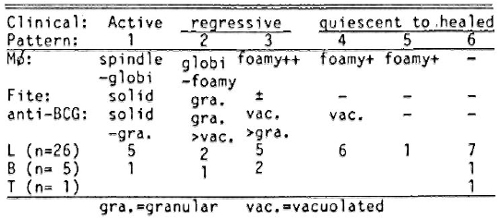
This work is partly supported by Ohyama Health Foundation, Japan
PO 586
IMMUNOREGULATORY ROLE OF THYROID HORMONES IN LEPROSY AND TUBERCULOSIS.
E.S. Balybin, V.Z. Naumov, L.A. Vinnick
Leprosy Research Institute, Astrakhan, USSR.
The levels of triiodothyronine (T3), thyroxin (T4), titres of antibodies against collagen (Abc) and elastin (Abe), lymphocyte transformation test (LTT) with PHA and mycobacterial antigens, suppressor activity of T-lymphocytes were atudied in 46 patients with lepromatous leprosy and 35 patients with pulmonary tuberculosis. The levels of T3 were significantly higher in patients with inactive leprosy process than in active leprosy patients and healthy persons. The levels of T3 in tuberculosis patients were lower as compared with healthy persons. In active tuberculosis patients with excudative manifestations the above levels were higher than in the patients with cicatrical tissue reactions, A significant increase in levels of Abo and Abe was found out both in leprosy and tuberculosis. Suppressor activity of T lymphocytes tended to decrease in aotive tuberculosis and leprosy. In both mycobacterioses T3 levels were directly correlated to Abc and Abc levels and inversly correlated to suppressor activity of T lymphocytes. The data obtained suggested a significant role of T3 in destruction of oonneotive tissue resulting in severe consequences both in active and quiescent leprosy (ENL hepatic and renal damages). In tuberculosis, on the contrary, the role of such mechanism is possible only in active patients with excudative tissue reactions.
PO 587
FUNCTIONAL ROLE OF MAST CELLS (MGS) IN HISTOID LEPROMATOUS LEPROSY

Mast cells have been studed in human and murine leprosy but their exact role is not known. The histoid lepromatous leprosy (HLL) is known by increased proliterative and functional activity of connective tissue cells. MCS, as one of the important cellular components of connective tissue, have been studied in HLL and their morphological changes have been correlated with the disease.
Skin biopsy from 10 HLL were taken. The biopsy included the nodule and surrounding healthy area. Each biopsy was processed for paraffin embodding. The sections were stained with a) H & E (b) Toludine blue and (c) fite faraco.
The activity of MCS in terms of Morphological changes, proliferation and degranulation was maximum in the nodular area, gradually reduced towards the pheriphery and almost norma 1 in the surrounding healthy area. Mastocytosis, excessive degranulation and change in shape from round to thin, elangated and even irregular were the constant features in HLL. These changes reflected the increased functional activity of MCS in HLL which is the outcome of the host immune response.
PO 588
PATHOLOGIC CHANGES AND BACILLATION OF BLOOD VESSELS IN AND BL LEPROSY
Liu Jihe, Shen Lin, Ye Ganyun, Kong Qingyinq, Zheng Xuesi, Dai Jianjun, Ji Feng, Xia flmgyu, Li Jie or.JWang liauhong, Institute of Denatology, Chinese Acadeiy of Medical Sciences, Nanjing, China
Blood vessel involvement and endothelial bacillation were observed histopathologicalli in 60 cases of LL and BL leprosy, including 3 groups:(1) 20 new patients, (2) 20 relapsing cases and (3) 20 cases after the treatment with combined chemotherapy for half to one and half years. The histopathologic changes and bacillation in group 1 were basically similar to that of group 2. There cases of group 1 and 1 cases of group 1 were observed under EM also. The ultrastructurat changes and bacillation of blood vessel were the sane in both groups. But in group 3 the endothelial bacillation was much less than in group 1 and 2 histopathologically and the occurrence of vasculitis were less than in the other groups. However, a few bacilli were still found in errector pili muscles, small bundles of nerves, hair follicles, and muscte layers of small vessel in group 3. Therefore the remnant bacilli after the treatment with combined chemotherapy is still to be investigated.
PO 589
Statistical study on the agreement among histopathologic readings made by different pathologists of a series of 89 cases clinically diagnosed as "Indeterminate Leprosy" in São Paulo State, Brazil.
Lombardi, C.; Cohen, S.; Ridley, D.S.; Leiker, D.L.; Souza, J.M.P.; Noordeen, S.K.
Public Health School, University of São Paulo, Brazil.
89 cases of leprosy clinically diagnosed as "Indeterminate" and submitted to cutaneous lesion biopsy, were retrospectively selected from the Central Files of São Paulo State Pathology and Dermatology Department. Slides were provided for each case and the same material was handed to three different pathologists, for diagnosis and classification within one of the following groups:
A. no hystological evidence of leprosy
B. suggestive of leprosy
C. Definite evidence of Indeterminate leprosy
D. Definite evidence of Tuberculoid leprosy
Agreement ratio among the three pathologists diagnosis is discussed and analysed from the statistical viewpoint.
PO 590
Morphological alterations of Mycobacterium Leprae duo to chemotherapy
Christoph Luderschmidt, Investigative Laboratory of Applied Dermatology and Allergology, München W-Germany
Using chemotherapy the number of microorganisms is reduced in multibacillary forms of leprosy. This fact can be characterized in the skin using staining methods like Ziehl-Neelsen or Fite. On the Other hand, morphological alterations of M. leprae can also be established using scanning electron microscopy.
In multibacillary types of leprosy biopsies of the skin were taken before and during chemotherapy. Using light and transmission electron microscopy the specimens were also investigated using scanning electron microscopy. 5u thick specimens were eputtegod using gold particles. Using a tip-angle of 35 the sputtered specimens were investigated.
In the multibacillary type many Virchow-cells were found.Within the cytoplasm of these cells many typical bacilli were present. After a period of 8-10 weeks using parenteral chentthorapeutical regimens control biopsies of the same patients wore taken. Kany large inflammatory cell s were found in the dermis. But most of these cellula r elements showed either a few bacilli or bacilli fragments or remnants.The surface of the cellular membrane of the bacilli or the bacilli fragments was desintegrated. Using the method of scanning electron tfiicroscopy specific alterations of the microorganisms can be demonstrated due to therapeutic influences.This method can prove therapeutic effects.
PO 591
EFFECTS OF LEPROMIN TEST ON THE TUBERCULOID LESION COMPARED WITH NORMAL SKIN
T.V. Muruganantham, Department of Dermatology and Leprosy Government Ccnerat I lospital, Madras, India.
In leprosy, youngest age incidence has been found to be 3 months - babies born to healthy parents and contacts. Evcnthough intact leprosy bacilli are found in j placenta and cord, congenital leprosy is not produced . Pregnancy period, 265 days, are more than sufficient for the spread of the disease from the lepromatous mother to her foetus, if it is blood borne infection. Bacilli free Grenz zone and formation of graunlomas favouring the deeper dermis disproves spread of the disease through skin . Leprosy bacilli found over the ENL lesions and ulcers are dead. Nasal mucosa acts as portal of entry and excit for viable bacilli3.
Findings from the comparative study of lepromin test conducted on the lesion of 100 tuberculoid patients and their normal skin explains the exact mechanism of delayed hypersensitivity and spread of infection.
References :
1. Merlin L. Brubaker et al
Inter. J. Lep., 1985 ; 53 : 517
2. Jopling W.H. Hand Book of Leprosy
3rd edition page : 2
3. Cehl. S Job. K and Hastings RC
Am. J. Trop. Med. Hyg 1985 ; 34 : 1161.
PO 592
RENAL INVOLVEMENT IN MYCOBACTERIUM LEPRAE DEFECTED MICE. HISTOPATHOLOGICAL, BACTERIOLOGICAL AND IMMUNOFLUORESCENCE STUDY.
Chetana Vaishnavi, N.K. Ganguly, B. Kumar,
R.N. Chakravarti and Surrinder Kaur.
Departments of Experimental Medicine and Dermatology, Postgraduate Institut e of Medical Education and Research, Chandigarh-160012 India
Swiss albino mice were inoculated in the footpads with Mycobacterium leprae obtained from untreated lepromatous patients. The kidneys obtained from the animals sacrificed during different periods were processed for histopathology, presence of AFB and immunofluorescence studies. Renal lesions, AFB and immune complex deposits were seen in the infected animals. Such findings have not been studied in great detail in experimental leprosy earlier.
PO 593
THE LONG TERM PROGNOSIS OF PROVEN RENAL AMYLOIDOSIS IN LEPROMATOUS LEPROSY
Michael F R Waters, P E Philalithis and Sebastian Lucas.
Hospital for Tropical Diseases, St Philip's Hospital and University College and Middlesex School of Medicine, London, UK.
Secondary amyloidosis still occurs in irregularly treated lepromatous leprosy or in inadequately controlled severe chronic erythema nodosum leprosum (ENL). The natural progression of amyloidosis leads to a nephrotic phase followed, usually within 2-4 years, by renal failure and death.
Five LL patients, diagnosed on renal biopsy in the pre-nephrotic phase, were treated energetically with thalidomide to suppress completely their ENL. Repeat renal biopsies showed no further deterioration histologically, and on a 5-15 year follow-up, no patient has developed nephrosis. In the light of this experience, the early diagnosis and management of amyloidosis in LL leprosy will be discussed.
PO 594
CHARACTERIZATION OF MONONUCLEAR CELLS WITH MONOCLONAL ANTIBODIES IN LEPROSY CUANUIOIVS BEFORE AND AFTER Iff UNOTIDERAPY
R.N. Fleury; S.Ura, D. Opromolla, M.S. Arruda, M.E. Nogueira, C.E. Bacchi, M.M. Bacchi.
Hospital Lauro Souza Lima - BAURU - SP - BRAZIL
We studied 22 patients with lepromatous leprosy divided in two groups: 1) twelve patients received immunoterapy according the protocol of Convitt et alli, consisting of a mixture of M. leprae and viable BCG, injected intradermally every 3 months during 2 years and 6 months; 2) control group of 10 patients submitted to a placebo and followed the same protocol. All patients were evaluated clinically, and immunologically. Biopsy specimens were obtained before and after the immunotherapy or when the patient presented reactional states, like reversal reaction. The tissue was submitted to histopathological examination and the bacterial index was calculated; part of the tissue was frozen in liquid nitrogen, cutting in cryostat and the slides stained with immunoperoxidase technique (ABC method) using monoclonal antibodies against T cells antigens (CD3) T helper (CD4); T suppressor (CD8); interleukin -2 receptor (CD25). B lymphocyte (CD22), HLA-DR(Ia) antigen and macrophages.
We compared the number and the microanatonic localization of mononuclear cells in leprosy granuloma before and after immunestinulation in order to detect "in situ" the effectiveness of the host cell-mediated immune response induced by immunotherapy.
This study was supported by a grant from Heiser Program for Research in Leprosy.
PO 595
Serum Immunoglobulins In Leprotic Arthropathy patients
By
Sawsan H.M. El-Tayeb and Mohamed H. Basiouni
Professors of Clin. Path, and Rheumatology, Al Azhar University, Cairo, Egypt.
This study included two groups of patients. The first group consisted of 30 lepromatus patients, classified int:20 patients with arthropathy and 10 patients without arthropathy. The second group-the control group-consisted of 10 age matched patients suffering from arthritis.
It was found that the mean IgG and IgA levels were significantly higher in lepromatus patients with and without arthritis than the control group. An apparent decrease in the mean IgM level was observed in lepromatus patients.
It was observed that the mean IgG in leprotic arthropathy patients was significantly lower than the mean IgG in leprotic patients without arthritis. As regard the mean IgM and IgA levels they were significantly higher in leprotic arthropathy patients than those without arthritis.
PO 596
Interleukin 1, Interleukin 2 and Interferon Production in Leprosy Patients.
Sanit Makonkawkeyoon*, Watchara Kasinrerk*, and Chakrit Hirunpetcharat.**
*Department of Clinical Imnunology. Faculty of Associated Medical Sciences and **Section of Microbiology and Immunology.
Research Institute for Healt Sciences, Chiang Mai University, Chiang Mai, Thailand.
Twenty three lepromatous leprosy (BL/LL) patients were studied for interleukin 1 (IL1) production when their monocytes were stimulated with LPS. More than 80% of BL/LL tested patients had significant low levels of IL1 when compared with normal subjects. Production of Interleukin 2 (IL2) was studied in 47 BL/LL, 24 BT/TT and 30 normal subjects atimulated with PHA-P or Con A or PPD. The level of IL2 In BL/LL or BT/TT was not significantly different from normal subjects when stimulated with PHA-P or Con A. However, the level of IL2 in BL/LL and BT/TT was significantly lower than normal subjects when stimulated with PPD. Interferon (IFN) production in BL/LL, BT/TT and normal controls was not significantly different when stimulated with PHA-P or Con A. However, when PBML was stimulated with PPD, BL/LL and BT/TT showed significantly lower levels of IFN production than normals.
PO 597
OBSERVATIONS ON T-CELL SUBPOPULATIONS IN ENL REACTIONS.
K. Kalavanasundaram,
N. Elangeswaran & V.N. Bhatia
Central Leprosy Teaching & Research Institute, Chengalpattu-603001, Tamil Nadu - India.
15 cases of LL with ENL were studied for phenotypics markers OKT4. OKT3, OKT8 before during and after reaction. 15 LL cases, 15 TT cases and 20 endemic controls were also included in the study. It was found that OKT4 cells were proportionally more during reaction.
The inversion of the OKT4/OKT8 ratio during ENL reaction has been observed by many Investigators. The cause for the inversion Is claimed to be due to the marked decrease in OKT8 surface marker. In our studies we observed that the ratio, though affected it is not reversed and the disturbance observed was due to fluctuation in the T4 phenotype marker and not due to T8.
PO 598
The Immunological profile of three generations of a family with numerous leprosy patients: A two part study. Part I
Ana Valdés-Portela, Manuel Hernandez Angulo, Odelaisy Suarez-Moreno, Elba González-Abreu, José E. Rodríguez and Alina Llop
Instituto de Medicina Tropical "Pedro Kourí" and Hospital Antileproso de Cuba, La Habana, Cuba.
The occurrence of leprosy in a large family in a high endemic focus with a prevalence rate of 16.7/1000 inhabitants is studied. The immunological profile of this family, consisting of 11 sons and 4 daughters, 10 of which present the lepromatous form of leprosy and 1 the tuberculoid, as well as the second and third generations, is described in two ports. The second generation has two clinically defined cases of leprosy, one diagnosed as indeterminate in 1973 at the age of 3 and a 23 year old girl diagnosed as borderline lepromatous in 1976. Marriages to other leprosy patients is a common denominator in this family as well as consanguinity with marital relations to lepromatous close relatives. The first case, one of the daughters, was diagnosed in 1953 at the age of 14 and, thereafter, the brothers and sisters and the mother developod the disease in a stepwise fashion. Part one of this study refers to the DTH response to lepromin, antibody titers to M. leprae and macrophage capacity to destroy the leprosy bacillus in the "healthy" family members as compared to those of their leprosy relatives, to the results obtained in untreated and unrelated leprosy patients as well as age and sex matched healthy individuals with no known contacts with leprosy.
The immunological profile of three generations of a family with numerous leprosy patients: A two part study. Part II
Ana Valdés-Portela, Manuel Hernández Angulo, Odelaisy Suarez-Moreno, Elba Gonzalez-Abreu, Jose E. Rodríguez and Alina Llop Instituto de Medicina Tropical "Pedro Kourí" and Hospital Antileproso de Cuba, La Habana, Cuba.
The occurrence of leprosy in a large family in a high endemic focus with a prevalence rate of 16,7/1000 inhabitants is studied. The immunological profile of this family, consisting of 11 sons and 4 daughters, 10 of which present the lepromatous form of leprosy and 1 the tuberculoid, as well as second and third generations, is described in two parts. Marriages to other leprosy patients as well as to lepromatous close relatives is observed in the family. The immunological profile of the "healthy" household contacts and family members in both parts is analyzed as a whole. The Immunological tests carried out in Part II of this study deals with lymphocyte subpopulation surface markers, lymphocyte function and lymphokina release. The responses obtained are compared as described in the preceding paper. Those departing from the healthy control values and coinciding with the range of values obtained in leprosy patients is individually analyzed and the high risk individuals identified. The possible role of a gonetic potential and/or environmental influence is discussed.
PO 599
Circulating immune complexes in lepromatous patients and the relationship with specific anti-Mycobacterium leprae antibodies and major immunoglobulins.
Odelaisy Suárez, Elba González-Abre, Ana Valdés-Portela, Jorge Aparicio, Manuel Hernández and José Rodríguez.
Instituto do Medicina Tropical "Pedro Kouri", Ciudad de la Habana, Cuba, and Hospital Antileproso de Cuba, Ciudad do la Habana, Cuba.
A study is carried out on the humoral immune response in lepromatous leprosy patients, household contacts and healthy individuals with no known contact with leprosy. The patients were divided into 3 groups; group 1 were patients with less than 2 years of treatment, group 2 consisted of patients with more than 2 years of treatment and showing an unfavorable evolution and group 3 were patients also treated for more than 2 years but with a satisfactory evolution. In this study immune complexes were determined by polyethylene glycol precipitation as well as anti-M. leprae antibody levels by the ELISA technique using the semisynthetic dissacharide-BSA antigen. IgG, IgM and IgA were quantified by radial Immunodifusion. The values of IgG and IgA in group 2 were high in relation to the other groups as well as to the controls, IgM values in the patients were observed to decrease with time of treatment while the anti-M. leprae antibody values were inversely proportional to those of the immune complexes.
PO 600
Peripheral Helper: Suppressor Ratios and Natural Killer Cell Populations in Hansen's Disease.
Sophie M. Worobec, Kenneth D. Bauer, Arlene A. Slajchert, Pierre M. George and Virginia C. Fiedler Chicago Regional Hansen's Disease Center, University of Illinois and Northwestern University, Chicago, U.S.A.
The purpose of this research was to study circulating T-cell subsets in individuals with Hansen's Disease. Correlations were sought based on disease type, reactional states, age and sex. Ethnic, sex and age-matched controls were recruited. Peripheral blood samples were collected in heparinized tubes, then lymphocytes were separated, and stained with monoclonal antibodies for dual flow cytometry. The following combinations of fluorescein (FITC) or phycoerythrin (PE) conjugated monoclonal antibodies were used: FITC Anti-leu 2 + PE Anti-leu 15 (suppressor-cytotoxic cells), FITC Anti-leu 3 + PE Anti-leu 8 (helper-inducer cells), FITC Anti-leu 7 + PE Anti-leu 11 (natural killer cells), and FITC Anti-leu 4 (pan T-cells). Major findings: There was no statistically significant difference in the total counts of pan T and natural killer cells in controls, paucibacillary and multibacillary (BI>3) patients. Women with multibacillary disease had higher helper: suppressor ratios (mean 2.45; 13 samples) than men with multibacil1ary disease (mean 1.13; 17 samples). These ratios did not differ on a sex basis in controls nor in paucibacillary patients. In further study, women under 40 years of age with multibacillary disease had a higher mean value (2.49; 12 samples) than women over 40 years of age (mean 1.65, 21 samples).
This study shows that women with multibacillary Hansen's Disease differ significantly in their helper: suppressor ratios from women with no disease or paucibacillary disease. This difference is especially marked in the 20-40 year range.
PO 601
LONG TERM EVALUATION 0F IMMUNE STATUS IN LEPROSY PATIENTS UNDERGOING MULTIPLE DRUG THERAPY (MDT) IN VIETNAM.
Hoang Thuy Long, , Dang Duc Trach, Vu Tan Trao, Nguyen Do Quyen, Ho Minh Ly & Nguyen Diem Hong (1); Nguyen Duy Khang, Nguyen Nguyen & Le Kinh Due (2); E.P. Wright & J.T. Hendriks (3).
(1) National Institute of Hygiene and Epidemiology, Hanoi, Vietnam.
(2) Dermatology Institute, Hanoi, Vietnam.
(3) Dep't of Medical Microbiology, University of Amsterdam, The Netherlands.
Since 1985 , a group of newly-diagnosed, untreated leprosy patients in Hanoi are being monitored for immunological, clinical, and bacteriological parameters at 3-month intervals during multiple drug treatment(MDT) . Immune status evaluation includes both humoral (Ig levels, see abstract Hang et al.; anticomplementary activity (ACA)) and cell-mediated (lymphocyte transformation (LTT) assays, see abstract Trao et al.; circulating lymphocytes; skin tea ting) variables.
ENL developed during MDT in over 5O% of lepromatous cases, in some cases associated with an increase in ACA; reversal reaction occurred rarely. Bacterial indices decreased in lepromatous patients, but were still positive after 24 months in most LL/LLs cases, sometimes accompanied by a persistent anergy of the cell-mediated immune response (CMI). Lepromatous patients in the first year of MDT often had a restoration of CHI (increase in % circulating T cells, positivity to mycobacterial antigens in skin tests and LTT). In the second year of treatment, this trend in improvement of immune status was less consistent.
PO 602
Changes in cellular immune responses to leprosy antigens during multiple drug therapy
Vu Tan Trao, Phan Le Thanh Huong, An thi Thuan, Dang Duc Trach, Le Kinh Due, J.T. Hendriks, E.P, Wright, National Institutes of hygiene and Dermatology, Hanoi, Vietnam and University of Amsterdam and Royal Tropical Institute, Amsterdam, The Netherlands.
Cellular immune response measured by in vitro lymphocyte proliferation in the presence or absence of added lymphokines was studied in new leprosy patients before and during up to 2 years of MDT. Responses to a crude sonicate of M. leprae and other mycobacteria and to synthetic peptide and dimethylglucose antigens did increase during treatment in nearly all cases but were reduced during reactions. Added lymphokines were usually needed to amplify the response. After longer treatment, most patients' cells responded without added lymphokines, but also produced factors suppressing responses of cells from healthy persons. Cellular immune responses were closely correlated with the clinical improvement or lack of it in all types of patients including those at the lepromatous end of the spectrum.
PO 603
DETERMINATION OF DIFFERENT POPULATIONS OF BLOOD LYMPHOCYTES IN BRAZILIAN PATIENTS WITH HANSENIASIS.
Rubem David Azulay
Federal University of Rio de Janeiro
Rio de Janeiro, Brazil
B and T lymphocytes were determined in the blood of 35 Brazilian patients with hanseniasis (19 VH, 9 BH, 4 TH and 3 IH) and in a control group (30 individuals). The results were the following:
1 -B lymphocytes : there were no differences between the hanseniasis patients and the control group.
2 -T lymphocytes: there was an evident depletion in the VH patients compared to the control group and TH patients.
3 - The average of T lymphocytes in BH and IH was lower than that seen in the control group and in TH patients. In spite of that their variations approach them to the HT and the control groups.
Conclusion: There is an evident depletion of T lymphocites in VH and BH Brazilian patients, showing an impairment of the late hypersensitivity in those forms of hanseniais.
PO 604
CIRCULATING IMMUNE-COMPLEXES AND AUTO-ANTIBODIES IN LEPROSY PATIENTS
P.I. VACHKOV, B.G. Zographsky, M. Radev, M. Kozhoukharova, V.A. Balabanoff, I. Elenkov, E. Stoycheva
Dept. Tropical & Parasitic Diseases, Institute for Infectious and Parasitic Diseases, Medical Academy, Sofia, Bulgaria
Leprosy reactions are inflammatory processes in the course of the treatment as a result of not fairly explained yet immunological changes in the response to mycobacterial antigens. The first type, "reserval" leprosy reactions, which may occur in all forms but polar-lepromatous leprosy, has been shown as an increased cellular immunity respouse, wheareas the second, erythema nodosum leprosum (ENL) that occurs in lepromatous leprosy (LL) only, seems to relate to formation of immune complexes (IC)
We have investigated in dynamic circulating immune complexes (CIC), immunoglobulin levels, total compliment and fractions, rheumatoid factor and a variety of antobodies such as anti-nuclear (ANAB), anti-muscular (AMAB) anti-cardial (ACAB) anti-vascular (avab) etc. from the sera of 16 leprosy patients (four with and 12 without ENL).
In polar LL an overproduction of gamma-globulin (mainly IgG), raised CIC, higher titres of rheumatoid factor and antibodies (anab, AVAB, ACAB chiefly) was found. There was no evidence that leprosy reactions aggravated by full doses of rifampicin and DDS, so the multidrug regimen was maintained throughout the reactional period and the leprosy reactions were treated successfully with anti-reaction drugs, namely steroids and thaiidomide in ENLcases (clofazimine or antomonials) and single steroid therapy in the cases of "reversal" leprosy reactions only.
PO 605
MALADIE DE HANSEN ET SEROPOSITIVITE VIH
JANSSEN F., WALLACH D., PENNEC J., PRADINAUD R., SAID G., COTTENOT F.
Service de Dermatologie, Hôp. St Louis, Paris, FRANCE
Bien qu'ayant de nombreuses régions d'endémie communes l'association maladie de Hansen et infection par le VIH n'a été décrite que très récemment dans un cas. Nous en rapportons deux nouvelles observations.
La première observation concerne un patient martiniquais de 28 ans, bisexuel, suivi depuis 1976 pour une lèpre lépromateuso et traité efficacement jusqu'en mai 1985. Les contrôles bactériologiques répétés sont négatifs entre 1978 et 1986. En février 1987, à l'occasion d'une polyarthrite réactionnelle à clamydiae, sont découverts simultanément une infection VIH 1 stade III (CDC Atlanta) et une rechute bactériologique de la maladie de Hansen : indice de Riddley 1 + sur le F.B.O.
La deuxième observation est celle d'un patient guyanais do 27 ans, hétérosexuel, traité pour une lèpre BL depuis 1978 par une polychimiothérapie comprenant de la DAPSONE retard, jusqu'en 1982, où il arrête de lui-même son traitement. En septembre 1987, il est hospitalisé à Cayenne puis dans notre service pour une altération de l'état général et une multinévrite sensitivo-motrice. La sérologie VIH 1 est positive avec une infection stade IV C2 (CDC Atlanta). L'ensemble du bilan infectieux et neurologique est en faveur d'une névrite de réversion, sans qu'il soit toutefois possible d'éliminer un rôle direct du VIH, dont on connait le neurotropisme.
Ces deux observations permettent de discuter les problèmes diagnostique et thérapeutique que soulève l'association lèpre et infection par le VIH. Elles soulignent la complexité, prévisible, des rapports entre ces deux maladies infectieuses impliquant l'immunité cellulaire.
PO 606
Some Immunological Aspects In Patients With M. Leprae and M. Tuberculosis Infections In Egypt
By
Ezat M. Nasr and Sawsan H.M. El Tayeb Professors of Clin. Path. Al Azhar University, Cairo, Egypt.
Cell mediated immunity parameters were studied in (1) 35 patients with leprosy, 20 with tuberculoid leprosy (TL) and 15 with lepromatus leprosy (LL) (2) 20 patients with skin tuberculosis and (3) 50 age-matched normal individuals. The study included (a) determination of peripheral blood T-lymphocyte subpopulation and (b) estimation of migration inhibition factor i.e. lymphocyte response to PHA.
Cell mediated immunity was impaired in patients with LL and lupus vulgaris and was intact in TL and scrofuloderma.
The frequency of HLA antigens in leprosy and tuberculous patients were also studied and the results revealed association between these diseases and certain HLA antigens.
PO 607
CELL AGGREGATION PHENOMENON OF CULTIVATED BLOOD MACROPHAGES ISOLATED F ROM LEPROSY PATIENTS.
Akira Yamagami. National Institute for Leprosy Research, Tokyo, Japan. Kiyotaka Sanada, Shutaku Kim, Syogo Hazama and Masamichi Koseki. Tama Zensei National Leprosarium, ToKyo, Japan.
In the cultivation of human blood macrophages from leprosy patients, we found that the macrophages from some leprosy patients were isolated as an aggregate form on a coverslip. On the other hand, the macrophages from almost all of the leprosy patients we re isolated separately. The cell aggregate phenomenon was observed in the progressive stadium of leprosy, such as in a new patient, in many patients of Erythema Nodosa Leprosum (ENL) and many leprosy neuralgic patients. But, the macrophages from the quiescent stadium of leprosy were in a separated form. Materials and methods used were as follows. About I5 ml heparinized blood was isolated from every leprosy patient, and about 6ml plasma was separated. The plasma with penicillin was put in 6 plastic Leighton tubes with a coverslig, and was cultivated in a CO2 incubator at 37ºC. Three days later, a cover-slip was taken out from the Leighton tube, and was fixed with methanol and stained with the Giemsa solution. The number of macrophage isolated was I -2X10⁵ per coverslip. The mechanism of this cell aggregate is such that we think the macrophages will react with any antibodies and antigens in the plasma of leprosy patients.
PO 608
Effects of thymopentin on the immune system of lepromatous leprosy patients
Giuseppe Fumo, Giuseppe Barbieri+, Irene Munno++ and Emilio Jirillo++
+ : Miulli Kospital, Acquaviva Fonti, Bari.
++: University of Bari, Dept. of Immunology.
23 patients with lerpomatous leprosy were evaluated for their immune status (T cells frequency and interferon gamma production).
In 6 patients with deficits of both immune parameters, thymopentin was administred.
At the end of the treatment, a full recovery of immune dysfunction was observerd.
The efficacy of thymopentin in LL patients is discussed.
PO 609
M. LEPRAE EPITOPE DETECTION IN ARMADILLO AND HUMAN TISSUES.
Ben Naafs*, William Faber**, Roël Chin A Lien*, Grietje van Dijk*, Teunis Eggelte*** and Arend Kolk***.
*Dept. of Dermatovenereology, Dijkzigt Hospital, Erasmus University Rotterdam, **Dept. of Dermatovenereology, Academisch Medisch Centrum, University of Amsterdam, ***Swellengrebel Laboratory of Tropical Hygiene, Royal Tropical Institute Amsterdam.
With a panel of monoclonal antibodies directed against M. leprae specific and nonspecific epitopes, using an immunoperoxidase system, the presence of antigen was shown in infected human and armadillo tissues.
It was shown that different monoclonal antibodies showed different patterns of reactivity. Some monoclonals detected the M. leprae cytosceleton and showed bacilli, others exhibited a more diffuse staining pattern, staining the cytoplasm of the host cells. It may be speculated that these antibodies detected epitopes on soluble antigens.
In armadillo tissue one of the antibodies detected cross reacting epitopes on the basal membrane of epidermis and vascular wall.
This finding is very interesting when we consider the ethiopathology of adjuvant disease in rats and of rheumatoid arthritis in man and may give food for thought.
PO 610
MODULATION OP IMMUNE DEFICIENT CELLS OF LEPROSY PATIENTS BY PROTEIN COMPONENTS OP MYCOBACTERIUM LEPRAE, LEADING TO INACTIVATION OF PHAGOCYTOSED BACTERIA I. DELIPIDIFIED CELL WALL
P.R. Mahadevan, Meenakshi Vermani, Prema Robinson, Jolly Marolia and Archana Pardhy
The Foundution for Medical Research R.G. Thadani Marg, Worli, Bombay 18, India
In leprosy patiente, Mycobacterium leprae are tolerated inside the macrophages. This presentation reports our observations to demonstrate the following. The viability of M. leprae inside macrophages was demonstrated by in vitro tests and mouse foot pad growth. Immunomodulation of the test component was carried out in immunized mice and in vitro test systems using cultured peripheral blood cells especially macrophages from leprosy patients and normal healthy individuals. In normal healthy individuals, encounter with M. leprae lead to production of superoxide and inactivation of the bacteria. This is totally lacking in the macrophages from lepromatous leprosy patients. A component of M. leprae, the delipidified cell wall (DCW) has been demonstrated to be a successful immunizing agent by the following criteria. a) It has been shown to activate the peritoneal macrophages of immunized mice so as to kill M. leprae through reactive oxygen intermediates. b) The macrophages of any leprosy patients are also activated on exposure to DCW-stimulated leucocytes culture fluids of the same patient, leading to production of superoxide on encounter with M. leprae and inactivation of the bacteria. Thus the immune deficient cells, that are at first unable to meet the challenge of M. leprae, are made to do so as normal healthy individuals, by the component of M. leprae, the delipidified cell wall.
PO 611
MODULATION OF IMMUNE DEFICIENT CELLS OF LEFROSY PATIENTS BY PROTEIN COMPONENTS OF MYCOBACTERIUM LEPRAE, LEADING TO INACTIVATION OF PHAGOCYTOSED BACTERIA II. DCW PROTEINS AS M.LEPRAE DNA/RECOMBINANT PRODUCTS EXPRESSED AS FUSION PROTEINS
P.R. Mahadevan, Dinakar Iyer, Archana Pardhy, Prema Robinson, Indranil Dasgupta and H.K. Das
The Foundation for Medical Research R.G. Thadani Marg, Worli, Bombay 18, India and Jawaharlal Nehru University, New Delhi
The delipidified cell wall (DCW) of M. leprae is an insoluble complex of proteins. Antibodies in the rabbit were obtained using this complex and the λGT11 M. leprae gene library was screened for clones expressing proteins of DCW. Six clones in which lysed proteins interacted with antibodies of DCW were obtained. The fusion protein referred to as Clone 3 on immunisation of mice, induced an ability to show FTE on challenge with M. leprae, but showed no activation of peritoneal macrophages to kill M. leprae in an in vitro system. Clone 3 also showed positive LTT with cells from leprosy patients, but no substantial ability to induce killing of M. leprae by the cells. However, fusion protein 5, induced macrophage activation in immunised mice, to kill M. leprae but no FPE to challenge of live M. leprae. Clone 5 lysate stimulated-supernatant of cells from patients could activated same patient macrophages to induce superoxide and kill M. leprae. Fusion protein 5 induced LTT in leprosy patients. Thus it has been demonstrated that there are modulators existing as components of M. leprae that could activate immunodeficient cells of leprosy patients to inactivate M. leprae, and these may be potential vaccines for leprosy.
PO 612
INTERLEUKIN 2 STUDY IN SKIN AND BLOOD OF LEPROSY PATIENTS FLAGEUL B., BACH M.A, WALLACH D., & COTTENOT F.
Service de Dermatologie - Hôpital ST LOUIS-Paris-France
Using an avidin-biotin immunoperoxidase technique and monoclonal antibodies (MoAb), we have investigated the presence of interleukin 2 (IL2) and it s receptor in the cutaneous granulomas of 26 leprosy patients = 11 tuberculoid patients, 7 unreactional baccilary lepromatous patients and 8 erythema nodosum leprosum (ENL) patients. Concomitantly we have studied the number of IL2 receptor positive circulating T cells and in vitro M. leprae response in presence or absence of IL2.
The labelling patterns observed with the MoAb used made us able to distinguish IL2 producer cells, and IL2 responder cells divided in two subsets : IL2 receptor positive cells and IL2 binding cells.
The results were as follows : 1 -Tuberculoid granulomas contain the highest number of IL2 producer cells and IL2 responder cell s when compared to unreactional or ENL lepromatous patients. The IL2 responder cells belong to the IL2 receptor + cell subset and to the IL2 binding cell subset. 2 -Unreactional lepromatous granulomas exhibit a lack, both IL2 producer and IL2 responder cells. The rare IL2 responder cells observed belong exclusively to the IL2 receptor + cell subset. None IL2 binding cell has been observed. 3 - ENL granulomas exhibit a significantly increased number of IL2 producer and IL2 responder cells in comparison to unreactional lepromatous granulomas. These cells, however, still remain fewer than in tuberculoid granulomas. The IL2 responder cell s belong to the IL2 receptor + cell subset and to the IL2 binding cell subset. 4 - As expected, an absence of in vitro response to M.leprae has been observed in all the lepromatous patients (unreactional and ENL patients). After IL2 addition, 2 of 5 unreactional lepromatous and 1 of 4 ENL patients exhibit a significative response to M.leprae. These patients do not present any particularity on their IL2 and IL2 receptor granuloma content when compared to the non responder patients of their group.
PO 613
MONONUCLEAR PHAGOCYTE SYSTEM IN LEPROSY.
F.E. Vishnevetsky, A. A. Juscenko, V.V. Anokhina, M. Yu. Yuahin, A.K. Maslov
Leprosy Research Institute, Astrakhan, USSR.
Obligate parasitism of M.leprae in a macrophage cell is one of the main factors in pathogenesis of leprosy infection. Macrophages from human and animal (mice and armadillos) lepromas and cultivated monocyte-derived macrophages were studied using the methods of cytochemistry and transmission and scanning electron microscopy. Macrophages from untreated leprosy patients showed a high activity of glucose-6-phosphate dehydrogenase and markedly reduced levels of β-glucuronidase and lipase. The different levels and localization of peroxidase were noted in leprosy macrophages suggesting an important role of peroxidase system in intracellular phagocytosis of M. leprae. The effective anti-M. leprae therapy decreased dehydrogenase and esterase activities in tissue macrophages. Monocyte-derived macrophages underwent in vitro a more rapid giant cell transformation and showed a decrease followed by an increase in the levels of β-glucuronidase. Ultrastructure of macrophages cultivated from blood monocytes was changed when dapsone was administered while rifampicin had no such effect. The regularly obtained cultures of leprosy granulation tissue consist of M. leprae-laden macrophages as well as lymphocytes and fibroblasts. The addition of rifampicin or dapsone to culture media significantly diminished mycobacterial load of macrophages. The results of the investigations permitted to develop the tests for early assessment of effectivity of specific therapy and rapid screen of the drugs with potential antileprosy activity.
PO 614
Leprosy and Nutrition
K.N. Rao and Kunal Saha
Vallabhbhai Patel Chest Institute, University of Delhi Delhi 110 007 (India).
This study was undertaken since it was earlier suggested that undernutrition in leprosy might be due to food deprivation or poverty or due to the disease process itself. Also concomitant infectious diseases in them might also modulate their nutritional status.
In order to study the above problem, body measurements as well as assessment of daily dietary intakes were undertaken in these patients along with the evaluation of biochemical and endocrinal parameters. Also incidence of coexisting bacterial, viral and helminthic infections with special reference to pulmonary tuberculosis malaria and sexually transmitted diseases were evaluated. Our lepromatous patients often Suffer from pulmonary tuberculosis, resulting in a negative nitrogen balance decline of body weight and decrease in various serura micronutrient levels, which proved ultimately to be fatal.
PO 615
Preliminary Efforts at the Reconstruction of the Epidemiology of Medieval Leprosy: Naestved Revisited
Stephen R. Ell
The University of Chicago Hospitals, Chicago, Illinois USA
Excavations at several medieval leprosaria have shown that the skeletons of those buried there have diagnostic changes of leprosy. This study centered on re-evaluation of the 123 complete skeletons excavated at Naestved, Denmark by Moller-Christensen (dated 1250-1550 A.D.). The intent was to determine the age of onset of disease, since this factor and the sex ratio of patients characterize the incidence of the disease. Resorption of the anterior alveolar process of the maxilla was chosen for study because the extent of destruction has been linked in Malaysian patients to duration of untreated disease and because this form of lepromatous osteitis protects from normal periodontal bone loss. First, the Malaysian data was subjected to statistical analysis and it was found that bone loss fit a straight line regression model with a slope of 2.4%/yr. and correlation coefficient of 0.83. Skulls from Naestved were measured directly for percent bone loss and a formula employing estimated age at death was used to estimate age of onset. Over 70% of cases indicated a childhood onset. Coupled with an equal sex ratio, these findings characterize late medieval Denmark as an area of extremely high incidence. This method may have a broader application both in estimating incidence for areas where such remains have been found and in using such insight as a perspective for understanding medieval leprosy in a broader context.
PO 616
ON SOME UNKNOWN SOURCES FOR THE HISTORY OF LEPROSY
Dr. Boris. IossifoV Miloshev, Union of Scientific Workers, Scientific Worker, Anton Cechov Street, 9. bl.88 (W) Sofia 1113, Bulgaria
Dr. Yordanka Hristova Peeva, Mag. Pharm., Ioan Exarch Street, 61, Sofia 1126, Bulgaria
Some books of the Bible contain not only separa rate texts but also entire chapters on the epide emiology, prophylaxis, diagnosis, treatment, the clinical picture and the symptoms of leprosy.The refore the Ancient World, especially Egypt and Babylon, exhibit through the Bible a remarkable degree of knowledge on many aspects of leprosy.
The present-day doctor will find explanations on many of the problems of interestbto him.
The Bible describes with remarkable precision details from the clinical picture of the disease - forms, symptoms, diagnosis, treatment, prevention, etc. Let us recall in this respect that Werner Keller addresses to negative criticism the wise advice - 'And Still the Bible Was Right'.
The present paper is, within the bounds of our opportunities and within the framework of the literature available, a modest contribution to the study of the problem of leprosy seen in the context of the history of medicine.
PO 617
THE CREATION AND OPERATION OF A COMPUTERISED NATIONAL REGISTER OF LEPROSY PATIENTS.
Rev Peter Garland
National Manager, LEPRA, Box 496, Blantyre, Malawi.
The Poster will present suggestions which might be followed for parties interested in using computerised records for leprosy control. It will illustrate the kind of reports which can be produced as well as details of data collection. Stationery used in the collection, coding and capture of data will also be displayed. Ihe work will be based on the National Register of leprosy patients in Malawi.
PO 618
ANALYSIS OF TRENDS OF DETECTION AND SPECIFIC INCIDENCE RATES OVER A 32-YEAR PERIOD IN POLAMBAKKAM, SOUTH INDIA.
Etienne Declercq, Claudine B. Misson, Claire Vellut, Mark Vanderveken, Xavier Kurz, Murielle Deguerry, Michel F. Lechat.
Epidemiology Unit, Catholic University of Louvain, Brussels, Belgium.
Some 50,000 leprosy patients have been detected in the Polambakkam area between 1955 and 1986. An average annual decline of incidence rate of 4.5 % has been observed.
Mean age at registration was in average 5 to 7 years lower for paucibacillary than multlbacillary patients, and was slightly decreasing for the former, while no change was observed for multlbacillary patients. Distribution of incidence by age, sex and type showed that leprosy was more frequent In males than females for both mulct- and paucibacillary types. Sex ratio was stable with age for paucibacillary cases, but was increasing for multlbacillary leprosy, to reach a maximum in the age-group 35-39. A bimodality was observed for paucibacillary leprosy, the second peak of which tended to disappear along the years. Observations suggest that the first peak mainly concerns household contacts of leprosy patients, wtiile the non-contacts are mainly responsible for the second peak.
The observations also suggest a slower decline of incidence among household contacts than in non-contacts.
PO 619
ADAPTATION OF THE OMSLEP SYSTEM TO ILEP REQUIREMENTS
Claudine Misson, Michel Lechat, Catherine de Fauconval, Yves de Kettenis
Epidemiology Unit, Catholic Unlveraity of Louvain Brussels, Belgium.
The Omslep Recording and Reporting System for Leprosy Patients is in use in 43 countries or projects, whether in its original form or adapted to local requirements. It is simple enough to allow health service workers at all levels, even the most peripheral, to collect the necessary data for operational or epidemiological evaluation in a decision making context.
It has been modified to meet the needs of monitoring multidrug therapy as well as monotherapy, and to be compatible with the reporting procedures of ILEP member- associations under the new name of IL-OMSLEP, in order to alleviate the administrative tasks at the projects level.
The three categories of leprosy patients (treated, under surveillance, under care) are fully integrated into the system and the micro computer software. This software requires no special knowledge of information technology. It can be used to record data on an individual and personalized form; to update these data, to compile periodic returns from these data (ILEP B-questionnalre as well as OMSLEP Statistical Forms) to calculate ILEP or WHO indicators for evaluating control campaigns and to calculate other statistics, at the user's request for more detailed studies. The Epidemiology Unit of the Catholic University of Louvain, Brussels, can assist any projects to implement an information system for leprosy control programmes and to computerize it.
The OMSLEP booklet is available in 4 languages (English, French, Spanish, Portuguese).
PO 620
POSSIBLE ROLE OF PHLEBOTOMINE SANDFLIES IN THE TRANSMISSION OF LEPROSY.
Sreevatsa and Desikan, K.V.
Central JALMA Institute for Leprosy, Agra, India
Mode of introduction of M. leprae into the human body being not clear, vector hypothesis gained much importance. Several arthropods existing in the leprosy endemic areas are found to harbour acid fast bacilli. Phlebotomine sandflies are one of the most commonly available arthropods found in the leprosy endemic areas, which havo not been screened so far for mycobacterial infection.
Sandflies representing two genera and eight species were collected from the houses of few localities of Agra. Acid fast bacilli were seen in 47% of the sandflies collected from the houses of leprosy localities. Laboratory roared sandflies fed on the blood of leprosy patients showed that acid fast bacilli persist only upto eight days in sandflies. Morphologically granular and fragmented bacilli were more, compared to intact bacilli. Light and electronmicroscopy of sandflies did not reveal any cellular changes. Results of mouse foot pad harvest did not indicate multiplication of bacilli in the gut of sandflies. When refed on mouse foot pad very few bacilli were carried mechanically by the contaminated proboscis. From the study it is evident that sandflies may not be having any role in the transmission of leprosy.
PO 621
DOES LEPROSY CLING TO HOUSEHOLDS : A RETROSPECTIVE STUDY OF HOUSEHOLD-CONTACTS
MG RANANE - Gandhi Memorial Leprosy Foundation, Wardha (India).
The purpose of this study is to test the hypothosio 'Leprosy clings to households'. The Data relates to 1184 Primary cases (PC) and their 6284 household contacts (HC), of the Sevagram Leprosy Control Unit run by the Gandhi Memorial Leprosy Foundation a non-Governamental agency, working for the cause of leprosy control.
The Sevagram unit is situated in Wardha, a district in the State of Maharashtra, India. The Data for this study, on variables like period of contact, age, sex, type of PCs, closeness of relationship, and start of contact with PC before, at the time of and after detection, was culled from the case records maintained in the unit.
Analysis of the Data shows, that the attack rates per 1000 person years at Risk (PYR) ranges from 9.9 in the case of HC of L+BL+BB type of PC and 3.9 in other types of PC to 1.98 in the unexposed per sons; the attack ratio being 5:2:1. Similarly the attack rate was higher in males than in females, more in HCs of L+BL+BB type of PC than in the other types of PC and relatively high in the case of higher grades in BI. The case rate per family having PC during the period of study was found to be 0,45 and that of unexposed family 0.35
The study reveals that the attack rate neither depend on the period of contact with the PC nor on their treatmont. Significant difference in attack rates exist in close and distant contacts in case of females, but there is no difference in males.
PO 622
AN EXPLORATORY STUDY OF MULTIPLE-CASE LEPROSY FAMILIES : A GENEALOGICAL ANALYSIS
S.N. MORANKAR
Centre for Social Science Research on Leprosy Gandhi Memorial Leprosy Foundation, Hindinagar Wardha-442 103 (INDIA).
Genealogies of twentyseven multiple-case leprosy families of two randomnly selected villages of Vizianagaram district, a high endemic area, of Andhra Pradesh (India) were studied in 1987. Pedigrees extending to 4-7 generations covered 1460 family members, among whom were 168 patients - 122 males and 46 females.
The study was intended to compare the off-springs of consanguineous and non-consanguious marriages in relation to occurrence of disease (i) in different generations (ii) disease of the parents (iii) among different sex (iv) by birth order end (v) acceptance/rejection of the patients.
In majority of genealogical trees, occurrence of disease was found intermittently. Continuity was observed only in 12% of the trees. Both in consanguineous end non-consanguineous types of marriages occurrence showed similar pattern when both parents were patients and higher in non-consanguineous type where either the parent was a patient or both were healthy. Sex ratio among patients among non-consanguious type of marriage was 3:1 whereas it was 2:1 in the case of consanguineous type. No significant relationship was found in the birth order in either types of marriages. Culturally accepted mores of consanguinity has prevailed favourably both in cases of choice of spouses (irrespective of of disease) and in acceptance of patients.
PO 623
Age at onset of Leprosy among household contacts of primary cases.
Dr.S. Ananth Reddy, Dr.K. Udaya Kiran, Dr. Kishore Molani & Dr. Purushotama Rao J.
SIVANANDA REHABILITATION HOME, KUKATPALLY HYDERABAD-500 872 (ANDHRA PRADESH) INDIA.
Most reported studies on age distribution of Leprosy are based on age at the time of detection of disease and not an age at onset of the disease. Even few studies on age distribution based on age at onset, /iave certain limitations as information is based on statements of patients with varying degree of dependability. However, in our present study we have based our finding on actual examination of contacts, every six montlis and there by getting accurate information of age at oneset.
8131 Household Contacts of 1970 primary cases of leprosy of all classification detected by different methods by Sivananda Rehabilitation Home, Hyderabad, in its control unit during the period 1979 to 1983 were included in the study. The cases were subjected to examination every six monttis during the period 1979-1985. Fresh cases detected during the survey were 299. These cases will be analysed as regards to age of onset in general and in relation to type of ciasstfication and sex of primary cases. Further the study will analyse the occurrence of leprosy in different age groups by calculating age specific incidence rates of each group and make comparisons.
PO 624
PREVALENCE OF LEPROSY AMONG HOSPITALISED PATIENTS FOR MEDICAL EMERGENCIES.
P. Thirumalaikolundusubramanian, & R. Alagappan. Dept. of Medicine, Madurai Medical College, Madurai 625 020, India.
Cases of adult acute medical emergencies admitted Into the medical wards during 1982-1987 were screened for associated leprosy. Of the 1057 cerebrovascular accidents - 'CVA' (hemorrhage, infraction and embolisation), 1307 cardiovascular diseases (Coronary Heart Disease. 'CHD' congestive heart failure - 'CHF' and hypertensive heart disease - 'HHD'), 2518 gastrointestinal emergencies (Acute diarrhoeal disease - 'ADD' - with dehydration and/shock. Acute viral hepatitis - 'AVH' with hepatic failure, Portal Hypertension - 'PHT' with upper GI bleeding and / Hepatic encephalopathy), 550 Respiratory emergencies (hemoptysis, COPD, ARDS), 50 endocrine emergencies and 6800 cases of suicidal poisoning, leprosy was detected in 3 who had CVA ; one each with CHD & CHF, and 3 with HHD ; 17 with ADD, one with AVH with hepatic failure ; 3 with pulmonary tuberculosis and hemoptysis ; one with diabetic ketoacidosing ; and 27 with suicidal poisoning. No leprosy lesions were detected in patients with PHT, COPD and ARDS. Thus present study clearly denote that the medical men should look for associated leprosy in every case when brought for checkup or with emergency medical problems, in areas where leorosy is endemic. However, it is difficult to say at this juncture whether leorosy patients are less likely prone for these Acute medical emergencies unless population based studies are made.
PO 625
IMPLICATIONS OF NEW TECHNOLOGY FOR DATA PROCESSING IN EPIDEMIOLOGICAL STUDIES OF LEPROSY.
Lyn Bliss, Jorg M. Ponnighaus and Paul E.M. Fino London School of Hygiene and Tropical Medicine, Department of Tropical Hygiene, Keppel Street, London WC1E 7HT; and
Lepra Evaluation Project, P.O.Box 46, Chilumba, Karonga District, Malawi, Central Africa.
Recent developments in data processing technology have important implications for field studies of leprosy. Projects lasting many years must be able to adapt and incorporate new information and technical advances with minimum upheaval.
In spite of increases in the storage capacity of micro computers, some large studies may find the need to utilise mainframe computers. Even if this is so, it may still be possible to take advantage of some of the benefits microcomputers offer.
These points will be illustrated by experience of the Lepra Evaluation Project and leprosy vaccine trial in Northern Malawi. Among the logistic problems were considerations of machine maintenance and electricity supply in a remote location in Africa. Nevertheless, using a small generator solely to supply the microcomputers, having a system with modular components and having a spare hard disk, it has been possible to run the system largely without interruptions. It gave us all the advantages of being able to alter entry programs as required, and to incorporate quality control and validation at source shortly after data collection, by means of various check letters, double entry and cross checks. Examples of these procedures will be discussed to illustrate their value to other research groups considering the use of micros.
PO 626
A GEOMEDICAL STUDY ON THE SPATIAL DISTRIBUTION OF LEPROSY IN INDIA
S. Shanmunanandan and P.T. Subramanian Department of Geography, Madurai Kamoraj University, MADURAI-625 002, INDIA.
Leprosy is a chronic granulomatous infection of humans which in its various clinical forms attacks superficial tissues. India with hermany millions of people has ot least a third of the World's leprosy patients. The major objectives of the present study ore II to analyse the spatial distribution of leprosy cases ii) to observe the spatio-temporal variation in the distribution end its trend iii) to identify the leprosy-endemic zones and to probe into the details iv) to find out the association with selected socioeconomic and environmental factors v) to evolve a conceptual frame - work towards planning for an efficient health care delivery system. The study revealed that large ports of the country ore leprosy endemic zones and at least half the Indian population Is exposed to the risk of Infection and that too particularly 30% of the new cases are Children. It is estimated that there ore more than 15 million leprosy patients in the world and nearly 4 million of them are in India. It is also inferred that 55 % of the cases are found to be below the age group of 20 years. 80% of the cases of india belong to the non-infectious type of leprosy. The five states namely Tamilnadu, Andhra Pradesh, Orissa, West Bengal and Maharashtra alsone account more than 60% of the cases, Calcutta has the largest concentration for any city. In 76 districts of the country, the incidence of leprosy is 10 per thousand.
PO 627
STUDY ON OPERATIONAL EFFICIENCY OF MULTI DRUG THERAPY WITH A VIEW TO IDENTIFY THE FACTORS AFFECTING THE IMPLEMENTATION
DR.K.R. JOHN, M.D., DR. JAYAPRAKASH MULTYIL, M.D. AND DR. ABRAHAM JOSEPH
Community Health Departiment, Christian Medical College, Vellore 632 002, South India
Multi drug therapy (MDT) has been implemented in the North Arcot District from 1983 onwards. The Community Health Department of Christian Medical College, Vellore is covering nearly 2,00,000 population in North Arcot District under the national leprosy eradication programme.
At start in 1984 January in the Leprosy eradication programme of this department was having a total of 4029 patients with a mean of 447 cases per sub centre (MB cases of 80 and PB cases 367). At the end of 4 years the case load Is 955 with a mean of 106 cases per sub centre (PB cases 51 and MB cases 55). It was observed during the implementation of MOT in the 9 sub centres under this programme that they performed at different levels of efficiency. The following efficiency indicators wore studied according to the sub centres which included the rate of intake of patients for MDT, attendance rate, rate of bacillary index (BI) converstion rate, rate of reporting of new cases, rate of release from treatment etc. The factors effecting the efficiency of Implementation studied are the pre valance of leprosy at start, proportion of MB/PB cases, Mean BI, posiiivity rate, geographical distribution of villages, no. of previous years of leprosy work in the sub-centre etc.
From the above mentioned efficiency indicators and the factors and the factors affecting the outcome a series of operational mo da Is are developed. The data is analysed with the aim of quantifying the effect of explanatory variables on performance. Multivariate analysis is carried out and most appropriate model is presented. On the basis of these models a set of feasible operational targets fox a sub centra are developed for a given set of variables affecting the programme implementation.
PO 628
IMMUNOLOGICAL RESPONSIVENESS TO M. leprae ANALYZED IN HEALTHY HOUSEHOLD CONTACTS F ROM LEPROSY PATIENTS AND SUBJECTS NOT EXPOSED TO LEPROSY.
E.P. Sampaio, M. Spinosa*, A.A. Figueiredo, N. Nogueira* and E.N.Sarno. Department of Leprosy, Oswaldo Cruz Foundation, RJ, Brazil.
* Laboratory of Molecular Parasitology, Rockefeller University, NY, USA.
It is generally accepted that lepromatous patients display a selective immunological unresponsiveness to M. leprae antigen (ML) demonstrated in vitro by the specific inability of their PBMC in proliferating and/ or release IFN-gamma. This lymphokine has been considered the most directly related to the effective activation of macrophages and actually involved in the immunological resistance against mycobacterial infections. The aim of our study was to analyle the cellular immune response to ML in 113 household contacts of lepromatous patients supposed to constitute a ML - infected but healthy population. Forty-eight controls not exposed to leprosy were, also included. PBMC isolated by Ficoll-Hypaque density centrifugation were cultured with ML for 5 days, when the supernantant of the cultures was removed and the levels of IFN-gamma determined with a RIA kit obtained from IMRX Corp. (Centocor, Malvern, PA). Sixty-five contacts showing levels>100 U/ml (57.5 %) were considered high responders (HR) to the antigen and 48 persons (42.5 %) were low responders (LR). Among the controls, 16.7 % and 83.3 % were found to be HR and LR respectively. Four contacts had anesthetic areas clinically detected and histologically, all of them showed an inespecific chronic inflanatory infiltrate, AFB negative. Two of these persons were HR to ML and one of this healed spontaneously after one year of follow-up. The percentage of HR contacts was three times higher than that found in the control group and suggest the existence of active subclinical infection among them. As for the LR contacts, it is probable that other immunological mechanisms may be responsible for their unresponsiveness since it is very difficult to admit that they had never been exposed to the bacillus.
PO 629
THE USE OF ANTI M.LEPRAE ANTIBODY DETECTION FOR THE SEROEPIDIMIOLOGICAL STUDY OF CONTACT'S OF LEPROSY PATIENTS.
F. Agis*, P. Bobinº, J.L. Cartel+*, S. Chanteau+, P. Corbeauº, S. Desforgesº, C. Guidi+*, P. Launoisº**, M.A. Bach**.
* Institut Pasteur de la Guadeloupe BP 484 Pointe à Pitre
º Institut Pasteur de Nouméa BP 61 Nouvelle Calédonie
+ Institut Territorial de Recherches Médicales Louis Malardé BP 30 Papetee-Tahiti Polynésie Française
** Institut Pasteur de Paris 75724 Paris Cedex 15
IgM antibodies to the PGL1 of M. leprae were measured by an Elisa assay, using a semi-synthetic antigen, the natural disaccharide-octyl-bovine serum albumin (NDO-BSA). Sera were obtained from leprosy patients, healthy subjects and more than 1000 intradomiciliary contacts in 3 french overseas territories : New-Caledonia, Tahiti and Guadeloupe. Control sera from healthy subjects living in Prance were also tested. Similar results were obtained in Tahiti and New-Caledonia. Healthy controls from these areas displayed significantly higher background levels of anti NDO-BSA antibodies than controls from non-endemic areas. With a seropositivity level defined as the mean of healthy controls from endemic area +2 SD, the seropositivity rates in Tahiti were 100% among multibacillary patients, 21% among paucihacillary patients and 19.5% among contacts. In New-Caledonia, 97% of nultibacillory patients, 23% of paucibacillary patients and 12.5% of contacts were found seropositive. In Guadeloupe, autochtonous healthy controls displayed low anti NDO-DSA antibody background, similar to that of controls from non-endemic areas. Moreover, such a background was still reduced in this study by the introduction of an anti human IgG antibody in the assay. Seropositivity rates then readied 43% among pnucibacillary patients and 32% among contacts. These data indicate that a large proportion of contacts developed infraclinical M.leprae infections, and also suggest that procedures lowering the background antibody level in control populations should be developed to improve the efficiency of detection of paucibacillary leprosy.
PO 630
Leprosy Disability in a Control Programme - Trends Over 10 Years.
W.C.S. Smith, S.M. Parkhe, K. Solomon, P.D. Samson.
Department of Community Medicine, University of Dundee, UK and Belgaum Leprosy Hospital, Belgaum, Kamataka, INDIA.
A leprosy control programme has been implemented in a defined rural population for the past 10 years. During this period 3 population surveys have been conducted and the characteristics and prevalence of disabilities due to leprosy assessed at the end of each survey in 1979, 1983 and 1987.
There has been no decrease in the cases detected during successive surveys but the ratio of pauci-bacilliary cases to multi-bacillary cases has rapidly risen from 3.9 to 17.1. There was little change in the prevalence of active leprosy between the end of the 1st and 2nd surveys however the prevalence has fallen by two-thirds in the 3rd survey following the introduction of multidrug therapy in 1984. The prevalence rate of disability due to leprosy fell by % between the 1st and 2nd surveys. There has only been a small fall in prevalence between the 2nd and 3rd surveys but the degree of disability measured using the WHO Disability Index has fallen. The characteristics of the changes in disability rates by age, sex and type are described. The importance of disability assessment as an outcome measure in leprosy control is discussed.
PO 631
Transmitted leprosy from transfusion of lepromatous patient's blood and its incubation period of leprosy
Wang Chengyi. Wu Qinxue. Lu yisi. Sun Chuan-zhen. Deng Kexing. Liang Changquiang. Tong Guilin. Nong Hengting.
The patient named wang with lepromatous leprosy whose disease of leprosy could not discovered by a surgeon of a hospital was a blood doner in 1975-1980 to donate his blood to the 60 donees who needed the blood for surgical operations and anemia. Eight out of 60 donees were infected by blood transfusion to develop the leprocy during the observation of 6 years by us. The eight cases of leprosy were diagnosed by clinical, pathological and bacteriological methods, 2 patients had TT type of leprosy, 4 had BT type, 1 had Bl type, 1 had LL type. Those patients' incubation period of leprosy were 1-19 months.
Transmitted leprosy from blood transfusion of lepromatous leprosy patient were fully proved. It tells us how long is the time of its incubation period and the blood doner must be examined by the doctor of skin department every year in epidemic area of leprosy and the leprosy indirect transmission of biting insects Should be studed deeply again.
PO 632
MULTIDRUG THERAPY OF LEPROSY IN HONG KONG A REVIEW OF 425 PATIENTS TREATED BETWEEN 1977 AND 1987.
Norman R. Honey and Tam Shue Tong
Special Skin Unit (Hansen's Disease)
Social Hygiene Service,
Medical and Health Department, Hong Kong Government, Hong Kong
A form of multidrug therapy with dapsone, clofazimine and rifampicin was first used for the treatment of leprosy in Hong Kong in 1977. All case records of leprosy patients have been studied and 425 patients identified who have taken multidrug therapy between 1977 and 1987. The indications for use, regimon used, clinical and bacteriological results, patient acceptability, compliance with treatment and side effects have been reviewed. The treatment was found effective and acceptable with no serious side effects and so far no patients have relapsed after multidrug therapy. An analysis of results with background information set against falling annual registrations of new cases is included.
PO 633
EFFICACY OF FIXED DURATION MDT ON PAUCIBACILLARY LEPROSY - CLINICAL AND HISTOLOGICAL FINDINGS
Rachel Mathai and Mary Jacob
Dept. of Dermatology,
Christian Medical College Hospital,
Vellore, India.
During the 14 month period from May 1984 to July 1985, patients attending the leprosy clinic of the Christian Medical College Hospital, Vellore, India, with single leprosy patch were screened. Children below 5 years, patients with face patches or patches less than 2.5 cm and those who could not come for regular followup were excluded. Patients were randomly assigned to two regimes of therapy: Conventional dapsone monotherapy, or MDT for 6 months as per WHO recommendation for paucibacillary disease. Clinical, histological and immunological status were determined prior to initiation of therapy. Clinical and histological parameters were reassessed at 3 months, 6 months, 1 year, 2 years and 2 1/2 years.
This paper presents the findings of the study, showing the evolution of the disease through the treatment period with particular emphasis on the status of the disease 2 1/2 years after starting treatment. Of the 17 patients who completed the study in the MDT group, 4 (23%) showed no treatment response and continued to have histological evidence of active disease. These findings did not differ significantly from those treated with dapsone alone. The implication of these findings are discussed.
PO 634
The implementation of MDT in Kenya 1983-1987
G.O. Idukitta, M.C.J. Bosman, J.v.d. Broek National Leprosy and Tuberculosis Control Programme(NLTP), P.O.Box 20781, Nairobi, Kenya
The extent of the leprosy problem in Kenya is discussed. Total estimated prevalence: 25.000. Of 6558 leprosy cases on register in 1986 90% live in 10 districts with a total population of 6.683.445. Prevalence 0.88/ 1000; incidence 8.5/100.000. Among new cases: 5% children, 9% disability grade 2+3, 22% MB.
NLTP initiated modified WHO MDT for MB cases in 1983. Regimen: lRCD/23CD/D until BI negative. MB cases put on this regimen from 1983-1987: 100. NLTP decided to implement WHO MDT in 1985. The NLTP manual gives all guide lines. Different is the maximum duration of treatment of 39 4-weekly doses of R, thereafter RFT regardless BI.
In 1985 and 1986 1072 patients were put on MDT. (643 PB and 429 MB). Results of 392 PB cases: 89% RFT, 7% TnC. From 203 MB cases put on MDT in 1986 and 1987 2% were declared O.o.C. so far.
The NLTP development plan 1987-1990 envisages the district-wise implementation of MDT in 4 regions with a high leprosy prevalence. The target is to have put all new and eligible old cases in 14 districts with 95% of all cases on MDT before 1-1-1990.
PO 635
The effect of Seven Years MDT in Leprosy Control Unit at Miraj, India
Drs. P.D. Samson, S.M. Parkhe, P.H. Das and M. Solomon Richardson Leprosy Hospital, Miraj 416 410, India.
The MDT regime was implemented in the Leprosy Control Unit, Miraj, in 1982. The regime recommended by W.H.O. are being followed for multi bacillary and pauci bacillary cases. The programme is monitored by tablet counts and urine examination. Patients are assessed clinically and bacteriologically.
The following results are observed: 98% one-patch cases showed improvement in 9 months, 95% of more than one patch cases showed improvement in 9-12 months, 75% of multi bacillary cases with high B.I. showed improvement in 30-36 months. The remaining multi bacillary cases showed improvement within 20-24 months. Two pauci bacillary refractory cases and one multi bacillary case have not shown any improvement so far.
The overall activity of the Leprosy Control Unit, such as Case Holding and Case Finding has improved. The rate of deformity and lepromatous cases has declined and the detection of one-patch and voluntary reporting has improved.
PO 636
CLINICOPATHOLOGICAL CHANGES IN LEPROSY PATIENTS ON MULTIDRUG THERAPY DURING 1983-86.
Dr J.Cherian, Dr C.M.E. Matthews Dr P.Sreekumar, Christian Fellowship Community Health Centre, Ambilikkai, Tamil Nadu, India.
Hundred cases were given multidrug therapy according to a modified WHO regimen, without daily clofazimine. Changes in bacterial indices were followed annually. Changes in skin lesions, activity, nerve involvement, ophthalmological condition, degree of deformity (WHO scale) were followed over a 4 year period and results will be given. Changes in bacterial index were compared with published results for the unmodified WHO regimen. For each initial range of bacterial index, the reduction was the same as for the full WHO regimen. Number and type of reactions and the number of relapses were also monitored. Surgical methods used will be reviewed. By clinical assessment supplemented with laboratory investigations, no complications due to the drugs were reported.
PO 637
A step towards leprosy eradication through multi-drug therapy.
Dr. Sudhakar G. Inamdar (Dr.B. Sudhakar)
Medical Officer, The Baroda District Antileprosy Association, S.E.T. Centre, Baroda 390 001 India.
Multidrug therapy, certainly, is a breakthrough for leprosy eradication. The study was carried out in the project area of Baroda district antileprosy association, a voluntary organisation, which has 31 villages consisting of 108270 population.The treatment schedule was according to WHO(1982). (1) 14 days intensive treatment followed with pulse therapy, (2) pulse therapy to all new cases. MB and PB patients were given 36 maximum doses and 6-12 doses respectively. The study shows analysis of 578 patients (218+360 PB) upto 31.12.87. 47 cases, out of regularly treated 203 KB cases, were positive and 46(97.87%) cases showed decline of B.I, Nine persister cases though showed decline In B.I., remained positive after 36 doses. One case (2.12%) showed static B.I, 349 PB cases were removed from treatment (RFT) after 6-12 doses of M.D.T. But the remnants of hypoplgmented patches and anaesthesia on the body continued the feeling of psychological trauma over patients. One MB case developed acute neuritis resulting Into foot drop during M.D.T. Another MB case had exfoliative dermatitis. Only one PB case relapsed and 26 (15MB + 11PB) cases could not complete the M.D.T, due to anaemia, old age, ignorance and refuse. Incidence rate of leprosy In the area dropped from 0.99 to 0.49 and existing P.R. came down from 3,41 to 0.96.
PO 638
EXPERINECE OF MULTIDRUG-THERAPY IN PAUCIBASILLARY LEPROSY AT THE DR. SUTOMO GENERAL HOSPITAL SURABAYA .
S. Martodihardjo, A.G. Sooparlan, H. Sukanto, I. Agusni, M.I. Ilias.
Dept. of Dermatology Airlangga Medical Faculty, Dr.Sutomo General Hospital Surabaya, INDONESIA .
226 Paucibacillary (TT&BT) leprosy patients consisting of 145 male and 81 female, age ranging between 6-73 years old were put on MDT during the period of March 1985 to March 1987. 208 cases among them were fresh untrated patients and 18 cases has been treated with Dapsone mono therapy less than one year. The clinical diagnosis are based according the Ridley & Jopling Classification with the following criteria: Histopathological picture shows TT or BT type, the Lepromin test is positive and the absence of AFB in all smears. The evidence of clinical symptoms, side effect of the drugs and bacteriological examination were monitored during the MDT schedule and RFT period. At the end of February 1988, 202 patients has completed the MDT within the poriod of 6 to 9 months. 24 patients were discharged due to irregular of attendaned, 9 patients transferred to the HC, 2 patients were pregnant, 2 patients with jaundice and 11 patients discontinued their treatment before the end, but showed up again after 9 months. During the RFT observation period 2 patients developed a reversal reaction 6 and 8 months after completing the MDT. The reexamination of histopathology and smears all showed a negative AFB.
Conclusion: The diagnosis for typing of leprosy confirmed by the examination of histopathology, lepromin test, direct smears and the routine examination may prevent the eror of typing and also the misinterpretation of relapse cases in MDT of paucibasillary leprosy .
PO 639
FIXED DURATION COMBINED THERAPY IN MULTIRACILLARY LEPROSY.
V.K. Pannikar, P. Vijayakumaran, K. Jesudasan and M. Christian.
Schieffelin Leprosy Research and Training Centre, Kariqiri-632 106, North Arcot District, Tamil Nadu, India.
The objectives of this trial are:-
1) To define the precise relationship between BI and relapse in MB leprosy.
2) To measure relapse rates after treatment with MDT for 24 months.
3) To establish that if relapse occurs it will be with drug sensitive organisms.
Since 1984, about 175 newly detected, previously untreated, smear positive multibacillary leprosy patients have been put on two WHO recommended regimens for 24 months (doses). Treatment is then discontinued irrespective of the clinical or bacteriological status. The patients are subsequently followed up every month at the village clinics by our Medical Officers. Treatment has since been terminated in about 100 patients, and 50 patients have completed more than one year of surveillance with detailed clinical and bacteriological examinations. The majority of patients are showing sustained clinical and bacteriological inprovement during the follow-up period.
This paper will present data on the incidence of lepra-reactions, the change in the clinical status and the BI after fixed duration therapy. Operational factors will also be discussed.
This study is supported by the UNDP/World Bank/WHO Special Programme for Research and Training in Tropical Diseases.
PO 640
M.D.T. CHEMOTHERAPY TRIALS IN LEPROSY. A FOLLOW-UP AND COMPARATIVE STUDY OF THE RIFAMPICIN 1500 Mg MONTHLY PULSE REGIMEN AND THE STANDARD W.H.O PULSE IN MULTI-BACILLARY CASES.
A.J.W. Jacob, A. Rajendran, M. Vaz, A.K. Gershon
Emmaus-Swiss Leprosy Project, Palamaner, A.P S. India.
A trial study of Rifampicin 1500 mg at pulsed monthly intervals along with Clofazimine 50 mg daily and Dapsone 100 mg. daily was started in 1981 in a typical rural population at Emmaus-Swiss Leprosy Project, Palamaner on 123 positive patients and presented at the XII International Leprosy Congress in 1984; and is now being compared with 123 positive patients who were subsequently started on the standard W.H.O, MB regimen.
In each group positive patients were selected from two geographical areas who (I)inspite of 3-5 years D.D.S monotherapy showed (a) an increase in B.I and clinical deterioration, (b) static B.I and (II) fresh cases of B.I. over 2+.
The study trial shows (1) the initial short- term effect s in both groups (2) the compara tive drop in B.I levels over a period of 36 months, (3) comparison of ENL and neuritic episodes, (4) the effect on 5 cases of preg nancy and (5) comparative relapse rates.
PO 641
ESSAI CONTROLE DE TRAITEMENT DE LA LEPRE PAR PLUSIEURS SCHEMAS DE P0LYCHIMIOTHERAPIE : BILAN COMPARE APRES 5 ANS D'APPLICATION .
A. Kondé, J. Millan, J.N. Rasaon-Rakotomalala, P. Boucher, I. Mané, M. Bodian et F. Diouf
Institut de Léprologie Appliquée de Dakar B.P. 11023 CD Annexe, Dakar, Sénégal
Depuis 1982 , un essai contrôlé a été lancé à Dakar pour tester l'applicabilité sur le terrain de plusieurs protocoles de polychimiothérapie de la lèpre . Pour les paucibacillaires, le protocole OMS a été adopté. Pour les nouveaux cas multibacillaires, un pranier schéma est similaire à celui préconisé par l'OMS ; un second s'en différencie par l'incorporation d'une ptiase initiale de 2 mois de traitement intensif. Enfin, dans les cas de récidives probablement résistantes à la DOS, la DDS quotidienne est remplacée par 1'Ethionamidc. Près de 600 malades sont entrés dans l'essai. Les auteurs présentent pour chacun de ces schémas thérapeutiques un bilan concernant l'assiduité, la tolérance clinique, la fréquence des réactions et des névrites, et l'évolution à court terme de l'index bactériologique. Les auteurs soulignent les difficultés du suivi des malades dans cette grande métropole Africaine et déplorent la proportion importante de malades perdus de vue après l'arrêt de la PCT.
PO 642
Comparison of Effectiveness On Dapsone Therapy And MDT Of Multibacillary Leprosy Through Monitoring of The BI, Thirty Years' Observation In Taiwan.
Yung-Fa Chao and Hsin-Yi Su
Department of Dermatology, Mackay Memorial
Hospital, Taipei, Taiwan.
The study was designed to review the efficacy and effectiveness of three chemotherapy remedies namely 1) dapsone monotherapy (DMT), 2) multidrug therapy (MDT), 3) DMT followed by MDT, on the treatment of outpatients who have multibacillary (MB) leprosy. These cases were drown over a period of thirty one years, who visited the skin clinic of the Mackay Memorial Hospital in Taipei, from 1956 to 1987, and included 731 patients of which 263 (36%) were MB patients.
The statistical observation revealed that: 1) as their clinical symptoms improved their initial BI fall down quantatively every year as the number of years was up. 2) the data also showed initial high daily dose of DMT was substantially superior to the lower and slowly increased to daily dose of lOOmg, the same high dose as earlier recommended in the DMT. 3) in regard to MDT group, it showed a remarkable reduction in the mean BI after one year treatment in our cases and also was far superior to the DMT group in the past as well as the group which was shifted to MDT from DMT due to the MDT implementation since 1982.
We regard regular attendance of the MB cases at the outpatient clinic with monitoring of the BI by regular bacteriological examination of sli t skin smear is sufficient for the practice in general hospital skin clinic.
PO 643
MDT IN THE HEALTH CENTERS OF SURABAYA
Hendro Sastrowidjojo and Kuntjoro T.M. Surabaya Municipality Health Office, Indonesia
MDT (WHO regimen) was started in Surabaya in 1982 only for new MB cases and/or with smear po6. Starting at the end of 1984, all cases who can be expected to come regulary, were given MDT.
Completion of treatment for MB cases were decided by CDC-Surabaya Municipality Health Office, while PB cases by Health Center Doctors. For completion of Surveillance and possible relapses, the examination were done by CDC-MHO.
A "package" supply of drugs for each patients were given to overcome the problems of regular drugs supply
The use of presentation list of MDT patients in each H.C. is very useful for monitoring, record= ing and reporting. Omslep 2nd edition cannot be used for MDT evaluation, while the 3rd edition can cover almost all items.
Between 1982-1987 779 PB and 491 MB cases were given MDT, 631 PB and 83 MB cases have completed treatment and 161 PB cases were declared completion of surveillnace.
During surveillance phase, 12 PB cases "relapsed" due to wrong classification at the start of MDT, one PB case had late reversal reaction and new anaesthetic patches appeared in 3 PB cases where biopsy from one of the case showed a picture of BT. while the other two were still under investigation.
PO 644
POLYCHIMIOTHERAPIE ANTILEPREUSE AU TOGO: Résultats après deux ans
EDORH A. A., GIRARDIN M., KPADENOU Y.K., SCHALLER K.F., PATTYN S. R.
Ministère de la Santé Publique, LOME, TOGO
Pour étudier la faisabilité des nouveaux schémas de polychimiothérapie (PCT) recommandés par l'OMS en 1981 avant de les généraliser, un plan d'activité est formulé et une zone d'introduction fut ouverte le 3 Mars 1986 dans la préfecture du Golfe.
Aussi, 183 malades, 80 multibacillaires (MB), et 103 paucibacillaires (PB) ont été traités dans neuf dispensaires par deux infirmiers mobiles. Pendant six mois, 99 % des PB ont accepté le traitement avec une excellente assiduité et une parfaite tolérance. A la fin des vingt quatre prises, seuls trois MB, décédés à la suite d'autres maladies, ont ramené de 80 à 77 le nombre des MB.
Ainsi, le Ministère de la Santé se prépare à étendre, dès 1989, en "peau de léopard", la PCT dans d'autres régions du pays. Toutefois, il faudra d'abord éloigner certaines contraintes techniques, logistiques et de faisabilité.
PO 645
FOLLOW UP STUDY OF 210 LEPROSY CASES TREATED BY M.D.T. IN EGYPT
Roshdy W. Mohareb
WHO Consultant, Former Direc.Lep.Cont.Dep.MOH. Abdel Fattah Waly
Director Dumiat Skin & Lep. Clinic, MOH, Egypt.
210 Lep. cases (153 from Dumiat & 75 from a clinic in Cairo) were treated by M.D.T. as advised by WHO in 1982. Cases were clssified as follows: TT 8, Border line 151, LL 51.
70 cases (33 multibacillary & 37 paucybacil.) completed the course of treatment for 2 years & were followed up for varible periods (16 cases 3-5 years). Out of the 70, 58 became clinically & bact. free of the dis., 10 suffered from reactions & 2 LL cases were still smear posetive.
Out of the 210 cases 26 suffered from reactions; 16 from ENL & 10 from reversal type. In 8 ENL cases the condition relapsed 2 to five times.
A peculiar type of reaction was observed in 2 LL cases, a crop of small red tender nodules 2 to 4 or more appear few days (2-3) after the monthly dose of Rifampicin. This was repeated 7 times in one case & 5 times in the other. Most episodes of reactions were responsive to treatment, however, a 13 years old boy suffering from LL, died during a severe attack of ENL.
Detailed tables & colored slides will be shown, comparing the results in the 2 groups of cases studied.
PO 646
RECIDIVES MULTIBACILLAIRES DE LEPRE OBSERVEES APRES DIFFERENTS PROTOCOLES DE CHIMIOTHERAPIE COMPORTANT L'ADMINISTRATION DE RIFAMPICINE.
J.N. RASAON-RAKOTOMALALA, J. MILLAN, C.C. GUELPA-LAURAS et J. GROSSET.
Institut de Léprologie Appliquée de Dakar Service de Bactériologie, Faculté de Médecine Pitié-Salpétrière, Paris 13º.
Entre 1974 et 1980 ont successivement été utilisés à Dakar plusieurs schémas thérapeutiques différant par le rythme et la durée d'administration de la Rifampicine (RMP) ainsi que par les antibacillaires qui lui étaient associés. Tous devraient être suivis d'un traitement-relais illimité par DDS seule.
Les auteurs rapportent 27 cas de recidives multibacillaires confirmées cliniquement, bactériolociquement et histologiquement, survenus après de tels traitements.
Le temps moyen séparant le début de l'Administration de RMP de la constatation d'une récidive a été de:
91 mois pour 13 cas ayant reçu les associations RMP-ETH-DDS ou RMP-DDS, durant 3 à 12 mois (écarts: 72-112 mois)
78 mois pour 14 cas ayant reçu une dose unique de 1500 mg de RMP (écarts : 45-138 mois)
La durée d'inactivité clinique ne parait liée ni à la nature de l'association antibacillaire, ni à la durée d'administration de la FMP. Dans tous ces cas par contre, soit le traitement relai3 par DDS n'a pas été suivi, soit existait une résistance probable à la DDS.
Dans quelques cas la sensibilité à la RMP a pu être testée chez la souris : souches sensibles dans 8 cas de recidive après prise unique de RMP ; résistante dans 1 cas de traitement plus prolongé.
Les auteurs avancent quelques considérations d'ordre thérapeutique.
PO 647A
CHANGES IN EPIDEMIOLOGICAL AND OPERATIONAL INDICATORS BEFORE AND AFTER MDT
Manickam Rangaraj
Leprosy Control Programme, Freetown, Sierra Leone
The National Leprosy Control Programme in Sierra Leone has completed 15 years of its existence on January 1988. MDT as recommended by WHO using the Clofazimine combination for MB cases was introduced in 1983.
Regular evaluation of the programme is being carried out every 5 years using essential operational and epidemiological indicators as recommended by WHO.
These indicators in 1988, 5 years after the introduction of MDT, are compared with those at the end of 10 years (in 1983 before the introduction of MDT).
The changes are dra-natic with certain indicators like a) proportion of children among cases under treatment b) attendance rates c) cases released from control, both PB and M3 cases d) prevalence rate e) case detection rate or annual incidence rate.
On the other hand, some of the indicators like a) inactivity of the disease b) bacteriological examination of the MB cases do not seem to have the same significance they had before the introduction of MDT.
These and other changes in the indicators will be presented in the form of posters of tables and graphs.
PO 647B
FIVE YEARS OF MULTIPLE DRUG THERAPY IN SIERRA LEONE - AN ANALYSIS
Manickam Ranqaraj and Jaqueline Rangaraj
Leprosy Control Programme, Freetown, Sierra Leone
As on January 1988 a total number of 4'828 cases have, been put on MDT, of which 1'427 are multibacillary and 3'401 are paucibacillary cases.
The standard regimen recommended by WHO is being followed for both paucibacillary and multibacillary cases.
The following factors are analysed:
- for paucibacillary cases
1. percentage of cases which completed the full course of treatment
2. time taken for lesions to become inactive
3. follow up ranging from 6 months to 42 months
4. relapses and type I reaction.
- for multibacillary cases
1. clinical improvement
2. bacteriological improvement
3. reactions - ENL and type I
4. attendance
5. side effects of the drugs used.
PO 648
COMPARISON OF DAILY RIFAMPICIN-L AMPRENE-DAPSONE VERSUS MONTHLY ONCE RIFAMPICIN WITH REGARD WITH B.I. AND RELAPSE RATES.
Sivasomnath G.V. Ananth Reddy. S. and Kiran K. Udaya Sivananda Rehabilitation Home. Kukatpalli.
Among the new patients registered during 1982 and 1983 at Sivananda Rehabilitation Home. Hyderabad, 350 patients were put on multidrug therapy. These patients were divided into two groups: and different regimens were given to them. Group A had 190 patients who received 450 mg Rifampicin daily with Lamprence 100mg on alternate days and 100 mg Dapsone daily. The monthly dose of Lamprene and Rifampicin were supervised in the second group and all drugs were administered under supervision in the first group.
These two groups were analysed after four years from start of treatment, and the results of Bacterial clearance and relapse rates among them will be presented; as also the occurence of type II reactions and side effects of the drugs will be discussed.
PO 649
STUDY OF RELAPSE AMONG 7445 CLINICALLY CURED LEPROSY PATIENTS IN WEIFANG PREFECTURE OF SHANDONG PROVINCE OF CHINA
Zheng Dayou et al, Municipal Institute of Dermatology, Weifang City, China
In order to study leprosy relapse and factors affecting it, and thereby to draw up pertinent measures to control this setback, in 1986, all surviving cured patients were followed up by clinical and bacterial examination. All files and records of all such cured patients were reviewed and analysed according to a uniform standard questionare. The total relapse rate was 4.3%(3.78 per 1000 person-years). The relapse rate of multibacillary leprosy patients was 5.67% (5.86 per 1000 person-years) and that of paucibacillary patients was 3.44% (2.76 per 1000 person-years). The relapse rate in males was significantly higher than that in females.The average lapse of time before relapse in this group was 5.31 years and the lapsed time in multibacillary and paucibacillary patients were simillar, i. t. 50% of the relapses occurring within 5 years in multibacillary and within 4 years in paucibacillary patients. The regularity of maintenance therapy had some impact and the relapse rate decreased as the duration of the maintenance therapy was lengthened. However, prolonging the maintenance therapy only played a part in postponing relapse and did not decrease the relapse rate in multibacillary patients. No such influence on paucibacillary patients was observed. As the leprosy control program has developed, the decline in the relapse rate of leprosy has paralleled the decline in prevalence and incidence in Weifang. The factors possibly affecting these results are discussed.
PO 650
OBSERVATION OF MULTI-DRUG THERAPY FOR MULTIBACILLARY LEPROSY OVER TWO YEARS IN XICHANG FIELD, SICHUAN, CHINA
Hu Lufang, Wu Peiwei etal, Provincial Institute of dermatology, Chengdu, China
In 1984-1987, in Xichang city, 111 multibacillary cases of leprosy were treated with the multi-druq regimen recommended in 1981 by the World Health Organization. Sevety-two cases were treated for 24 months (LL 39 cases, BL 30 cases, BB 3 cases). The results show clinical improvement and decrease of average bacterial index(BI). No deterioration of their disease was, found in any case, among which, 65 cases had been treated with rifampin and DDS and 7 cases were untreated. The average BI before the start of MDT was 1.50 and after 24 months of MDT the average BI was 0.62, so the decrease in the average BI was 0.88 Leprosy reaction and neuritis decreased with prolonged course of treatment.
The pigmentation with clofazimine in the skin lesions and ichthyosis-like skin lesions were primary side effects and a few patients had mild gastro-intestinal discomfort. THe treatment of two cases was discontinued because of damage to liver and kidney. We regard MDT as having little side effects and fives satisfactery results in treatment for multibacillary leprosy. It is suitable for field treatment.
PO 651
IMPLEMENTATION OF MULTIDRUG THERAPY IN GUIZHOU PROVINCE, CHINA
Liu Guocai, Provincial Institute of Dermatology, Guiyang, China
The Guizhou Province has signed in 1985 with WHO a five-year collaborative leprosy control programme with MDT. Guizhou has a comparatively high prevalence of leprosy (1985, 0.24/1000) and the patients live widely seperated. We have successfully implemented MDT (WHO 1982) in 2,037 active cases of which 89 percent are multibacillary. The programme may be divided into the following phases:
A. Preparatory Phase:
1) Health education to the public and the different categories of health personnel.
2) Training of field worms in the three-tiered primary health system in standardized methodology and asignment of responsibilities.
3) Active case-finding, confirmation of diagnosis and completion of case histories.
B. Implementation Phase:
1) To ensure drug delivery and supervision (96.7%).
2) To check on regularity (97.4%).
3) To give immediate care to patients with indications of leprosy ind drug reactions, admission to the subdistrict general hospitals, if necessary.
4) Prevention of disabilities at monthly visits.
After 10-14 months of MDT, there were 446 patients(26.8%) with marked improvement, 1,081 (63.2%) with moderate improvement, 163 (9.5%) stationary and 20 (1.2%) deterioration. The reduction of BI was in average 0.58 at the end of 10 months and 0.8 at the end of 14 months of MDT. The main side-effect was gastrointestinal disturbances.(1.7%).
THe above experiences indicate that:
1) MDT has a high therapeutic effect.
2) MDT may be successfully implemented in a highly montainous and difficult terrain.
3) The three-tiered primary health system is a guarrantee to the success of the leprosy control programme with MDT.
4) The control programme should be well planned and properly implemented to avoid the occurrence of multidrug resistance.
PO 652
LEPROSY AND SIDDHA MEDICINE.
R. Kannan, Jeyam Kannan, & P. Thirumalaikolundusubramanian*. Siddha Specialist, Guest Lecture; Siddha College, Thennur Trichy 620 017, & *Asst. Prof. of Medicine, Madurai Medical College, Madurai 625 020, India.
Siddha Medicine (SM) is a well recognised form of Traditional Medicine, and practised in TAMIL speaking areas at present. Description of leprosy in SM as well as in ancient TAMIL literature make one to feel that leprosy might have been prevalent In this part even before descriotlons made in Ayurveda (5th century BC). The term "KUSHTAM" (popular in the community even today) in SM denotes leprosy. SM describes it as a highly contagious disease. The clinical forms of leprosy, course, complications and therapeutic modalities wore dealt in SM and hence Siddha medical practitioners (SMP) continue to prescribe SM without any proven scientific value. Moreover some other skin diseases which simulate leprosy were also included. The deep enrooted wrong conception for leprosy a nd the therapeutic modalities of Siddha, continue to be a déterrant for its eradication. As sizables number of leprosy cases are found in TAMILNADU, it is suggested that the current concepts of leprosy, may be taught to SW and incorporate them in the healthcare delivery like local dais for antenatal care and delivery. This procedure will help to identify the early cases, provide an opportunity for uniformity of therapy, and win the confidence of local people for eradication of leprosy. (Sponsored by TNSRC, Madras).
PO 653
THE CLOFAZIMINE THERAPY OF SULFONE RESISTANT LEPROSY: LONG-TERM FOLLOW-UP
Robert R. Jacobson
While monotherapy of leprosy can now no longer be recommended, between 1965 and 1978, 81 patients at Carville were placed on treatment with clofazimine monotherapy for proven or suspected infections with sulfone resistant Mycobacterium leprae. Although many of these left Carville, died of non-clofazimine related causes, or were changed to other therapy because of side effects (usually pigmentation), 50 continued treatment at Carville until their disease became inactive. All remained on clofazimine thereafter and follow-up has revealed no relapses.
Clofazimine resistance could, of course, still develop in some of these cases and life time therapy is impractical in most control programs. However, these results are of interest because they suggest that clofazimine monotherapy was at least as effective as dapsone monotherapy, and resistance to clofazimine may be less common.
PO 654
ANTI LEPROSY THERAPY-RESISTANCE OF HANSEN'S BACILLI MONOTHERAPY BY D.D.S. - TRIPLE CHEMPOTHERAPY
H.A Floch and Th. Floch, Académie Nationale de Médecine, Brest, Laboratoire- C.H.G Morlaix.
Several publications (mainly in USA) underline the phenomenon of sulfone resistance in M. leprae.
Advocating treatment of H.D. by mother Sulfone (D.D.S.) since April 1949 we have not sropped from drawing attention om potential danger of sulfone resistance but we think that importance of resistance of H.b. to D.D.S., is now exaggerated. We must look to avoid it by the best use of Mother-Sulfone. It is caused by: utilisation of sulfone substitutes (of an unstable metabolism) and D.D.S. insufficient, irregular or prematurely interrupted treatments (leading Co sulfonaemla deficiency). It is vital to prescribe the D.D.S. "maximum-tolerated-effective-dosage"- 200mgs. per diem, as a standard adult treatment (used with satisfaction for many years). Alas! Little by little the adult dally dose has been reduced to 50 mgs, even 10 mgs(!), then it was fixed at 100 mgs, but this dosage itself, is able to cause sulfonaemia deficiency leading to resistance (Browne). Isn't it the common sense attitude to return to the dosage of 200 mgs? Advantages of D.D.S: good tolerance, parallelism toxicity-activity (easily controlled), regular metabolism, bacteriostatic action (perhaps bactericidal in strongest concentrations), easy administration "per os" and I.M. (same dose) and low net cost, vitally for countries with high prevalence, poor and under-developed. Since 1951, we have not ceased to underline the advantage of associating D.D.S. with other effective anti-leprosy drugs. It is obvious that triple associations will statistically eliminate the risk of appearance of resistant mutations in Hansen's bacilli. Some products can be associated now, with D.D.S: RIFAMFICINE, CLOFAZIMINE, PROTHIAMIDE. But cases of resistance of these drugs are already published. The triple drug therapy is unfortunately quite expensive, inapplicable in most countries with high prevalence. Implementation of this therapy also raises problems in order to avoid a potentially catastrophic emergence of multiple drug resistance in M. leprae.
PO 655
ESTUDIO DE TRATAMIENTO COMBINADO DE CORTA DURACION CONTRA LA LEPRA EN MEXICO
Dr. Francisco Castellanos García.
Dirección General de Medecina Preventiva, Secretaría de Salud, Mexico.
Antecedentes: El estudio se inició en marzo de 1985, teniendo como antecedente que en el país se ha usado prácticamente sólo monoterapia suffónica. Se trata de un ensayo clínico comparado dos esquemas con politerapia, con tres drogas, aceptados por la OMS, por espacio de dos anos, uno de ellos con fase inicial Intensiva de suministro diario, supervisado durante tres meses; con seguimiento de los pacientes de ambos esquemas por espacio de cinco anos al término del tratamiento. Objetlvo:Evaluar la efacicia terapéutica y aparición de efectos secundarios comparando ambos esquemas. Esquemas usados: OMS MÍNIMO (A). Una dosis diaria de DDS 100 mg. y CLO 50 mg. complementada con una dosis mensual de RMP 600 mg.y CLO 300 mg. durante dos anos. OMS CON FASE INICIAL INTENSIVA (B). Fase Inicial: una dosis diaria de RMP 600 mg., DDS 100 mg. y CLO 50 mg. supervisadas durante tres meses. Fase de continuación: Una dosis diaria de DDS 100 mg. y CLO 50 mg. complementada con dosis mensuales de RMP 600 mg. y CLO 300 mg. hasta completar dos anos. La asignación de los esquemas fué aleatoria; para evaluación se medirá eficacia terapéutica (evolución clínica, resultados bacteriológico e histopatológico), reacciones secundarias y recidivas post tratamiento. La unidad de investigación son enfermos multibacílares, vírgenes al tratamiento, con baciloscopía positiva y sin patología agregada. Procedimientos:
Los enfermos fueron pesquisados y diagnosticados dentro de las actividades habituales del programa de control de lepra; el tratamiento lo supervisa el personal de las unidades regulares de salud y la revisión clínica el leprólogo. Los exámenes clínicos y de laboratorio se realizaron a los 3, 6 y 12 meses.
El estudio se lleva en cabo en 4 estados con la mayor tasa de prevalência del país. Resultados: Los resultados son preliminares al cumplirse doce meses de tratamiento. In-gresaron 61 pacientes, 34 con esquema A y 27 con esquema B. Salieron 15 enfermos que corresponde al 25% de los que ingresaron; de ellos salió el 24% de esquema A y 26% de esquema B. Eficacia terapéutica: Como era esperarse, con ambos esquemas la proporción de enfermos con mejoría, conforme aumenta el tiempo de tratamiento, pero al hacer la comparación, en-contramos franca superioridad del esquema B, particularmente durante los primeros tres meses de tratamiento, en proporción de 4 a 1; la relación a favor del esquema B se hace menos ostensible a los 6 y 12 meses, pero permanece 2 a 1, de acuerdo al reporte mensual del personal tratante. Raacciones secundarias: El efecto indeseable encontrado con más frecuencia, fué la híperpigmentación presentando se en el 18% de los enfermos, mayor entre los que tomaron el esquema A (73%) que entre los del B (27%). Solamente una pacienta presento hepatitis tomando el esquema B. Conclusiones: Por ser resultados preliminares no se realizaron pruebas de significancia estadística, sólo se compararon los esquemas a base de relaciones y proporciones. Los resultados orientan a pensar que es más efectivo el esquema terapéutico con fase inicial intensiva de fifampicina y clofazimina para lograr evolución de lesiones y negativización baciloscópica, particularmente en los inicios. Los efectos secundarios encontrados también favorecen en la comparación al esquema B. Estos hechos en principio están en desacuerdo con la hipótesis planteada de que el suministro diario o intermitente mensual de RMP surte efectos similares, tanto benéficos como adversos. Esperaremos al término del estudio para utilizar también los otros indicadores (estudio-histopatológico y presencia de recidicvas), además se practicarán pruebas de significancia estadística más estrictas.
PO 656
Combination therapy vs. monotherapy in BL and LL patients : a prospective randomized multi-center study.
Manfred Dietrich*, J. Rangaraj**, R. Ganapati***, V. Devanbu****, J. Jayakumar*****, T. Chiang******, W.M. Meyers******* and W. Gaus********, *Clinical Study Group, Bernhard-Nocht-lnstilute for Tropical Medicine, Hamburg, Germany; **Leprosy Control Programme. Freetown, Sierra Leone; ***Bombay Leprosy Project, Bombay, India; ****Gremaltes, Madras, India; *****St. Thomas Hospital & Leprosy Centre, Chetput, India; ******Marie Adelaide Leprosy Centre, Karachi, Pakistan; *******Armed Forces Institute ol Pathology, Washington D.C., USA; ********Statistical Center, University of Ulm, Ulm, Germany.
307 patients with DL and LL were randomized to three different treatment regimens : a. DDS , b. DDS + rifampicin, c. DDS + rifampicin + INH + prothionamide in five treatment centers : Freetown/Sierra Leone, Chetput, Madras, Bombay/lndia, and Karachi/Pakistan in order to evaluate the efficacy in direct comparison in a 3 years' treatment period with 5 years' follow-up. Over the years patients dropped out for various reasons; 216 could be finally evaluated. At 3 years treatment was stopped. Treatment parameters : clinical evaluation, histopathological classification, B.I. in skin smears, B.I. in histology and staining of bacteria In histology, all of them did not show any significant dltference between the three treatment regimens. Patients with established DDS resistance in MFP were assigned to combination therapy and evaluated separately. Again, no significant dilference. Hitherto only single cases with relapse have been observed without deference In all treatment groups. It Is concluded that DDS Is very efficient, rifamplcln or the combination with rifamplcln, INH and prothionamide do not add substantially to the treatment success. Frequency of reactions was equal in all groups. The combination of DDS, rifampicin, INH, and prothionamide was under no circumstances superior to the rifamplcln and DDS or DDS alone so far. Therefore, It Is to be assumed that at least a substance like INH which Is not active against m. leprae is unnecessary In treatment combinations and should not be used in view of Its potential liver toxicity. However, the final conclusion can only be made after the termination of the 5 years' treatment-free period.
Supported by Deutsches Aussätzigen Hilfswerk, Würzburg.
PO 657
STUDIES ON DAPSONE TOXICITY
Nayar S., Rao S.P., Taori G.M., Ghuliani K.K. and Desikan K.V.
Manatma Gandni Institute of Medical Sciences, Sevagram, (Wardna) 442 102 INDIA
Reports based on retrospective studies have indicated a possible Dapsone toxicity, resulting in deformities in leprosy patients. A prospective study is being carried out to verify the occurence of any such toxicity. TT and BT cases having tnickening of one of the major nerve trunks with normal size of the nerve on the contra-lateral side were selected. They were randomly allocated to two groups, one group (20 cases) receiving only Dapsone and the other group (28 cases) receiving Rifampicin. The cases were followed upto 2 years, carefully monitoring the extent of anaestnesia, muscle wasting, motor functions, nerve conduction velocity and electromyographic changes. It was found that:
(i) None of the cases in the test or control groups developed deformities - (ii) There was no difference in trie motor nerve conduction velocity (MNCV) between the affected and unaffected nerves initially or after 3-36 months of Dapsone tnerapy. The MNCV was witnin normal limits in both groups.
(iii) EMG studies on 10 lateral popliteal nerves showed a sensory deficit in 2 nerves. After 3, 6 and 12 months of treatment, the sensory deficit showed no change.
The findings of the study indicate that with the parameters applied, there is no evidence of deterioration of nerve function with Dapsone therapy.
PO 658
Assessment Criteria and Multidrug Therapy.
P.P. Irudayaraj and M. Aschhoff.
St. Thomas Hospital and Leprosy Centre, Chettupattu, INDIA - 606 801.
One hundred and thirty two untreated leprosy patients(77 LL + 55 BL) were randomised into 3 different regimens. They were treated with DDS, DDS + RMP and RMP + Isoprodian continuously for 3 years. Pre and post treatment biopsies were inoculated into the mouse foot pad. The effect, of different Chemotherapeutic regimens on bacterial viability, BI reduction, clinical improvement, the relationship betueen the smear BI and biopsy BI, the quantum of bacteria inoculated and the quantum harvested were investigated. A significant difference was observed between the pre and post treatment BI level. The BI reduction between the regimens was not significant. The percentage of bacteriologically negative patients after 3 year period in these regimens were not different from each other. Eighty three patients(63%) remained still BI positive at the end of the study. About 96% of the strains from bacteriologically positive patients after 3 years treatment did not multiply in the mouse foot pad indicating a uniform kill after this period. No relapses have been so far encountered. No correlation was obtained between the smear BI and biopsy BI (per mg), between the quantum of bacteria inoculated and the quantum of bacteria harvested. Significance of the results, the present criteria to assess the superiority of the regimens are discussed.
PO 659
THE COMPARATIVE EFFECTIVENESS OF VARIOUS REGIMENS OF INTERMITTENT THERAPY IN LEPROSY.
T.S, Gnenyuck, N.D. Kadantsev
Leprosy Research Institute, Astrakhan, USSR.
The results of the treatment of 44 patiente with active lepromatous leprosy are presented. Three regimens of intermitten therapy were studied: I (17 cases) - dimociphone (200mg) + rifampicin (300 mg) and clofazimine (100 mg) alternately; II (15 cases) - DDS (200 mg), rifampicin (450-600 mg) and prothionamide (500mg) alternately: III - DDS + prothionamide (in the above doses) and rifarapicin in a high dose of 900-1200 mg alternately (12 cases). The drug tolerance was satisfactory without deterioration of functional state of liver, kidneys and indices of peripheral blood. Clinical, histological and bacteriological investigations con firmed the effectiveneee of all three regimens of intermittent therapy. The combination of dimociphone, rifampicin and clofazimine was the most effective one; 16 out of 17 patients sho wed marked improvement (morphological and bacteriological indices fell on the average by 52% and 76, 4%, respectively (p < 0, 05). Clinical regress was noted in 11 of 15 cases treated by regimen II: MI decreased by 37% aad BI - by 86, 5% (p < 0,05) . The administration of single high doses of rifampicin did not Increase the effectiveness of intermittent therapy, nor was it superior over regimens I and II. Side effects in patients given high doses of rifampicin were more often, so regimen III is only possible under uupervised conditions and when the patients tolerate such doses well. The data obtained permit to recommend large-scale usage of intermittent therapy for leprosy patients.
PO 660
THE EFFECT OF CLOFAZIMINE ON THE PHARMACOKINETICS OF RIFAMPICIN AND DAPSONE IN LEPROSY.
K. Venkatesan, A.Mathur, B.K. Girdhar, V.P. Bharadwaj and G. Ramu.
Central JALMA Institute for Leprosy, Agra-282001, INDIA.
The standard therapy for multi-bacillary leprosy is atleast two years of daily Clofazimine (Clf) and Dapsone (DDS), augmented by Rifampicin (Rif) daily for 14 days and once a month thereafter. The purpose of this study was to examine the possible effect of Clf on the metabolism of Rif and DDS.
In the first phase of this study 15 untreated leprosy patients were given Rif and DDS for 7 days and then Rif, DDS and Clf for 7 days. Concentrations of Rif and DDS were estimated in timed plasma specimens and in 24h urine specimens on days 7 and 14. No significant differences in the pharmacokinetics of Rif and DOS were observed between two occasions of sampling.
In the second phase of the study, after giving 100 mg DDS orally once to 15 healthy volunteers, 3h blood and urine specimens were collected. Basal and 3h blood and urine samples were also collected on the day of study from 150 LL patients on DDS 100 mg daily or DDS daily plus Clf 100 mg AD for 3 months to 5 years. All samples were analysed for DDS content. While there was a difference between plasma levels of DOS on single and multiple doses, there was no difference between two groups of patients on either DDS or DOS plus Clf for varying periods, thereby ruling out any significant effect of Clf on metabolic disposition of DDS.
PO 661
A STUDY Of RELAPSE IN LEPROSY IN MDT PROJECT IN BARODA DISTRICT
N.K.CHOPRA
DISTRICT LEPROSY OFFICER CUM PROJECT OFFICER ANSUYA LEPROSY HOSPITAL, BARODA (GUJARAT)
The value of different treatment regimens in leprosy is measured using criteria : Clinical cure and the Lime rvjeussary to attain it, bacteriological cure as ascertained by culture negativity and relapse rate. Pauuueibacillary cases uf leprosy belonging to nono- lepromatous group consisting of tuberculoid, polyneuritic, indeterminate and maculoanaesthetic, Mul tibacillary cases belonging to Borderline lepromatous and lepromatous types were released from control from 1904 onwards. A total number of 13,752 cases consisting of 9522 paucibacillary and 4230 multibacillary cases, were so released in multidrug therapy project in Baroda by Government of India with active assistance of the State Government, the W.HO. and the 5wedish International Development Authority. Up till January 1988, 15 paucibacillary and 2 multibacillary cases relapsed after MDT within 3 years. Factors associated with the occurance of relapse will be discussed.
PO 662
MULTIDRUG REGIMEN IN LEPROSY ERADICATION PROGRAM, REPORT OF ACTIVITIES IN BARODA DISTRICT, (GUJARAT) INDIA.
N.K. CHOPRA, J.S. AGRAWAL & P.G. PANDYA
Though much information is available on MDT organising, it poses a challenge to the field staff due to limited field trials conducted and varied field conditions.
The MDT project was begun on 11th June 1984 in Baroda by the Government of India with active assistance of State Government, the WHO and the SIDA. The drug combination for MB cases was rifampicin 600 mg, clofazimine 100 mg and dapsone 100 mg, daily for 14 days intensive supervised therapy, followed by once a month (Pulse) supervised dose of rifampicin 600 mg, clofazimine 3Q0rng and dapsone 100 mg for 2 years and clofazimine 50 mg daily with dapsone 100 mg daily unsupervised for 2 years; for PB cases dapsone 100 mg daily for 6 months alongwith rifampicin 600 mg supervised (Pulse) once a month for 6 months.
Total number of active cases at commencement of MDT were 10706, out of these 10340(96.37%) cases brought under MDT till December 1987. Amongst 10340 old coses 9112 (88.05%) are cured with MDT (3110 MB + 6002 PB). 180 old MB cases BO + inspite of completed 24 Pulse. The rest 1056 (10.23%) stopped the treatment for various reasons. 790 (74.01%) cases have left the villages to earn their livelihood 30 (2.86%) cases dropped out due to complications, 150 (14.34%) cases were being treated by skin specilist. 86 (7.19%) refused to continue the treatment inspite of best efforts of field staff. New cases detected since June 1984 are 7628, out of which 7549 (96.20%) brought under treatment. New cases cured till December '87 are 4640 (1120 MB + 3520 PB). 17 cases relapsed after MDT (15 PB + 2 MB). 280 (1.56%) cases got complications, 250 developed reactions, 3 cases Jaundice, 15 cases Gastritis and rest 12 got anaemia. The study showed that MDT can be implemented in tribal, rural and urban population with high rate of compliance.
PO 663
Experience with multidrug treatment of leprosy patients in Israel
A. Leviatan, Hansen Governmental Hospital, Jerusalem, Israel
The experience and follow up multi-drug therapy in Israel of leprosy patients in Israel from 1982 to 1987 is described.
PO 664
Clinical and histopathological assessment of patients who continue to be bacterlologically positive even after 36 doses of multidrug therapy - the WHO recommended regimen.
VIJAY SHANKER,
DAMIEN LEPROSY INSTITUTE,
TRICHUR, KERALA, S.INDIA.
80 partially treated, clinically active, smear positive BL/LL patients commenced treatment between June 1984 and June 1985. 37 of them, whose initial mean BI was 3.75, continue to be bacillated inspite of having had 36 doses of continuous and regular effective chemotherapy. 9 of these patients, selected at random, are subjected to clinical and dermatopathological evaluation, with in the existing constraints of a controlled programme. The results of this field-based study are presented and discussed.
PO 665
MDT. SUPERVISADO PARA ENFERMOS DE HANSEN
DRS. ANA M. ZULUETA Y JACINTO CONVIT
Instituto de Biomedicina Caracas - Venezuela
Desde 1985 se desarrolla en Venezuela un Programa MDT Supervisado pana todas las formas de Lepra, basado en recomendaciones de la OMS.
El esquema utilizado es el siguiente: Dapsona 100 mgrs/dia autoadministrado con supervisión periódica de ta toma y determinación de Sulfonuria; Clofazimina 600 mgr. cada 15 dias y Rifampicina 600 mgrs. cada 30 dias ambas supervisadas (administración en boca), La duración del tratamiento depende de ta forma clínica, evaluaciones clínico-bacteriológicas semestrales.
En dos años de desarrollo en las áreas hasta ahora incluidas en el Programa, de un total de 5.236 casos activos existentes, han sido registrados y examinados 4.448, de los cuales 4.109 se encuentran bajo esta terapia (cobertura 78.5% en relación al total de activos y 92,3% en relación al total registrado). La regularidad en el cumplimiento es mayor al 86%. Porcentaje de abandono y/o renuencia 2%; bajo porcentaje de efectos secundarlos (7,9%). Promedio porcentual de inactivación bacteriológica semestral: 3,9% e inactivación anual del estado clínico 10,4%. Altas de 356 casos que se mantienen bajo vigilancia, post-terapéutica; sin presentar recidivas en 18 meses.
Las limitaciones operacionales presentadas en la implementación, fueron superadas con ta participación creciente del personal local, permitiendo adoptar metodologías de trabajo acordes a tas características y recursos de cada región.
PO 666
Clinical and Bacteriological Evaluation of patients after suspension of treatment with MDT-schemes.
Marques, A.B., Avelleira, J.C., Vianna, F.R. and Andrade, V.L.G.
Curupaiti State Hospital - Rio de Janeiro - Brasil
In 1983 a study on MDT as recommended by O.M.S. was initiated in the Curupaiti State Hospital. Up to this date, we have one hundred and fourteen patients who competed treatment. Out of sixteen patients, all paucibacillary, were released from control. Ninety-eight, seventy-four MB and twenty-two PB are undersurveillance after suspension of treatment. We have two defaulters (one MB and one PB). The clinical and bacteriological findings in a two years follow up are present ed and discussed.
PO 667
USE OF MODIFIED RIDLEY'S BACTERIOLOGICAL INDEX SCALE FOR BACTERIOLOGICAL ASSESSMENT OF MULTIBACILLARY CASES UNDER MULTIDRUG THERAPY.
S. S. Naik, R.Ganapati.
Acworth Leprosy Hospital Society for Research Rehabilitation and Education in Leprosy, Wadala, Bombay-400 031. India.
Ridley's bacteriological index scale is used universally to judge bacteriological assessment of multibacillary leprosy cases. The scale is based on log. 10 and thus rise in bacteriological index 1 to 2 is not the addition of one unit but it is multiplication with 10. To get the proper Judgement of bacteriological quantum in human source, the modification is suggested to Ridley's scale by applying formula such as Average Bacteriological Index of the group of a patients X No. of patients in the group and scoring point based on Ridley's logarithmic Bacteriological Index Scale. This scale has applied to the leprosy case in the model field unit and multibacillary cases under the treatment of multidrug therapy. This new system based on arithmetic scale revealed that (a) 92 to 99% bacteriological load is harboured in leprosy cases having Bacteriological Index more than 3 and (b) The introduction of multidrug therapy initiated the reduction in total bacteriological quantum is very fast such as 100% to 5% at 12 months and 2.5% at 24 months. So to achieve leprosy control within specific period the leprosy cases having Bacteriological Index more than 3 have to be treated on priority basis.
PO 668
MULTIBACILLARY LEPROSY CAN BE TREATED BY A FIXED DURATION THERAPY. THERAPY CAN BE STOPPED WHEN BI IS STILL POSITIVE.
Stefaan R. Pattyn, J. Bourland, G. Grillone, G. Groenen, L. Jansens.
Leprosy laboratory, Institute Tropical Medecine, Antwerp, Belgium.
Since 1980 we have been applying in MB leprosy fixed duration combined treatment regimens of 52, 26, and 13 weeks, composed of rifampicln (RMP), ethionamide (ETH), dapsone (DDS), clofazimine (CLO).
Regimens, patient years of follow up and confidence intervals for relapses are as follows : 26+26w (26 RED or REC 6/7+26 ED or D or EC or C 7/7) 954 pt yrs of FU. 0 relapses, confidence interval (CI) = 0-0.37. 8+44w (8 RED 6/7 + 44 R 1/7 ED 7/7) 714 pt yrs. 0 relapses, CI : 0.052. 26w (2 RED or REC 6/7+24 R 1/7 ED or EC) 52 pt yrs. CI=6.85. 13w (R 2/7 ED or EC 6/7) 497 pt yrs. 1 relapse (at 35 mo. post treatment) CI : 0.01-1.11. Bacilli from the one relapse case are inoculated in mouse foot pads for drug sensitivity testing.
PO 669
RESPONSE OF THELEP TRIAL PATIENTS TO COMBINED DRUG REGIMENS
Subcommittee on Clinical Trials, Scientific Working Group on the Chemotherapy of Leprosy (THELEP), UNDP/World Bank/WHO Special Programme for Research and Training in Tropical Diseases
World Health Organization, Geneva, Switzerland
Five combined drug-regimens were studied in a trial carried out among 215 previously untreated patients with lepromatous leprosy in Bamako, Mali, and in Chingleput, South India. The regimens--daily rifampicin (RMP), dapsone (DDS) and clofazimine (CLOF) or protionamide (PTH); a single initial large dose of RMP together with daily DDS; and daily CLOF or PTH for the first 3 mon, together with daily DDS and RMP, either in a single initial large dose or 900 mg once weekly-were administered for 2 yr. During this time, biopsy specimens were obtained, and the recovered M. leprae were inoculated into TR mice for detection of persisters. In addition, periodically, the BI and LIB was measured, patients were examined clinically and observed for side effects, and a number of laboratory tests were carried out.
Despite the widely varying "strength" of the experimental regimens, no differences were demonstrated among the regimens, with respect to the frequency with which persisting M. leprae were detected, clinical response, and adverse reactions, with two exceptions. The patients treated in Chingleput with Regimen A1--daily RMP, DDS and CLOF for 2 yr-- demonstrated more pigmentation than did those treated with Regimen D1, which included CLOF administered only for 3 mon. 2) Those patients treated in Bamako with Regimen A2--daily RMP, DDS and PTH for 2 yr-- may have suffered more hepatitis and jaundic than di the patients treated by the other regimens.
PO 670
RECOGNITION OF MYCOBACTERIAL ANTIGENS BY SERA F ROM LEPROSY PATIENTS.
Francisco Vega-López, Neil G. Stoker, Mary F. Locniskar, Hazel M. Dockrell and Keith P.W.J. McAdam.
Department of Clinical Tropical Medicine, London School of Hygiene and Tropical Medecine, London, England.
A knowledge of the antigenic composition of Mycobacterium leprae, and the role that these antigens play in the inmune response during infection, are prerequisites for understanding the pathogenesis of leprosy.
In order to identify antigens in 3 armadillo- derived M.leprae sonicates and a soluble extract (SE) of M.tuberculosis, these preparations have been subjected to SOS-PAGE and Western blotting using sera from lepromatous patients and healthy controls. Eleven distinct antigens were recognized in the M.leprae sonicates by IgG class antibodies in leprosy sera. Proteins of 33, 25, 18, 15 and 12 KD were the most coimonly observed and the 33 and 15 KD proteins were recognized with high intensity. The same sera recognized among others, antigens of similar molecular weight in the M.tuberculosis SE, although with less intensity and at a lower frequency.
The serum samples from healthy donors did not recognize the 33, 25, 18 or 12 KD antigens in the M.leprae sonicates. However, they did recognize a 33 KD antigen in the M.tuberculosis SE.
Using M.leprae-specific murine monoclonal anti bodies it was demonstrated that the 33, 25 and 15 KD antigens are different from those well characterized protein ocmponents previously described (65, 36, 28, 18 and 12 KD) and already cloned.
A selection of serum samples from these lepromatous patients are being used as antibody probes in order to screen the recombinant DMA. library of M.leprae expressed in E.coli.
PO 671
STIMULATION OF UNSELECTED T CELL POPULATIONS WITH PURIFIED RECOMBINANT PROTEINS OF MYCOBACTERIAL ORIGIN:
M. E. Munk, B. Schoel and S.H.E. Kaufmann
Dept. of Medical Microbiology and Immunology, University of Ulm, Germany
The identification of antigens with potential value for the prevention and diagnosis of the mycobacterial diseases leprosy and tuberculosis needs to be done on the T cell level. Recently, recombinant proteins of mycobacterial origin have been expressed as fusion proteins with β-galactosidase in the λgt 11 system by R.A. Young et al (Nature 316:450, PNAS 82:2583).
Some of these r- proteins have been shown to stimulate selected long term cultured T cell lines. In contrast, freshly isolated T cells cannot be used for the characterization of the T cell antigenicity of these proteins because their responses are obscured by various E.coli components. We have therefore developed a universal purification method consisting of an anti-β-galactosidase affinity column and an anion exchanger which allows screening of mycobacterial r-fusion proteins with unselected T cells. Purified r-proteins were then used for stimulation of freshly isolated peripheral blood cells from normal donors. The r-proteins tested thus for (12 kDa, 19 kDa, 65 kDa and 71 kDa proteins of M. tuberculosis) were all capable of stimulating T cell responses while the β-galactosidase control failed to do so. Thus screening of purified r-proteins with unselected T cell populations has become possible.
PO 672
IMMUNOLOGICAL SIGNIFICANCE OF MYCOBACTERIUM LEPRAE CELL WALLS.
Vijay Mehra, Johanne Melancon-Kaplan, Robert Modlin,
Thomas Rea, Shirley Wu Hunter, Patrick J. Brennan and Barry R. Bloom
Albert Einstein College of Medicine, Bronx, New York, USA
Both in vivo and in vitro studies suggest that resistance to M. leprae infection is mediated by T cells rather than antibodies. Thus to design new vaccines and skin test reagents there is need to identify antigens relevant for induction of T cell responses that are likely to be im portant in protection against leprosy.
It has long been known that the cell walls of mycobacteria can evoke DTH responses and have strong adjuvant activity. We have explored the possibility that the cell walls of M. leprae may contain important antigens for cell-mediated immunity (CMI) to leprosy. Highly purified cell walls of M. leprae stimulate proliferation of T cells from tuberculoid, but not lepromatous leprosy patients and elicit DTH skin reactions in guinea-pigs, tuberculoid patients and contacts sensitized to M. leprae. Analysis of the precursor frequency of antigen-reactive human peripheral T cells revealed that there are as many T cells reactive to antigens associated with purified cell walls as to intact M. leprae. Upon removal of mycolates and arabinogalactan, the protein-peptidoglycan complex retained all of the immunological activity, whereas, the reactivity was destroyed by protease treatment. Thus, one or more cell wall associated proteins appear to be a major contributor to CMI responses to M. leprae.
PO 673
Identification of a Major Imnunostimulating Protein From M. leprae.
Nahid Mohagheghpour 1,2, Malcolm W. Munn2, Robert H. Gelber, and Edgar G. Engleman2.
1 Medical Research Institute, San Francisco and
2 Stanford University. Stanford. CA, USA
Most patients with lepromatous leprosy (LL) have high titered antibody responses but fail to display specific cell-mediated responsiveness to M. leprae antigens. This immunologic defect is specific because cell mediated immune responses to antigens other than M. leprae are normal in these patients. Purified M. leprae antigens are essential for dissecting the cellular immune response to this bacterium. With the goal of obtaining such determinants, we initiated an effort to isolate native proteins from M. leprae. Using a relatively gentle acetonebased extraction procedure, we have isolated a potent immunostimulatory protein from the pellet fraction of sonicated M. leprae, designated MLP, with a MW of 35 KD, This protein is recognized by mouse mAb, (ML03-A.), by a polyclonal rabbit antiserum generated to MLP, and by sera obtained from LL patients. In contrast, neither rabbit anti-M. bovis sera nor sera from healthy controls recognized MLP. MLP stimulated T cell proliferative responses in all M. leprae reactive patients with leprosy as well as healthy individuals vaccinated with BCG. T cells from patients unresponsive to wholeM. leprae failed to respond to MLP. MLP also stimulated proliferative responses in M. leprae reactive CD4+ T cell clones. These findings suggest that MLP represents a major immunostimulatory component of M. leprae. In addition to serving as a useful probe for studies of the T cell anergy which characterizes some patients with lepromatous disease, this protein may ultimately be useful as a component of a vaccine designed to provide protection against M. leprae infection.
PO 674
DETAILED ANALYSIS OF A DR2-RESTRICTED T CELL EPITOPE ON THE 65KD PROTEIN
Anneke A.M. Janson, Dave C. Anderson*, Wim C. A. van Schooten. Dienne G. Elferink, Tom M. Buchanan* and Rene R. P. de Vries.
Dept. of Immunohaematology & Blood Bank, University Hospital, P.O. Box 9600, 2300 RC Leiden, the Netherlands.
* Dept. of Pathobiology, University of Washington, Seattle, U.S.A.
The study of M. leprae specific T cell epitopes is relevant for the development of M. leprae specific skintest reagents, because an antigen-specific skinreaction is induced by T cells.
We will report about the recognition of a peptide of the M. leprae 65 kD protein by two nearly M. leprae specific T cell clones (R2F10 and R2B6) from one tuberculoid leprosy patient. Both T cell clones were restricted via the DR2 molecule and recognized the recombinant M. leprae 65kD protein but not the recombinant M. bovis BCG 65kD protein. The minimal peptide determinant stretched from aminoacld 418 till 427. Multiple peptido synthesis was used to study the role of the different aminoacids within the peptide in binding to the HLA class II molecule (agretope) and the T cell receptor (epitope). For T cell clone R2B6 the glutamin at position 2 was critical for binding to the T cell receptor but not for T cell clone R2F10. Analysis of T cell reactivity to single substitution peptides showed that most peptides with substitutions in the middle 7-8 amino-acids of the 10-mer could neither stimulate the T cell clones nor compete for binding to the DR2 molecule of the "native" peptide. So, at least the middle 7 amino acids of this peptide cannot be replaced with another amino acid, probably because this leads to a change in the conformation of the peptide in such a way that both agretope and epitope are destroyed. These data show that there is a M. leprae specific T cell epitope on the 65kDa protein, and that for T cells reactive to the same peptide different aminoacids within a peptide determinant, can be essential for recognition.
PO 675
DETECTION OF M.LEPRAE SPECIFIC ANTIGEN IN ANTIGEN PRESENTING CELLS IN LEPROSY SKIN LESIONS.
W. R. Father, B. Naafs. J. D. Bos, A. Waterdrinker, S.R. Krieg, A.H.J. Kolk
Departments of Dermatology and Pathology, University of Amsterdam and Royal Tropical Institute. Amsterdam and Department of Dermatology, Erasmus University, Rotterdam, The Netherlands.
By means of histochemical techniques M.leprae organisms have been described to be present in all types of antigen presenting cells(APCs) investigated in the dermal infiltrates in multibacillary leprosy.
The aim of this study was to find out if M.leprae specific determinant could be demons trated in the different APCs in untreated paucibaci11ary as well as multibacillary leprosy. Biotinylated monoclonal antibody(Moab) F47-10 directed against a specific epitope on the 65kD M.leprae protein was used in a double staining technique.Moab F47-21 directed against a specific epitope on M.leprae phenolic glycolipid, which detected M.leprae antigen in a two stage peroxidase technique, could not successfully be biotinylated. Cells of the mononuclear phagocyte sys tern(MPS) were de tected by the following Moabs:OKM1(monocytes and granulocytes), RFD2 (all monocytes-macrophages), RFD7 (mature tissue macrophages), RFD9(epitheloid cells); dendritic cells(DC) were detected by RFD1(interdigitating cells), 0KT6 (Langerhans cells), M241(indeterminate cells).
No M.leprae specific antigen could be demonstrated in APCs in three biopsies from paucibacillary leprosy patients; on the other hand in two biopsies from multibacillary leprosy patients M.leprae specific antigen was found in the different APCs of the MPS as well as in RFD1 positive cells but not in OKT6 and M241 positive cells.In the cell types in which the antigen was found it was always present in part of these cells.Double staining with a Moab against HLA-DR gave the impression that HLA-DR expression did not differ on M.leprae antigen negative and positive cells. It appears that this M.leprae specific antigen is present in all MPS cell types. The possible participation of DCs in antigen processing in leprosy needs further investigation.
PO 676
Involvement of stress proteins in the immune response to leprosy.
Angela Mehlert, Raju Lathigra und Douglas Young
MRC Tuberculosis and Related Infections Unit, Hammersmith Hospital, London, England.
Several of the protein antigens from M. leprae and M.tuberculosis which were originally identified using monoclonal antibodies have been further subjected to detailed sequence analysis and immunological characterisation. An unexpected relationship between some of these antigens and proteins which are involved in cellular responses to environmental stress stimuli have been observed. The structure und function of stress proteins will be discussed in the light of tticir potential involvement in intracellular survival und in induction of autoimmune pathology.
PO 677
Purification of M.leprae antigens by preparative SDS-PAGE.
Madeleine Y.R. de Wit and Paul R. Klatser
N. H. Swellengrebel Laboratory of Tropical Hygiene, Royal Tropical Institute, Meibergdreef 39, 1105-AZ Amsterdam, The Netherlands.
Purified antigens of M. leprae will enable us to identify immunologically functional epitopes. Purification of antigens from complex mixtures like sonicates by chromatographic techniques can be time consuming. We have exploited the resolving power of SDS-polyacrylamide gel electrophoresis and adjusted the technique for the purification of mycobacterial antigens. This technique is relatively simple and can be adjusted for optimal preservation of antigenic determinants. We have isolated several M. leprae antigens in this way, which showed a high degree of purity. Results will be shown of the exploitation of these antigens in functional immunological tests.
PO 678
Immunological characterization of the 36 kD antigen of M. leprae.
Paul R. Klatser and Madeleine Y. L. de Wit
N.H. Swelengrebel Laboratory of Tropical Hygiene, Royal Tropical Institute, Meibergdreef 39, 1105-AZ Amsterdam, The Netherlands.
The 36 kD antigen of M. leprae has shown prevoviously to play a role in the humoral and cellular immune responses of leprosy patients. We have purified this antigen from M. leprae sonicate by preparative SDS-PAGE and have used it for immunochemicical characterization. The purified antigen appeared as a single band in SDS-polyacrylamide gel electrophoresis and isoelectrofocussing and eluted as a single peak in ion-exchange chromatography. The antigen contained both a species-specific and cross-reactive epitopes. Different treatments of the antigen suggest that it is largely protein in nature. Results will be discussed of the exploitation of the purified antigen in serological assays and other functional immunological assays.
PO 679
T-CELL EPITOPES ON THE 36K AND 65K MYCOBACTERIUM LEPRAE ANTIGENS DEFINED BY HUMAN T-CELL CLONES.
J. van Leeuwen*, W.C.A. v. Schooten**, T. H. M. Ottenhoff***, P. R. Klatser*, J. E. R. Thole*, R.R.P. do Vries**, A.H.J. Kolk*. *Laboratory of Tropical Hygiene, Royal Tropical Institute, Amsterdam, The Netherlands. **Department of Immunohaematology and Blood Bank, University of Leiden, Leiden, The Netherlands. ***National Institute for Public Health and Environmental Hygiene, Bilthoven , The Netherlands.
We studied the reactivity of M. leprae reactive T-cell clones from two tuberculoid leprosy patients towards a battery of different myco bacterial strains and purified mycobacterial antigens. Twenty percent of the clones appeared to be M. leprae specific. Twenty percent were cross-reactive with at least one of the three mycobacterial strains M. lepraemurium, M. vaccae and M.scrofulaceum. Thirteen percent were reactive with moat but not all strains and the remaining 18 were reactive with all seventeen mycobacterial strains. All T-cell clones were tested with the 36K and 6 5 K antigen isolated from M. leprae and with the M. leprae and M. bovis BCG 65K proteins produced in E. coli by recombinant DNA. At least three different epitopes could be defined on the 36K antigen of which one M. leprae specific. Two distinct epitopes were discerned on the 65K antigen of which one M. leprae specific and one cross- reactive. The M. leprae specific epitopes on the 36K and 65K antigen may help in the development of a specific sérodiagnostic test and skin test. Ref. Schooten WCA van, Ottenhoff THM, Klatser PR et al. T-cell epitopes on the 36K and 65K Mycobacterium leprae antigens defined by human T-cell clones. Eur J Immunol 1988, in press.
PO 680
IMMUNE RECOGNITION OF THE 18KD PROTEIN F ROM MYCOBACTERIUM LEPRAE
H.M. DockreLL, T. Chiang*. K.A. Grant, N.F. Jouy, R.S. Hasan**, R. Hussain**, M. Jackson, S.P. lee, N.G. Stoker and K.P.W.J. McAdam.
Dept. of Clinical Tropical Medicine, London School of Hygiene and Tropical Medicine, London, England, *Marie Adelaide Leprosy Centre and **Dept. of Microbiology, Aga Khan University, Karachi, Pakistan.
Several genes from M. leprae have now been cloned, based on the recognition of their en coded proteins by mouse monoclonal antibodies, but the role of these proteins in immunity to leprosy is not known. We have been working with the 18kD antigen (Young et al. 1985, Booth et al. 1988), using the techniques of lymphocyte proliferation, precursor frequency analysis, T cell cloning and ELISA tests to look for recognition of this antigen by patients and contacts from Karachi, and by UK donors. UK donors did not recognize the 18kD antigen, but leprosy sera contained antibodies to the protein. Non-specific immunosuppresion meant that the r18kD antigen had to be purified before use in cellular assays. In addition a variable but often strong response to β-galactosidase caused problems in cellular assays; this has been overcome by recloning the 18kD gene to remove most of the β-galactosidase. This antigen is now being used in the same assays to confirm that the 18kD antigen is specific to M. leprae and does not cross-react with M. tuberculosis or M. bovis BCG.
Young, R.A. et al. (1985) Nature 316:450.
Booth, R. J. et al. (1988) J. Immunol. In Press.
PO 681
IMMUNE CONTRASUPPRESSOR T CELL ACTIVITY IN HUMAN LEPROSY.
R. González-Amaro, J.F. Salazar-González, L. Baranda, C. Abud-Mendoza, R.García*, J. Alcocer-Varela** and B. Moncada. Department of Immunology, School of Medicine, University of San Luis Potosí, S.L.P. Mexico. *General Hospital Leon, Gto. México. **Department of Immunology and Rheumatology, Instituto Nacional de la Nutrición "Salvador Zubirán", México, D.F.
Immune contrasuppressor T cells (Tcs) antagonize the activity of suppressor cells. Since some leprosy patients appear to posses an abnormal suppressor T cell activity, we decided to study the peripheral blood mononuclear cells (PBMNC) from 20 leprosy patients (10 lepromatous and 10 tuberculoid) and six healthy contacts regarding the percent of CD8+, vicia villosa-adherent T lymphocytes (the putative Tcs cell subset) and expression of la and Tac antigens on these cells. In addition, we isolated Tcs cells and we studied their role on the in vitro proliferative response (3H-TdR incorporation assay) of PBMNC to M. leprae (ML). The role of gamma interferon (rIF) and interleukin 2 (rIL-2) on the Tcs cell activity was also assessed.
We found that LL patients have a similar number of Tcs cells compared to TT patients or controls. However, the expression of la antigens was lower in LL compared to TT patients or controls (p 0.05). In 5 LL patients, the addition of on excess of mitomycin C-treated Tcs cells to autologous PBMNC + ML cultures, increased significantly the proliferative response to ML. The pre-incubation of CD8+, vicia villosa-adherent cells with rIF + IL-2 and ML resulted in an enhancement of the putative CS activity of these cells. In TT patients or controls, the addition of Tcs cells, pre-incubated or not with lymphokines, did not produce any noticeable effect on the ^H-TdR incorporation of PBMNC + ML cultures.
Our data suggest that the in vitro immune response to M. leprae can be modified in some LL patients by manipulating their Tcs cells. The role of CS coll activity on the in vivo immune response to ML remains to be determined.
PO 682
E-RECEPTOR (CD2) AND LEPROSY
VR. Muthukkaruppan, H.R. Chakkalath, S. Malarkannan and R. Sheela
Department of Immunology Madurai KamaraJ University, Madurai 625 021 India.
Our earlier studies have demonstrated that the sheep erythrocyte receptor (CD2) is modulated In bacilliferous lepromatous leprosy patients (LL) and this is strongly associated with T cell unresponsiveness to mitogens and antigens. This finding la confirmed and further extended to understand the mechanism of CD2 modulation by a series of experiments. The proliferative response of peripheral blood mononuclear cells (PBMC) from bacilliferous LL patients to mitogenic anti-CD3 and pairs of anti-CD2 monoclonals was significantly reduced; however PBMC from bacillary index negative LL and tuberculoid patients and controls showed normal level of response. Interestingly, the CD2 modulation and the associated suppression of proliferative response was brought about in T cells of tuberculoid patients and healthy controls by prior incubation of their PBMC with M. leprae (Dharmendra lepromin) in vitro for 12h at 37ºC. IL-1 secretion was found to be at normal level in the above cultures and the addition of IL-2 resulted in the recovery of proliferative response. M. leprae treated PBMC culture supernatant, but not M. leprae by itself modulated CD2 In enriched T cell population, thus indicating the importance of macrophage in this process. BCG- but not M. leprae-induced suppression of PHA and PPD response could be recovered completely by Indomethacin. Activated T cells were found to be refractory to M. leprae-mediated CD2 modulation as well as suppression of proliferative response. On the basis of these results, the mechanism of immunologic unresponsiveness in leprosy will be discussed in the light of recent understanding on the importance of CD2 in T cell biology.
PO 683
MECHANISM OF IMMUNOSUPPRESSION IN TISSUES OF LEPROMATOUS LEPROSY PATIENTS.
T. Birdi, S. Desai, R. Mehta, U. Barros. N. Mistry and N. H. Antia.
The Foundation for Medical Research, 84A, R.G. Thadani Marg, Bombay 400018, India.
The absence of appropriately sensitized immune cells in lesions of lepromatous patients remains an enigma despite several theories. The present series of experiments carried out in lymphnodes and nerves of lepromatous patients high light pathways of immunosuppression that may selectively operate in each tissue.
Lymphocytes from lymph nodes of lepromatous patients have the capacity to react to M.leprae without the addition of exogenous activating agents. This suggests either sequestration of circulating antigen specific lymphocytes by antigen trapped with in lymphoid tissue or differential antigen processing by antigen presenting cells of the lymphnode. Experiments in evidence of the above will be presented.
If sensitized lymphoid cells are present, then their absence in tissue lesions is puzzling. Because of its clinical significance, the nerve was chosen for further studies. Data utilizing the nerve tissue culture model indicate that M.leprae infected Schwann cells may secrete a factor[s] that is toxic or inhibitory in terms of lymphocyte function and also perhaps in chemotaxis. Such factors may also operate physiologically in normal conditions to maintain the nerve as an immunologically privileged site.
PO 684
A ROLE FOR HLA-DQ MOLECULES IN THE M. LEPRAE SPECIFIC SUPPRESSION OBSERVED IN LEPROMATOUS LEPROSY?
Li Shuguang, Rene de Vries.
Dept. of Immunohaematology and Blood Bank, University Hospital Leiden, the Netherlands.
HLA-DQw1 was found to be associated with LL in several populations (Van Eden and de Vries, Lepr. Rev. 55: 89, 1984; De Vries et al., (1984) Histocompatibility Test. 1984, p. 362; Serjeantson, S.W. Immunol. Rev. 70: 89, (1983). Is has been suggested by Sasasuki and co-workers, that this and similar assocations might bo due to DQw1 being the product of an Immune suppression gene (Nature 327: 426, 1987). In order to test this hypothesis we added the anti-DQ monoclonal antibody SPV-L3. to PBMNC of fifteen LL patients, which were all non-responsive to M. leprae. In one out of these 15 cases the response to M. leprae was restored.
The results indicate that in a small minority of LL patients the HLA-DQw1 molecule may be involved in inducing M. leprae specific suppression. It seems unlikely however that this observation can explain the association between DQw1 and LL leprosy.
PO 685
METABOLIC STATUS OF PERIPHERAL BLOOD MONOCYTES TO GENERATE OXYGEN FREE RADICALS IN HUMAN LEPROSY.
Mridula Thakur, N.K. Ganguly", A.K. Sethi", B. Kumar and Surinder Kaur.
Departments of Experimental Medicne" and Dermatology, Postgraduate Institute of Medical Education and Research, Chandigarh - 160 012 India.
Phagocytic cells are known to generate oxyqen free radicals on exposure to soluble and particulate stimuli. These oxygen radicals also possess bactericidal capacity and hence act as infantry of our immune system. There fore, in the present study, the metabolic status of monocytes of human leprosy patients (includinq both bacteriologically positive and negative LL-BL and TT-BT patients respectively) have been investigated to know the reasons for the failure of the immune response to kill Mycobacterium leprae. The chemiluminescence and cytochrome - C reduction study revealed significantly decreased (P<0.001) oxygen free radical generation in patients of TT-UT and LL-BL group as compared to controls, further, no significant (P>0.005) chanqe in the NADU and NADPH oxidase activity of macrophages was observed between leprosy patients and controls; whereas significant decrease ( P<0.001) in glucose-6-phosphate dehydrogenase and 6-phosphogluconate dehydr ogenase observed in leprosy patients than controls. This study suqqests that there is suppression of oxyqen free radical qeneratinq capacity in human leprosy and is probably due to block in HMP shunt to qenerate reducinq equivalents i.e. NADPH required for the production of these toxic radicals.
PO 686
Characterisation of suppressive monocyte factors from Leprosy patients.
M. Selvakumaran, R.S. Misra*. I.Nath**
Department of Pathology, Biotechnology Laboratories**, All India Institute of Medical Sciences, Department of Dermatology*. Safdarjang Hospital, New Delhi-110 029, India.
Earlier studies from our laboratory have documented that factors derived from lepromatous monocytes (MoFs) abrogated antigen specific lymphoproliforation and the production of T cell growth factors (IL2). The present study indicates that such factors contain arachidonic acid metabolites such as PGE2 (evaluated by Radioimmunoassay) thromboxane and leukotrienes (identified on HPLC). Whereas non-suppressive MoFs from 5 tuberculoid patients had PGE2 levels ranging from 0.8 to 2.2 ng/ml, the suppressive factors from 13 lepromatous patients showed levels of 1.0 to 5.8 ng/ml. In addition, suppressive factors showed antigenic hierarchy at the effector levels of in vitro immune responses. Lymphoproliferation to M. leprae was abrogated maximally followed in order of importance by M. vaccae. M. smegmatis, H37Ra mitogen induced proliferation was not affected by the addition of suppressive MoFs.
PO 687
Expression of Mycobacterium leprae antigens and Modulation of Class II MHC antigens in Human monocytes.
Harshan, K.V.*, Prasad, H.K. and Indira Nath.
Department of Pathology*, Biotechnology Laboratories,
All India Institute of Medical Sciences, New Delhi, India.
Display of antigenic determinants in association with class II MHC molecule on the surface of monocytes has been considered to be critical in the generation of T cell mediated response. M. leprae is an intracellular pathogen naturally residing in human monocytes. Therefore, we monitored the expression of M. leprae derived antigens in cultivated monocytes using indirect immunofluorescence/ immunoperoxidase/FACSCAN techniques. Thirteen LL-BL, seven TT-BT and three healthy contacts were included in the study. A panel of murine monoclonal antibodies (Mabs) specific for phenolic glycolipid (PGL), protein and polysaccharide antigens (kindly supplied by Drs. Young and Ivanyi) were used. Monocytes maintained on coverslips with or without M. leprae (killed/live) were fixed and used for staining with various Mabs. The following observations were made: 1) Display of PGL and protein antigens were observed within 24 hrs following phagocytosis of M. leprae. 2) The staining pattern varied with different Mabs. ML04,ML10 and ML30 showed both cytoplasmic and membrane staining, while ML03 and ML34 showed, exclusively membrane staining. 3)5-17% of the uninfected LL monocytes were positive for the expression of M. leprae antigens. 4) The expression of M. leprae antigens on monocytes was found to be similar following infection in all groups of patients. 5) However, preliminary experiments showed down regulation of class II MHC antigen in LL monocytes, while its expression was unaltered in TT's and normals. Results indicate that LL monocytes are capable of processing and expression of protein, lipid and polysaccharide antigens of M. leprae, but simultaneous expression of class II molecule appears to be impaired.
PO 688
ESTUDIO DE LA CITOTOXIDAD DE MARCOFAGOS EN PACIENTAS CON LEPRA LEPROMATOSA EN PRESENCIA DE IL-2
Dr. Manuel F. Sanchez Nervion, Dr. Sergio Carrasco Gellida, Dr. Feliciano Roman Garcia, Dr. Valentin Martin Gonalez, Dr. Jose Carranza Martinez.
Instituto Leprologico de Trillo Junta de C. de Castilla
La Mancha. Departamento de Medicina (Universidad de Alcala de Henares). Centro de Biologia Molecular Universidad Autonoma de Madrid.
La susceptibilidad a la infección por el M. Lepras, es el resultado de un defecto de la immunidad mediada por células. En este estudio nuestro equipo de trabajo ha estudiado un grupo de enfermos de lepra lepromatosa procedentes del Instituto Leprológico de Trillo, de los cuales se obtuvieron células mononucleares de sangre periferica, previamente heparinizada se aislaron los macrófagos por adherencia al plástico, tras lo cual mediante técnicas inmunológicas habituales se testó la capacidad citotóxica de los macrófagos lepromatosos y de macrófagos del mismo número de sujetos control, en presencia de IL-2, la cual tiene como funciones fundamentales las iniciar la proliferación de células T activadas, Inducir la síntesis de otras linfocinas y activar linfocitos citotóxlcos, pero que aquí mostró también un efeto paracrino sobre los macrófagos.
Nuestros resultados muestran que hay:
1.- Un aumento de la citotoxicidad de los macrófagos lepromatosos y de los macrófagos control.
2.- El aumento de la citotoxicidad de los macrófagos control fué mayor que el de los macrófagos lepromatosos. Concluimos en que, aunque recientes estudios experimentales- de diversos autores sugieren que los macrófagos en lepra lepromatosa- son competentes, hay una marcada diferencia en la capacidad citotóxica de estos macrófagos y macrófagos control. Consideramos que esta información puede tener relevancia para enteder tanto los mecanismos microbicidas como la inmunopatología de este proceso infeccioso.
READ BY TITLE ONLY - T001-T017
T001
Extraordinary presentation of leprosy, three case reports.
Abd-al - Hady Omar, Mahmoud Alotaify, Maher Alassal, and Mostafa Alnaggar
Depts. Pathology, Surgery and Orthopaedics, Faculty of Medicine, Assiut University, Egypt.
This report deals with two cases of caseous leprous neuritis and one case of leprous synovitis. First, a 60 year-old male came with diffuse extensive thickening of Rt ulnar nerve The latter had gross and microscopic features, indistinguishable from those of caseous T.B. granuloma, with marked replacement of nerve tissue. Second, a 17 year-old male presented by Rt facial palsy, sensory loss of chin anil thickened great auricular nerve. The nerve showed segmental thickening (2 cm by 8 mm), with multiple caseous areas. Nerve biopsy revealed abundant caseation and typical tubercles. The pathogenesis of this extensive caseation is discussed. lt is noteworthy that tuberculoid leprosy neuritis with caseation must be differentiated from leprous neuritis with secondary infection and formation of pus .The third case was a 26 year-old male who had a swollen Rt middle finger in typical claw hand, associated with a thickened ulnar nerve.At operation, the synovial membrane of the proximal interphalangeal joint was nodular, with a turbidly yellowish synovial fluid and eroded articular cartilage.
Synovial biopsy revealed leprous granulomata, made of a mixture of epithelioid cell tubercles and collections of lepra cells (dimorphous lesion).
T002
Type I (downgrading) reaction occurring in histoid leprosy
Virendra N. Sehgal, Govind K. Srivastava and Vinay K.Sharma.
Departments of Dermatology and Venereology and Microbiology, Maulana Azad Medical College, New Delhi, India.
Abstract: A 20-year-old female reported with asymptomatic, multiple painless nodules over the back and face, which continued to evolve over the past 8 months. Examination of the skin surface revealed multiple, translucent to opague, skin coloured, non-tender, firm papules, nodules and plaques erupting out of an apparently normal skin. They were mobile and were distributed over the face, back and lower abdomen. Twen ty days following the multidrug therapy, she had moderate fever, and irregular erythematous, painful, raised patches on the trunk, face, buttocks and thighs. The lesions were although well-circuinscribed, yet serrated. The surface of the lesions was erythematous dry, tender and/or tenderness of the nerves feeding the plaques was conspicuously absent.
T003
STRUCTURES THROWING FURTHER INSIGHT INTO LIFE CYCLE OF M. LEPRAE.
V.N. Bhatia.
Central Leprosy Teaching and Research Institute Chengalpattu-603 001, Tamil Nadu - India.
Certain interesting structures have been noti ced in smears from preserved lepromatous bio psy suspensions. These include filaments with branching, conidial structures and membrane like structures showing acid bacilli. The fila ments showed round empty or pink stained areas in Ziehl Nelsens stained smears. On comparing suspensions in Hanks BSS incubated at 37ºC, 30ºC, 10'C and -20ºC; the proliferation of filaments appeared to be favoured by cooler temperatures. Such tubes showed a mat of long thin branching and growing filaments. These filaments also showed pink dots within them in acid fast staining. Proliferation of filaments was associated with appearance of acid fast bacilli in bunches within the membranous structures. The acid fast bacilli were also seen in relation to filaments. The morphology of acid fast bacilli was same as that of M. leprae. The above findings and other relevant observations made at this Institute will be presented.
T004
The Possibilities of a Complex Life Cycle of Mycobacterium leprae
R. Albert, India
T005
A STUDY ON THE ACTION OF AN OIL BASED HERBAL PREPARATION ON WASTING OF MUSCLES.
Dutta R.N. Sinha K, Mandai A and Sau G.P. District Hospital, Purulia. West Bengal, India.
Wasting of muscles is a common phenomenon in this hyperendemic zone, thus aggravating deformity and disability. An oil based herbal preparation was used as massage as part of the physiotherapy on 125 patients. Specific instructions were given along with demonstration regarding its use which was to be done regularly once daily.
Definite improvement was observed within one month. Appreciable strength was regained within three months. The girth of the muscles were increased along with power by six months depending upon the degree and chronicity of the illness. 1001, improvement was observed in 12% cases and no improvement was observed in &% cases only. Details were studied and data analysed.
T006
Treatment of Leg Ulcers with Omnidom® Permeable Polyurethane Membrane
A. Leviatan, Israel
T007
The use of a new type of cellulose graft in the treatment of leprosy ulcers.
Domingos Quintella De Paola, Curupaiti State Hospital, Rio de Janeiro, Brazil.
The author presents a critical analysis on the utilization of "BIOFILL" (a new type of cel lulose graft) in lower extremities ulcers of leprosy patients, in comparison with the results got with the application of daily dressings of zinc oxid.
It is presented, also, the period of wound healing of each kind of treatment and the criteria of otablishment for the eventual need of skin graft. This judgement was made after 90 days of the proposed treatment.
A comparison was performed between both operational costs. The use of "BIOFILL" shows that the patient does not need daily care or hospitalization, and is able to mantain his usual activities under ambulatorial control.
T008
Cellulose graft - a new biological dressing for improvement of the bed receptor for akin grafting.
Domingos Quintella De Paola and Mario G. P. Pires de Souza, Curupaiti State Hospital, Rio de Janeiro, Brazil.
It is presented a case of giant and infected basal cell carcinoma from external re gion submitted to ourgical resection and receiving "BIOFILL" (a new type of cellulose graft) before akin grafting.
It is proposed the use of "BIOFILL" after infected tumor removal and other conditions (leg sores, etc) when local conditions are not adequate to desirable reconstruction.
T009
INOCULATION LEPROSY FOLLOWING TATTOOING (TWO CASE REPORTS)
Ashok Ghorpade, Cherukot Ramanan, Pratap Rai Manglani
Department of Dermatology
Main Hospital & Research Centre
Bhilai Steel Plant, Bhilai (India) 490009
Two female patients in whom tuberculoid Hansens developed at the site of tattooing are reported. Tattooing is very common in several parts of India and is usually done by using dirty, unsterile needles. It may be an important mode of spread of leprosy in places, where leprosy is endemic and tattooing is common.
T010
ON THE HISTORY OF THE LEPROSY CLINIC AT THE HOSPITAL OF ALBERT SCHWEITTER AT LAMBARENE F ROM 1924 TILL 1986
Dr. Boris Iossifov Miloshev, Union of Scientific Workers, Scientific Worker, Anton Cechov Street, 9, bl.88(W), Sofia 1113, Bulgaria
Our study of the literature available in different languages has found articles, monographs phs, or other publications dealing directly with Dr. Scrweitzer's activity against leprosy and al so with his leprosy clinic. On account of that, of special value is the information provided by G. Göting, who was a personal friend of Dr. Schweitzer, and by Miss Ali Silver, his tireless coworker over the 1947-67 period.
The present paper fills this gap and is the first contribution to the history of the grandiose health service work of that unique humanitarian and is a new and positive addition to his biography. Through the presentation of statistics and other facts and conclusions the paper shows beyond doubt; 1/ the collossal dimentions of a peerless example of self-sacrifice for one's fellow-humanbeings and 2/ the boundless love and loyalty of the hospital staff - the European doctors and the Negro auxilliary staff. In that respect special gratitude is due to Dr. Takahasi, Dr. Trench, and others.
T011
LEPROSY AND IODINE. ARCHITECTURE OF AN IDEA
Arturo O'Byrne Gonzalez
Calle 5a. Nº 19-58 P.O. Box 1708
Cali, Colombia, South America.
Continuation of Abstract Nº IX/412(T) submitted to the XII International Leprosy Congress, New Delhi-1984:
In acordance with the "Leprosy-Iodine Hypothesis", the following possibilities are suggested:
Treatment of leprosy patients in regions renowned by their iodine-deficient environment and with drinking water containing less than 1 microgram of iodine per liter, such as areas bordering the Great Lakes of North America; some Cantons of Switzerland; some parts of the Alps; the Pyrenees; the Carpathians through Poland, Czechoslovakia, Rumania and Russia; Mendoza in Argentina; parts of the Himalayas; parts of Tibet and Cuangxi (reported by Dr. Wang Cheng-yi); Finland and Sweden, etc.
Dietary factors: diet rich in certain foodstuffs that interfere with iodine metabolism such as: cabbage, cauliflower, brussels sprouts, yellow turnip, mustard, soya bean, rutabaga, groundnut, mandioca (cassava), millet, hard water rich in calcium carbonate and magnesium, unsaturated vegetable oils, milk of soya instead of cow's milk and iodine-free kitchen salt.
Elimination factors: no sea food at all nor algae, nor fresh-water fish.
Supplementary drug regimens may be considered.
This experimental therapy is an earnest request to Governments, Health Institutions and Medical Doctors of the world on behalf of leprosy victims.
T012
THE ECOLOGY CF LEPROSY IN THE THIRD WORLD COUNTRIES
S. Shanmuganandan and P. T. K. Subramanian
Department of Geography, Madurai Kamaraj
University, Alagar Koii Road, MADURAI, INDIA.
Leprosy is in general only one of the many public health problems which affect tropical third World developing countries. It is estimated that out of the fifteen million people efflicted with leprosy in Third World countries, nearly a quarter ore Children. About 23 per thousand children are reported to be suffering from some stage of leprosy at only tiven time. The present study aims at analyse the following: 1) to observe and to analyse the general situation in the ecological structure end spatial distribution of leprosy in the Third world countries ii) to map cut the sptial distribution and tc identify the major areas of concentration iii) to group the countries on the basis of prevalence rates and to observe the trend of its variation over apace and time iv) to identify the risk prone areas and to probe into the factors v) tc conceptualise the facts for drawing out a suitable planning methodology. It is observed from the study that acme areas of the Andean Cordilleo (Colombia, Venezuela) with cool and medium climate have relatively high prevalence rates. The leprosy endemicity is higher in African and Asian fcci than Americas. So me limited fcci (Paraguay, Colombia, Brazil) have prevalence rates upto 24 per thousand. In the case of Africa the lepsoy is mainly concentrated in the Western, central and Eastern ports and is characterized by a low proportion of disabilities. The South-East Asia region contributes the lardest
T013
Full thickness nasal tissue less in leprosy
G. M. Malaviya and S. Fusain
Central JALMA Institute for Leprosy, Agra India.
The loss of full thickness of nasal wall is not an uncommon problem. The putrid nasal discharges in multbacillary caces provide a favourable brecding ground to the files. When larvae hatch out intense inflammation of surrounding tissues occu. The larvae eat off the local tissues before passing to the pupal stage. Sometimes the destruction of tissues is so extensive that ugly deformities result due to full thickness loss of the skin.
Twelve patients are being reported here with such deformities. The methods of reconstruction and the problems encountered are discussed in detail with a word on the prevertion of such deformities.
T014
OESOPHAGEAL CARCINOMA IN LEPROMATOUS LEPROSY
S. Premalatha and T.P. Alaganantham
Department of Dermatology and Leprosy,
Stanley Medical College and Govt. Stanley
Hospital, Madras, INDIA.
A 47 - year - old Indian male suffering from lepromatous leprosy taking treatment for about 20 years, has attended the leprosy clinic for the complaint of difficulty in swallowing of months duration. Barium swallow studies showed entry of barium into the trachea suggestive of an obstruction in the oesophagus and tracheo-bronchial fistula. Endoscopic study showed a proliferative growth in the oesophagus obstrueting the lumen. Histopathological features of the grouth were in favour of squmous cell carcinoma. Radiotherapy was given after performing a feeding gastrostomy. The decreased CMI may be responsible for an increased incidence of malignancy in lepromatous leprosy. Though squamous cell carcinoma arising from chronic ulcers of leg and foot has been reported frequently in literature, the i nc ide nee of cancer oosop hag us is very care and hence this case was recorded and reported.
T015
CONCEPTS OF LEPROSY IN SOUTH INDIA - Its implications for health education and treatment.
Hanne M. de Bruin
University of Leiden
Department of Indology
Witte Singel 25
2311 BG Leiden
The Netherlands
Underlying what are usually assumed to be the 'traditional concepts' of leprosy in South India (e.g. leprosy is the curse of Cod), other notions about the disease also play a role. These notions should be interpreted within the cultural framework of South Indian Hindu society. On the basis of data collected from unconventional sources such as Sanskrit and Tamil mythology, popular Tamil writing and film, as well as from informants, 4 hypothetic concepts of leprosy will be discussed. It will be argued that the association of leprosy with cultural taboos, esp. that of sexuality, accounts to a great deal for the continuing stigma. A practical implication, following from the association of leprosy with these taboes is, that the effectiveness of the health education could be improved when a more indirect approach is used. Preliminary results of an experiment in which traditional Tamil streettheatre was used to convey information about leprosy, suggest that traditional media can serve as excellent vehicles for transferring health education messages in an indirect way, that is understandable and acceptable for and appealing to a large rural public.
LEPROSY AND HUMAN DIGNITY
M. Ghuner
AHM Leprosy Relief Organization Munich e.V. Munich,
Federal Republic of Germany
The AHM Leprosy Relief Organization Munich e.V.has two aims:
1. to collect donations for those suffering from leprosy;
2. to free leprosy from its social stigma.
AHM has created a leprosy emblem which stands for the 3 distinct strategies of its leprosy campaign:
- to promote interest among healthy people in leprosy;
- to enable leprosy sufferers to receive confidential help and medical treatment;
- to support helpers who have devoted their lives to leprosy work.
For over 10 years AHM has concerned itself the following:
- Leprosy Health Education programmes aimed at activating young people in campaigns to prevent leprosy victims becoming outcastes in society.
- AHM's work is based on sociological research in the following areas:
I) the phenomenon of leprosy in medieval Europe;
II) present day projects of reintegration for leprosy victims.
- Developing strategies in cooperation with GMLF to combat leprosy in India.
Physical relief and a humane existence for those afflicted with leprosy will only be achieved as a result of the joint efforts of donor organizations and organizations directly involved in field work.
AHM has members in countries throughout the world. In cooperation with WAY and WHO, AHM continues to work for the human dignity of those suffering from leprosy.
T017
COMPREHENSIVE HEALTH PROGRAMME FOR EFFECTIVE CONTROL AND ERADICATION OF LEPROSY
M.C. VAIDYA DEPTT. OF ANATOMY ALL INDIA INSTITUTE OF MEDICAL SCIENCES NEW DELHI, INDIA
Leprosy control (LC) and eradication projects are catching up fast all over the globe to achieve the proposed goal of HFA by 2000 A.D. Yet the plans are not yielding expected results. Often there are reports of increase of new cases or no diminishing of their numbers in many pockets. It may be attributed to the consideration that the LC programmes get in 'absolute isolation'. It is, therefore, planned to have the control programme interwoven and co-ordinated with other health projects. A comprehensive programme including the community co-operative participation has been planned. It is recently being introduced in a small pocket in Maharashtra State of India. The programme is presented for discussion.